E. Paul Durrenberger - Böcker
Visar alla böcker från författaren E. Paul Durrenberger. Handla med fri frakt och snabb leverans.
19 produkter
19 produkter
417 kr
Skickas inom 5-8 vardagar
The first edition of the widely popular Anthropology Unbound prepared readers to see how the dynamics of Western economies were rapidly becoming unsustainable. This updated edition takes readers into the heart of the economic meltdown as it explains the many recent world events it had predicted. With the unique perspective of anthropology, this book offers a wider view of the present financial crisis-as well as pathways out of it. It describes the latest studies of fundamentalism, Al-Qaeda, and American culture, inviting students into an anthropological way of understanding our own society and the world at large.
321 kr
Skickas inom 7-10 vardagar
This anthology offers ethnographies from classical anthropology and the more familiar settings of the agrarian Midwest, the Mexican border, the Rust Belt, and the frontiers of the recent economic meltdown. Editors E. Paul Durrenberger and Suzan Erem have compiled readings from classic works by Bronislaw Malinowski, Eric R. Wolf, Ward Goodenough, Marvin Harris, and Marshall Sahlins alongside new writings by contemporaries like Alan Sandstrom, Lisa Gezon, Josiah Heyman, and Dimitra Doukas in order to provide a clear and riveting introduction to the anthropology of contemporary societies. These carefully selected articles illustrate how a variety of anthropologists approach such topics as religion, family, commerce, history, power, and wealth. An introduction to each essay helps students relate their own lives to the ethnographies and assists instructors in opening students' minds to replace prejudice with understanding, ethnocentrism with cultural relativism, and indifference with enthusiasm.
1 476 kr
Skickas inom 10-15 vardagar
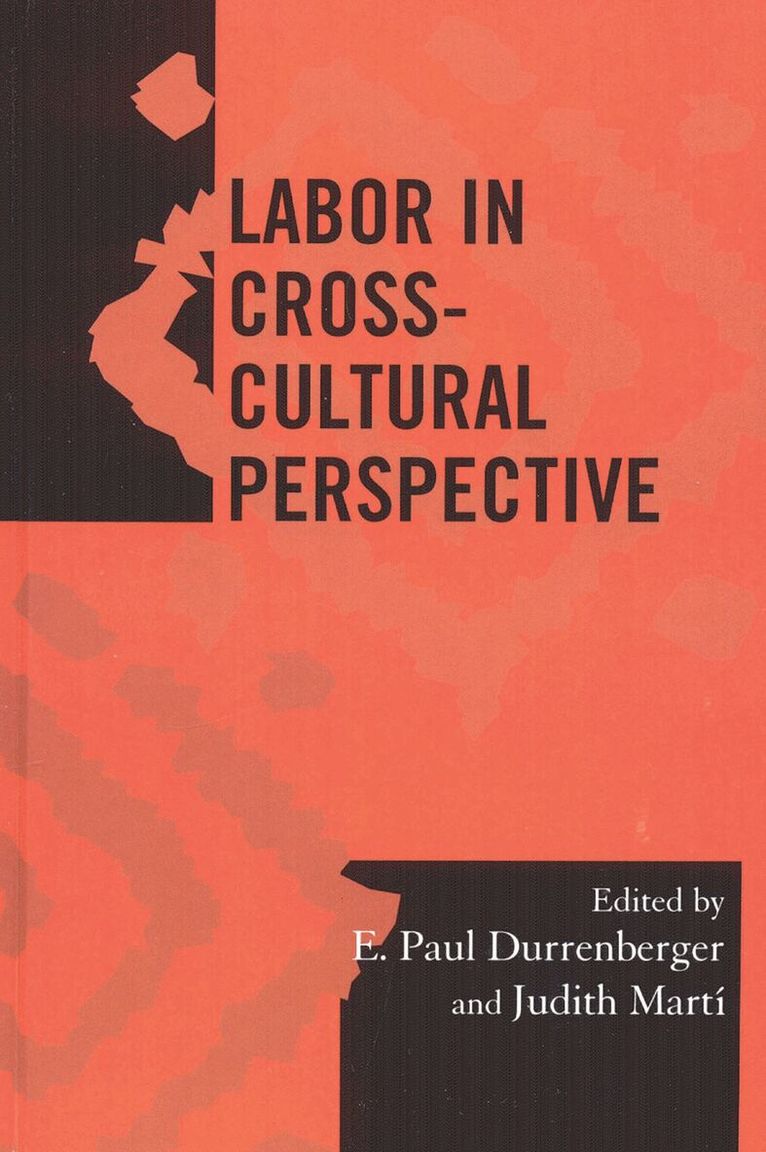
This excellent new volume in the series from the Society for Economic Anthropology focuses on the role of labor in contrasting world economies. The contributors offer a diverse collection of case studies, illustrating labor processes in a wide range of contexts in both western and nonwestern societies. The volume presents a detailed portrait of how the mobilization of labor changes dramatically with variations in social, political and economic conditions, as well as location and time period, reaffirming the unique contribution of anthropology to economic research. Individual sections include discussions on household labor, firms and corporations, and state and transnational conditions. This book will be a valuable resource for scholars, students and interested readers of international economics, anthropology, development issues, labor studies and sociology.
568 kr
Skickas inom 10-15 vardagar
This excellent new volume in the series from the Society for Economic Anthropology focuses on the role of labor in contrasting world economies. The contributors offer a diverse collection of case studies, illustrating labor processes in a wide range of contexts in both western and nonwestern societies. The volume presents a detailed portrait of how the mobilization of labor changes dramatically with variations in social, political and economic conditions, as well as location and time period, reaffirming the unique contribution of anthropology to economic research. Individual sections include discussions on household labor, firms and corporations, and state and transnational conditions. This book will be a valuable resource for scholars, students and interested readers of international economics, anthropology, development issues, labor studies and sociology.
1 057 kr
Tillfälligt slut
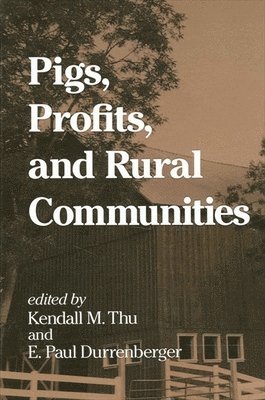
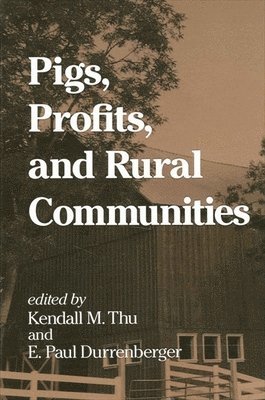
Using the pork production industry as an example, this book illuminates the processes and consequences of agricultural industrialization for the social, economic, human, environmental, and political health of the rural United States.This book illuminates the processes and consequences of agricultural industrialization, particularly within the swine production industry, for the social, economic, human, environmental, and political health of the rural United States. Contributors come from widely divergent backgrounds including a former U.S. senator, farmers, a veterinarian, a medical psychologist, an agricultural economist, a biological ecologist, a farm organization president, and anthropologists. Set within the theoretical framework of Walter Goldschmidt's research on the community consequences of industrialized food production, these contributions show that the increasing divergence of ownership has real human costs that continue to be ignored by economic developers and policymakers.
566 kr
Skickas inom 3-6 vardagar
Using the pork production industry as an example, this book illuminates the processes and consequences of agricultural industrialization for the social, economic, human, environmental, and political health of the rural United States.This book illuminates the processes and consequences of agricultural industrialization, particularly within the swine production industry, for the social, economic, human, environmental, and political health of the rural United States. Contributors come from widely divergent backgrounds including a former U.S. senator, farmers, a veterinarian, a medical psychologist, an agricultural economist, a biological ecologist, a farm organization president, and anthropologists. Set within the theoretical framework of Walter Goldschmidt's research on the community consequences of industrialized food production, these contributions show that the increasing divergence of ownership has real human costs that continue to be ignored by economic developers and policymakers.
522 kr
Tillfälligt slut
The Anthropology of Labor Unions presents ethnographic data and analysis in eight case studies from several very diverse industries. It covers a wide range of topics, from the role of women and community in strikes to the importance of place in organization, and addresses global concerns with studies from Mexico and Malawu. Union-organized workplaces consistently afford workers higher wages and better pensions, benefits, and health coverage than their nonunion counterparts. In addition, women and minorities who belong to unions are more likely to receive higher wages and benefits than their nonunion peers. Given the economic advantages of union membership, one might expect to see higher rates of organization across industries, but labor affiliation is at an all-time low. What accounts for this discrepancy? The contributors in this volume provide a variety of perspectives on this paradox, including discussions of approaches to and findings on the histories, cultures, and practices of organized labor.They also address substantive issues such as race, class, gender, age, generation, ethnicity, health and safety concerns, corporate co-optation of unions, and the cultural context of union-management relationships. The first to bring together anthropological case studies of labor unions, this volume will appeal to cultural anthropologists, social scientists, sociologists, and those interested in labor studies and labor movements.
1 009 kr
Skickas inom 10-15 vardagar
Those who are involved with fishing and fisheries resource management—including fishermen, their communities, production, processing, distribution, and marketing industries, and various government and non-governmental organizations—confront the contradictions arising from the appropriation, allocation, and distribution of fisheries and marine resources in a variety of ways.The authors call into question the assumptions of policy prescriptions to common resource problems by examining the experiences of people and societies confronted with and adapting to these resource appropriation, allocation, and distribution problems. They suggest that tragedies of resource depletion and institutional failure to deal with them are not characteristic of human nature, but rather are by products of particular cultural practices, institutions, and assumptions. The detailed, empirical ethnographic study of these relationships holds great potential for informing those who are making future policy decisions as well as contributing to the theories of human behavior and cooperation to solve such problems.
327 kr
Skickas inom 3-6 vardagar
Longshoremen stand at the nexus of the global economy, handling nearly every cargo container that enters or leaves any country. Even in the face of cargo "containerization" in the 70s and 80s, a development that decimated longshore unions, they have managed to win contracts that provide health benefits and high wages."On the Global Waterfront" tells the story of how longshoremen in South Carolina confronted attempts to wipe out the state's most powerful black organization. When a Danish shipping company began to shift their transportation to a nonunion firm in 1999, Local 1422 in Charleston, South Carolina, mobilized to protect their hard-won rights. What followed culminated in a protest in which 660 riot police were deployed against fifty dock-workers, a group that grew to 150 before the night was over. Four black and one white longshoreman - subsequently known as the Charleston 5 - were held for twenty months under house arrest on trumped-up felony charges of inciting a riot.Within the politically conservative, racially charged, and intensely religious climate of the South, the unassuming local union president, Ken Riley - supported behind the scenes by a militant AFL-CIO staffer - crafted an international, grassroots campaign in defense of the arrested longshoremen.From Australia to Europe to Korea to the entire west coast of the United States, longshoremen threatened to shut down ports jeopardizing billions of dollars in trade per day.Their ultimate success vaulted Riley, and his reform-minded coworkers, to higher leadership in a notoriously corrupt union, and laid the foundation for successful rebuffs in ports around the world. "On the Global Waterfront" explores in detail a local conflict and in the process exposes the powers that rule the United States and the global economy. This compelling narrative of a local struggle, a transformed union leader, and a newly energized international worker movement highlights the resounding importance of the international labor movement that is not only still vital, but still capable of stopping global commerce on a dime.
1 212 kr
Skickas inom 3-6 vardagar
Longshoremen stand at the nexus of the global economy, handling nearly every cargo container that enters or leaves any country. Even in the face of cargo "containerization" in the 70s and 80s, a development that decimated longshore unions, they have managed to win contracts that provide health benefits and high wages."On the Global Waterfront" tells the story of how longshoremen in South Carolina confronted attempts to wipe out the state's most powerful black organization. When a Danish shipping company began to shift their transportation to a nonunion firm in 1999, Local 1422 in Charleston, South Carolina, mobilized to protect their hard-won rights. What followed culminated in a protest in which 660 riot police were deployed against fifty dock-workers, a group that grew to 150 before the night was over. Four black and one white longshoreman - subsequently known as the Charleston 5 - were held for twenty months under house arrest on trumped-up felony charges of inciting a riot.Within the politically conservative, racially charged, and intensely religious climate of the South, the unassuming local union president, Ken Riley - supported behind the scenes by a militant AFL-CIO staffer - crafted an international, grassroots campaign in defense of the arrested longshoremen.From Australia to Europe to Korea to the entire west coast of the United States, longshoremen threatened to shut down ports jeopardizing billions of dollars in trade per day.Their ultimate success vaulted Riley, and his reform-minded coworkers, to higher leadership in a notoriously corrupt union, and laid the foundation for successful rebuffs in ports around the world. "On the Global Waterfront" explores in detail a local conflict and in the process exposes the powers that rule the United States and the global economy. This compelling narrative of a local struggle, a transformed union leader, and a newly energized international worker movement highlights the resounding importance of the international labor movement that is not only still vital, but still capable of stopping global commerce on a dime.
1 886 kr
Skickas inom 10-15 vardagar
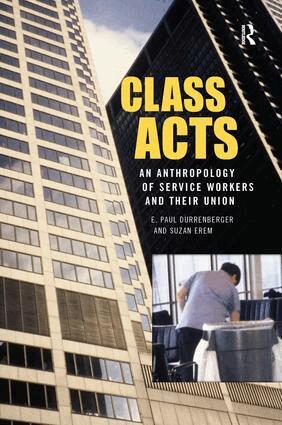
American labor leaders are constantly developing new programs to revive the union movement. What happens when these plans collide with the daily lives of front-line union staff and members? This book examines the often conflicting interests of key players in the trenches of a national effort to bring back the American labor movement. Brutally honest, funny, never dull, this anthropological ethnography shows the daily struggles of union members today to bring about positive change and hold together their urban labor union in an era of globalization, outsourcing, and deindustrialization. A union activist and an anthropologist (the authors) pair up to offer insideoutside views of labor unions and of how anthropological fieldwork is done. Explaining, coaching, and warning Paul of hazards, Suzan, the communications director for the Local, provides inside views and details of day-to-day interactions. Paul, the anthropologist, provides outside analytical views that related Suzan's experiences and his own observations to the wider view anthropology offers through ethnography, holism, and comparativism. The result is a story of one dynamic union local, one anthropological study, and the lit fuse that connects them until the end.
698 kr
Skickas inom 10-15 vardagar
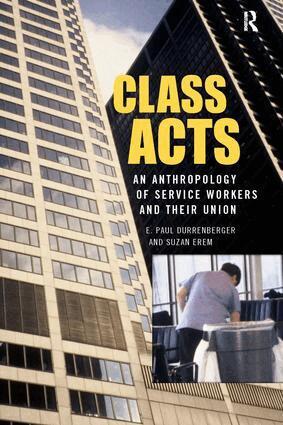
American labor leaders are constantly developing new programs to revive the union movement. What happens when these plans collide with the daily lives of front-line union staff and members? This book examines the often conflicting interests of key players in the trenches of a national effort to bring back the American labor movement. Brutally honest, funny, never dull, this anthropological ethnography shows the daily struggles of union members today to bring about positive change and hold together their urban labor union in an era of globalization, outsourcing, and deindustrialization. A union activist and an anthropologist (the authors) pair up to offer insideoutside views of labor unions and of how anthropological fieldwork is done. Explaining, coaching, and warning Paul of hazards, Suzan, the communications director for the Local, provides inside views and details of day-to-day interactions. Paul, the anthropologist, provides outside analytical views that related Suzan's experiences and his own observations to the wider view anthropology offers through ethnography, holism, and comparativism. The result is a story of one dynamic union local, one anthropological study, and the lit fuse that connects them until the end.
308 kr
Skickas inom 5-8 vardagar
The Anthropology of Labor Unions presents ethnographic data and analysis in eight case studies from several very diverse industries. It covers a wide range of topics, from the role of women and community in strikes to the importance of place in organization, and addresses global concerns with studies from Mexico and Malawu.Union-organized workplaces consistently afford workers higher wages and better pensions, benefits, and health coverage than their nonunion counterparts. In addition, women and minorities who belong to unions are more likely to receive higher wages and benefits than their nonunion peers. Given the economic advantages of union membership, one might expect to see higher rates of organization across industries, but labor affiliation is at an all-time low. What accounts for this discrepancy?The contributors in this volume provide a variety of perspectives on this paradox, including discussions of approaches to and findings on the histories, cultures, and practices of organized labor. They also address substantive issues such as race, class, gender, age, generation, ethnicity, health and safety concerns, corporate co-optation of unions, and the cultural context of union-management relationships.The first to bring together anthropological case studies of labor unions, this volume will appeal to cultural anthropologists, social scientists, sociologists, and those interested in labor studies and labor movements.
255 kr
Skickas inom 5-8 vardagar
Gambling Debt is a game-changing contribution to the discussion of economic crises and neoliberal financial systems and strategies. Iceland’s 2008 financial collapse was the first case in a series of meltdowns, a warning of danger in the global order. This full-scale anthropology of financialization and the economic crisis broadly discusses this momentous bubble and burst and places it in theoretical, anthropological, and global historical context through descriptions of the complex developments leading to it and the larger social and cultural implications and consequences.Chapters from anthropologists, sociologists, historians, economists, and key local participants focus on the neoliberal policies—mainly the privatization of banks and fishery resources—that concentrated wealth among a select few, skewed the distribution of capital in a way that Iceland had never experienced before, and plunged the country into a full-scale economic crisis. Gambling Debt significantly raises the level of understanding and debate on the issues relevant to financial crises, painting a portrait of the meltdown from many points of view—from bankers to schoolchildren, from fishers in coastal villages to the urban poor and immigrants, and from artists to philosophers and other intellectuals.This book is for anyone interested in financial troubles and neoliberal politics as well as students and scholars of anthropology, sociology, economics, philosophy, political science, business, and ethics.Publication supported in part by the National Science Foundation.Contributors: Vilhjálmur Árnason, Ásmundur Ásmundsson, Jón Gunnar Bernburg, James Carrier, Sigurlína Davíðsdóttir, Dimitra Doukas, Níels Einarsson, Einar Mar Guðmundsson, Tinna Grétarsdóttir, Birna Gunnlaugsdóttir, Guðný S. Guðbjörnsdóttir, Pamela Joan Innes, Guðni Th. Jóhannesson, Örn D. Jónsson, Hannes Lárusson, Kristín Loftsdóttir, James Maguire, Már Wolfgang Mixa, Evelyn Pinkerton, Hulda Proppé, James G. Rice, Rögnvaldur J. Sæmundsson, Unnur Dís Skaptadóttir, Margaret Willson
442 kr
Tillfälligt slut
In this first-ever collection of labor anthropology from around the world, the contributors to Uncertain Times assert that traditional labor unions have been co-opted by neoliberal policies of corporate capital and have become service organizations rather than drivers of social movements. The current structure of labor unions facilitates corporations’ need for a stable labor force while reducing their power to prevent outsourcing, subcontracting, and other methods of undercutting worker security and union power. Through case studies from Switzerland, Israel, Argentina, Mexico, the United States, Greece, Sweden,Turkey, Brazil and Spain, the authors demonstrate that this process of neutering unions has been uneven across time and space. They also show that the potential exists for renewed union power based on more vociferous and creative collective action. These firsthand accounts—from activist anthropologists in the trenches as union members and staff, as well as academics analyzing policy, law, worker organizing, and community impact—illustrate the many approaches that workers around the world are taking to reclaim their rights in this ever-shifting labor landscape.Uncertain Times is the first book to use this crucial comparative, ethnographic approach for understanding the new rules of the global labor struggle and the power workers have to change those rules. The volume will be of great interest to students and scholars of anthropology, sociology of work, and labor studies; labor union leadership; and others interested in developing innovative methods for organizing working people, fomenting class consciousness, and expanding social movements.Contributors: Alpkan Birelma, Emma Braden, Maria Eugenia de la O, Christopher Kelley, Staffan Löfving, Gadi Nissim, Darcy Pan, Steven Payne, Alicia Reigada, Julia Soul, Manos Spyridakis, Christian Zlolniski
463 kr
Skickas inom 5-8 vardagar
Presenting prehistoric, historic, and ethnographic data from Mongolia, China, Iceland, Mexico, Brazil, and the United States, The Anthropological Study of Class and Consciousness offers a first step toward examining class as a central issue within anthropology. Contributors to this volume use the methods of historical materialism, cultural ecology, and political ecology to understand the realities of class and how they evolve.Five central ideas unify the collection: the objective basis for class in different social orders; people's understanding of class in relation to race and gender; the relation of ideologies of class to realities of class; the U.S. managerial middle-class denial of class and emphasis on meritocracy in relation to increasing economic insecurity; and personal responses to economic insecurity and their political implications.Anthropologists who want to understand the nature and dynamics of culture must also understand the nature and dynamics of class. The Anthropological Study of Class and Consciousness addresses the role of the concept of class as an analytical construct in anthropology and how it relates to culture. Although issues of social hierarchy have been studied in anthropology, class has not often been considered as a central element. Yet a better understanding of its role in shaping culture, consciousness, and people's awareness of their social and natural world would in turn lead to better understanding of major trends in social evolution as well as contemporary society. This book will be of great interest to students and scholars of anthropology, labor studies, ethnohistory, and sociology.
1 171 kr
Tillfälligt slut
In The Dawn of Industrial Agriculture in Iowa E. Paul Durrenberger recounts the transformation of Iowa’s family farms into today’s agricultural industry through the lens of the lives and writings of Iowa novelist Paul Corey and poet Ruth Lechlitner. This anthropological biography analyzes Corey’s fiction, Lechlitner’s poetry, and their professional and personal correspondence to offer a new perspective on an era (1925–1947) that saw the collapse and remaking of capitalism in the United States, the rise of communism in the Soviet Union, the rise and defeat of fascism around the world, and the creation of a continuous warfare state in America. Durrenberger tells the story that Corey aimed to record and preserve of the industrialization of Iowa’s agriculture and the death of its family farms. He analyzes Corey’s regionalist focus on Iowa farming and regionalism’s contemporaneous association in Europe with rising fascism. He explores Corey’s adoption of naturalism, evident in his resistance to heroes and villains, to plot structure and resolution, and to moral judgment, as well as his ethnographic tendency to focus on groups rather than individuals. An unusual and wide-ranging study, The Dawn of Industrial Agriculture in Iowa offers important insight into the relationships among fiction, individual lives, and anthropological practice, as well as into a pivotal period in American history.
492 kr
Skickas inom 5-8 vardagar
In The Dawn of Industrial Agriculture in Iowa E. Paul Durrenberger recounts the transformation of Iowa’s family farms into today’s agricultural industry through the lens of the lives and writings of Iowa novelist Paul Corey and poet Ruth Lechlitner. This anthropological biography analyzes Corey’s fiction, Lechlitner’s poetry, and their professional and personal correspondence to offer a new perspective on an era (1925–1947) that saw the collapse and remaking of capitalism in the United States, the rise of communism in the Soviet Union, the rise and defeat of fascism around the world, and the creation of a continuous warfare state in America. Durrenberger tells the story that Corey aimed to record and preserve of the industrialization of Iowa’s agriculture and the death of its family farms. He analyzes Corey’s regionalist focus on Iowa farming and regionalism’s contemporaneous association in Europe with rising fascism. He explores Corey’s adoption of naturalism, evident in his resistance to heroes and villains, to plot structure and resolution, and to moral judgment, as well as his ethnographic tendency to focus on groups rather than individuals. An unusual and wide-ranging study, The Dawn of Industrial Agriculture in Iowa offers important insight into the relationships among fiction, individual lives, and anthropological practice, as well as into a pivotal period in American history.
302 kr
Tillfälligt slut
This is a 13th-century story of conflict over sheep and stranded whales, magic and ghosts, seduction, murder, torture and revenge. The book contains an extended essay on the political, economic and cultural background of the text, under various headings.