Elizabeth Pender - Böcker
Visar alla böcker från författaren Elizabeth Pender. Handla med fri frakt och snabb leverans.
5 produkter
5 produkter
1 105 kr
Skickas inom 7-10 vardagar
Djuna Barnes once said that “there is always more surface to a shattered object than a whole object,” and the statement is provocative when considering her own writing and art. Arriving as an accomplished writer and journalist in 1920s Paris, Barnes produced an eclectic body of work whose objects and surfaces continue to fascinate readers. In this volume, a series of internationally renowned scholars reassess both Barnes and modernism through a close examination of her prose, poetry, journalism, visual art, and drama.From the modernist classic Nightwood to the late verse play The Antiphon, Barnes’s distinctive voice has long resisted any easy assimilation into specific groupings of authors or texts. Responding to expansions of canons and critical questions that have shaped modernist studies since the late twentieth century, the chapters in this volume bring new thinking to her full oeuvre and collectively demonstrate that the study of modernism necessarily includes the study of Barnes. The essays show Barnes’s significant contributions to twenty-first-century discourses on topics such as the politics of print culture, the representation of animals and the human, queer aesthetics, modernist criticism, authorship, style, affect, and translation between media.Featuring an afterword by Peter Nicholls and a comprehensive bibliography, Shattered Objects provides a timely assessment of Barnes and considers the implications of reading her critically as an important modernist writer and artist. It will be welcomed by scholars of literature, art history, and the modernist era.In addition to the editors, contributors to this volume are Daniela Caselli, Bruce Gardiner, Alex Goody, Melissa Jane Hardie, Tyrus Miller, Drew Milne, Peter Nicholls, Rachel Potter, Julie Taylor, and Joanne Winning.
685 kr
Skickas inom 10-15 vardagar
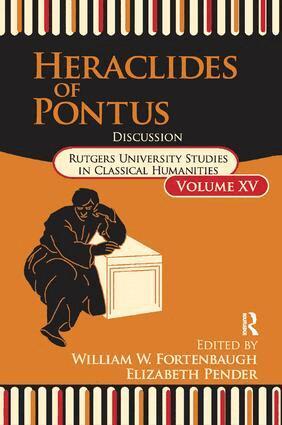
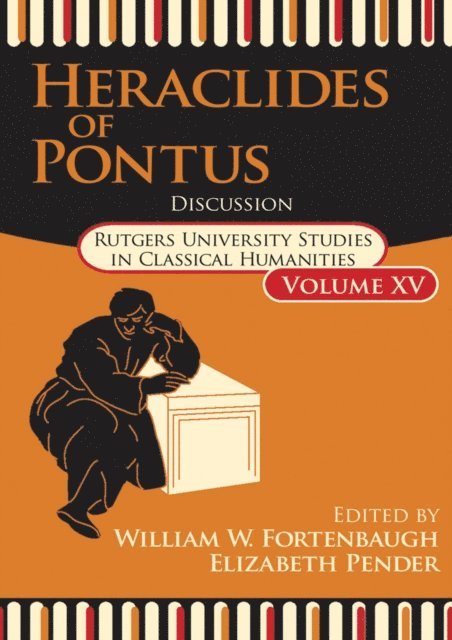
Heraclides of Pontus hailed from the shores of the Black Sea. He studied with Aristotle in Plato's Academy, and became a respected member of that school. During Plato's third trip to Sicily, Heraclides served as head of the Academy and was almost elected its head on the death of Speusippus.Heraclides' interests were diverse. He wrote on the movements of the planets and the basic matter of the universe. He adopted a materialistic theory of soul, which he considered immortal and subject to reincarnation. He discussed pleasure, and like Aristotle, he commented on the Homeric poems. In addition, he concerned himself with religion, music and medical issues. None of Heraclides' works have survived intact, but in antiquity his dialogues were much admired and often pillaged for sententiae and the like.The contributions presented here comment on Heraclides' life and thought. They include "La Tradizione Papirologica di Eraclide Pontico" by Tiziano Dorandi, "Heraclides' Intellectual Context" by Jorgen Mejer, and "Heraclides of Pontus and the Philosophical Dialogue" by Matthew Fox. There is also discussion of Heraclides' understanding of pleasure and of the human soul: "Heraclides on Pleasure" by Eckart Schutrumpf and "Heraclides on the Soul and Its Ancient Readers" by Inna Kupreeva. In addition, there are essays that address Heraclides' physics and astronomical theories: "Unjointed Masses: A Note on Heraclides Physical Theory" by Robert W. Sharples; "Heliocentrism in or out of Heraclides" by Paul T. Keyser, "The Reception of Heraclides' Theory of the Rotation of the Earth from Posidonius to Simplicius: Texts, Contexts and Continuities" by Robert B. Todd and Alan C. Bowen, and "Heraclides of Pontus on the Motions of Venus and Mercury" by Alan C. Bowen and Robert B. Todd. Finally, there are essays that view Heraclides from the stand point of ancient medicine, literary criticism and musical theory: "Heraclides on Diseases and on the Woman Who Did Not Breathe" by Philip van der Eijk, "Heraclides of Pontus on Homer" by Malcolm Heath, and "Heraclides and Musical History" by Andrew Barker. This volume is a companion to RUSCH, volume 14, which contains a new edition of the sources for Heraclides' life and thought.
2 088 kr
Skickas inom 10-15 vardagar
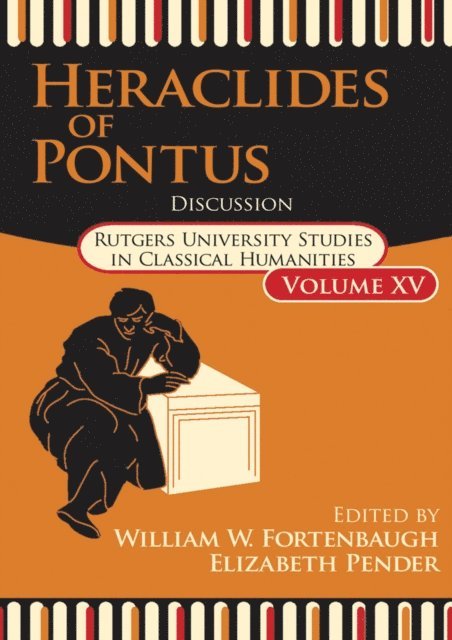
Heraclides of Pontus hailed from the shores of the Black Sea. He studied with Aristotle in Plato's Academy, and became a respected member of that school. During Plato's third trip to Sicily, Heraclides served as head of the Academy and was almost elected its head on the death of Speusippus.Heraclides' interests were diverse. He wrote on the movements of the planets and the basic matter of the universe. He adopted a materialistic theory of soul, which he considered immortal and subject to reincarnation. He discussed pleasure, and like Aristotle, he commented on the Homeric poems. In addition, he concerned himself with religion, music and medical issues. None of Heraclides' works have survived intact, but in antiquity his dialogues were much admired and often pillaged for sententiae and the like.The contributions presented here comment on Heraclides' life and thought. They include "La Tradizione Papirologica di Eraclide Pontico" by Tiziano Dorandi, "Heraclides' Intellectual Context" by Jorgen Mejer, and "Heraclides of Pontus and the Philosophical Dialogue" by Matthew Fox. There is also discussion of Heraclides' understanding of pleasure and of the human soul: "Heraclides on Pleasure" by Eckart Schutrumpf and "Heraclides on the Soul and Its Ancient Readers" by Inna Kupreeva. In addition, there are essays that address Heraclides' physics and astronomical theories: "Unjointed Masses: A Note on Heraclides Physical Theory" by Robert W. Sharples; "Heliocentrism in or out of Heraclides" by Paul T. Keyser, "The Reception of Heraclides' Theory of the Rotation of the Earth from Posidonius to Simplicius: Texts, Contexts and Continuities" by Robert B. Todd and Alan C. Bowen, and "Heraclides of Pontus on the Motions of Venus and Mercury" by Alan C. Bowen and Robert B. Todd. Finally, there are essays that view Heraclides from the stand point of ancient medicine, literary criticism and musical theory: "Heraclides on Diseases and on the Woman Who Did Not Breathe" by Philip van der Eijk, "Heraclides of Pontus on Homer" by Malcolm Heath, and "Heraclides and Musical History" by Andrew Barker. This volume is a companion to RUSCH, volume 14, which contains a new edition of the sources for Heraclides' life and thought.
2 089 kr
Skickas inom 3-6 vardagar
The new modernist studies have recognised a range of writers, many of whom are now receiving new attention in criticism and teaching. Yet if an older modernist studies was developed for a different, narrower selection of literary works, how can its tools be brought to this new, widened canon? This book considers how close reading may change as the discipline's subjects of study change. The chapters ask first how modernism was being read around 1930 and at mid-century, and then what close reading might look like now for three new modernist novels Djuna Barnes's Nightwood, John Rodker's Adolphe 1920, and Mina Loy's Insel. These novels tend to deflect strategies of reading that were interdependent with the establishment of a more familiar canon of modernist literature at mid-century. Reading this new modernist fiction closely offers a way to open up modernism to other voices.
491 kr
Skickas inom 3-6 vardagar
Since the late twentieth century, new understandings of modernism have come with new attention to a range of writers. Yet if the academic study of modernism took shape around an older, narrower selection of writers and works, how can its modes of reading be relevant to newly recovered modernist writing? This book considers how close reading may change as the subjects of literary study change. Elizabeth Pender asks what reading meant for critics of modernist literature around 1930 and around 1960, and then what close reading might look like now for three new modernist novels. Djuna Barnes’s Nightwood, John Rodker’s Adolphe 1920 and Mina Loy’s Insel tend to resist some of the strategies of reading that helped construct a narrowed modernist canon at mid-century, such as the pursuit of coherence. These novels offer new thinking about the temporality of reading, style, and the ethics of narration. Reading these novels now suggests that other new modernist fiction, too, may require revisions to vocabularies with which modernist literature has sometimes been read.