Ernesto Capello – författare
Visar alla böcker från författaren Ernesto Capello. Handla med fri frakt och snabb leverans.
5 produkter
5 produkter
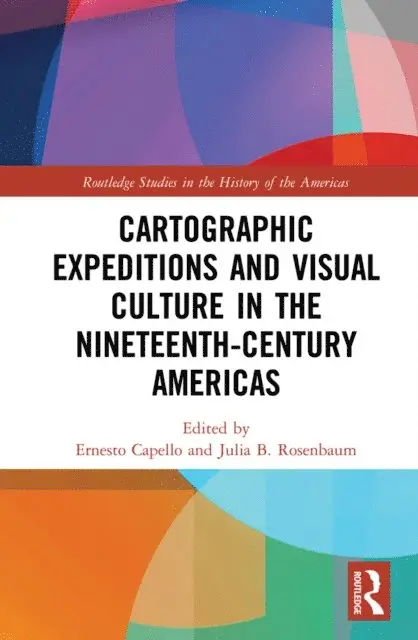
Cartographic Expeditions and Visual Culture in the Nineteenth-Century Americas
Inbunden, Engelska, 2020
2 405 kr
Skickas inom 10-15 vardagar
During the nineteenth century, gridding, graphing, and surveying proliferated as never before as nations and empires expanded into hitherto "unknown" territories. Though nominally geared toward justifying territorial claims and collecting scientific data, expeditions also produced vast troves of visual and artistic material. This book considers the explosion of expeditionary mapping and its links to visual culture across the Americas, arguing that acts of measurement are also aesthetic acts. Such visual interventions intersect with new technologies, with sociopolitical power and conflict, and with shifting public tastes and consumption practices. Several key questions shape this examination: What kinds of nineteenth-century visual practices and technologies of seeing do these materials engage? How does scientific knowledge get translated into the visual and disseminated to the public? What are the commonalities and distinctions in mapping strategies between North and South America? How does the constitution of expeditionary lines reorder space and the natural landscape itself? The volume represents the first transnational and hemispheric analysis of nineteenth-century cartographic aesthetics, and features the multi-disciplinary perspective of historians, geographers, and art historians.
Cartographic Expeditions and Visual Culture in the Nineteenth-Century Americas
Häftad, Engelska, 2022
656 kr
Skickas inom 10-15 vardagar
During the nineteenth century, gridding, graphing, and surveying proliferated as never before as nations and empires expanded into hitherto "unknown" territories. Though nominally geared toward justifying territorial claims and collecting scientific data, expeditions also produced vast troves of visual and artistic material. This book considers the explosion of expeditionary mapping and its links to visual culture across the Americas, arguing that acts of measurement are also aesthetic acts. Such visual interventions intersect with new technologies, with sociopolitical power and conflict, and with shifting public tastes and consumption practices. Several key questions shape this examination: What kinds of nineteenth-century visual practices and technologies of seeing do these materials engage? How does scientific knowledge get translated into the visual and disseminated to the public? What are the commonalities and distinctions in mapping strategies between North and South America? How does the constitution of expeditionary lines reorder space and the natural landscape itself? The volume represents the first transnational and hemispheric analysis of nineteenth-century cartographic aesthetics, and features the multi-disciplinary perspective of historians, geographers, and art historians.
731 kr
Skickas inom 5-8 vardagar
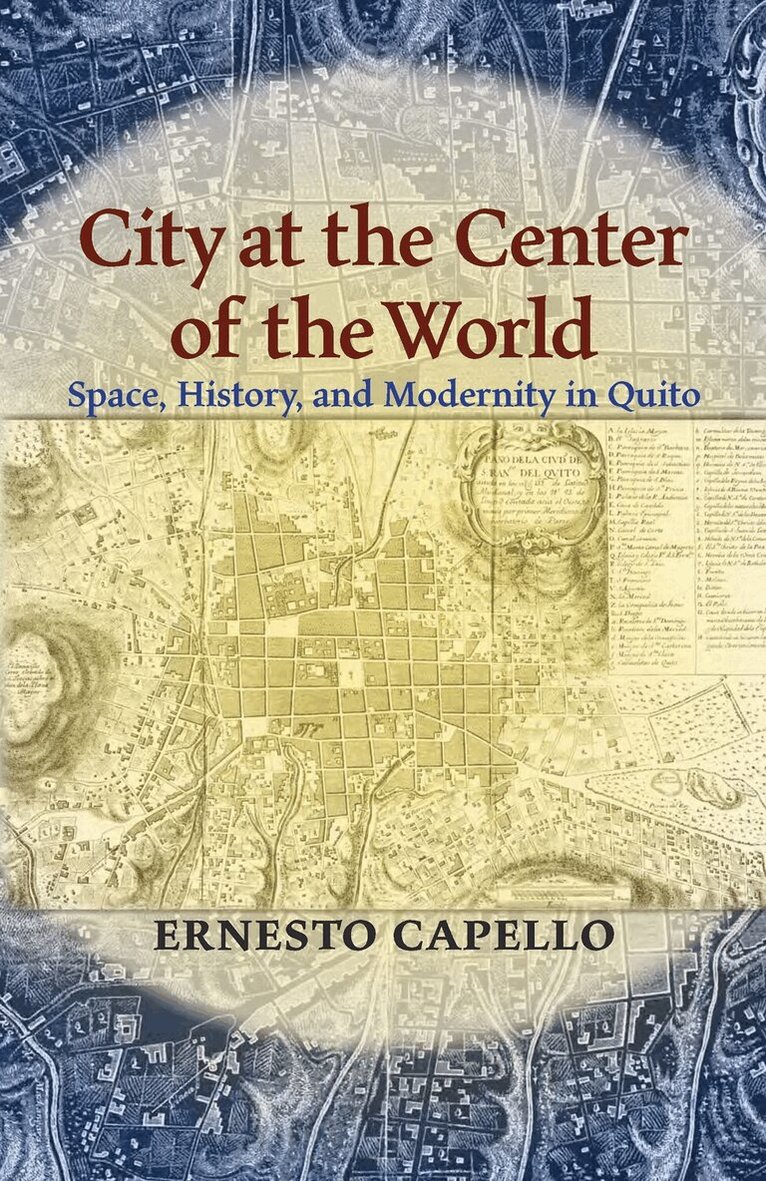
In the seventeenth century, local Jesuits and Franciscans imagined Quito as the \u201cnew Rome.\u201d It was the site of miracles and home of saintly inhabitants, the origin of crusades into the surrounding wilderness, and the purveyor of civilization to the entire region. By the early twentieth century, elites envisioned the city as the heart of a modern, advanced society—poised at the physical and metaphysical centers of the world.In this original cultural history, Ernesto Capello analyzes the formation of memory, myth, and modernity through the eyes of QuitoÆs diverse populations. By employing Mikhail BakhtinÆs concept of chronotopes, Capello views the configuration of time and space in narratives that defined QuitoÆs identity and its place in the world. He explores the proliferation of these imaginings in architecture, museums, monuments, tourism, art, urban planning, literature, religion, indigenous rights, and politics. To Capello, these tropes began to crystallize at the end of the nineteenth century, serving as a tool for distinct groups who laid claim to history for economic or political gain during the upheavals of modernism.As Capello reveals, QuitoÆs society and its stories mutually constituted each other. In the process of both destroying and renewing elements of the past, each chronotope fed and perpetuated itself. Modern Quito thus emerged at the crux of Hispanism and Liberalism, as an independent global society struggling to keep the memory of its colonial and indigenous roots alive.
508 kr
Kommande
A collection of essays examining the role of visual materials in shaping Latin American lives, historical thought, and worldmaking.Historians have long valued visual media as a source of documentation and illustration. More recently, scholars have also been turning to visual media for another purpose: to directly observe historical processes. Paintings, maps, visual narratives, graffiti, photography—these objects do not simply transmit information about events; they are events. They imbue the historical change we seek to understand.The Visual in Latin American History is a collection of essays that applies cutting-edge visual-studies methodology to the history of Central and South America and the Caribbean. Contributors focus on the visual production of postcolonial national imaginaries across Latin America—mythologies that purposely omitted Indigenous groups, African diasporic communities, and new migrants from Europe and Asia. The essays range across a vast territory, including erasure in archeology and Afro-Colombian portraiture; image making in domestic spaces and social movements; the visual vocabularies of urban planning and agrarian reform; military "performance" and anti-imperial Cold War exchanges; and humanitarian documentary along the US border.Collectively, the authors show how visual methods can radically transform our understanding of power and culture in Latin America and beyond.
1 208 kr
Skickas inom 5-8 vardagar
Mountains appear in the oldest known maps yet their representation has proven a notoriously difficult challenge for map makers. In this essay, Ernesto Capello surveys the broad history of relief representation in cartography with an emphasis on the allegorical, commercial and political uses of mapping mountains. After an initial overview and critique of the traditional historiography and development of techniques of relief representation, the essay features four clusters of mountain mapping emphases. These include visions of mountains as paradise, the mountain as site of colonial and postcolonial encounter, the development of elevation profiles and panoramas, and mountains as mass-marketed touristed itineraries.