Eugene McCarraher – Författare
Visar alla böcker från författaren Eugene McCarraher. Handla med fri frakt och snabb leverans.
4 produkter
4 produkter
236 kr
Skickas inom 7-10 vardagar
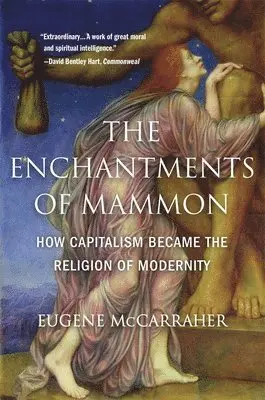
“An extraordinary work of intellectual history as well as a scholarly tour de force, a bracing polemic, and a work of Christian prophecy…McCarraher challenges more than 200 years of post-Enlightenment assumptions about the way we live and work.”—The ObserverAt least since Max Weber, capitalism has been understood as part of the “disenchantment” of the world, stripping material objects and social relations of their mystery and magic. In this magisterial work, Eugene McCarraher challenges this conventional view. Capitalism, he argues, is full of sacrament, whether one is prepared to acknowledge it or not. First flowering in the fields and factories of England and brought to America by Puritans and evangelicals, whose doctrine made ample room for industry and profit, capitalism has become so thoroughly enmeshed in the fabric of our society that our faith in “the market” has become sacrosanct.Informed by cultural history and theology as well as management theory, The Enchantments of Mammon looks to nineteenth-century Romantics, whose vision of labor combined reason, creativity, and mutual aid, for salvation. In this impassioned challenge to some of our most firmly held assumptions, McCarraher argues that capitalism has hijacked our intrinsic longing for divinity—and urges us to break its hold on our souls.“A majestic achievement…It is a work of great moral and spiritual intelligence, and one that invites contemplation about things we can’t afford not to care about deeply.”—Commonweal“More brilliant, more capacious, and more entertaining, page by page, than his most ardent fans dared hope. The magnitude of his accomplishment—an account of American capitalism as a religion…will stun even skeptical readers.”—Christian Century
466 kr
Tillfälligt slut
Far from displacing religions, as has been supposed, capitalism became one, with money as its deity. Eugene McCarraher reveals how mammon ensnared us and how we can find a more humane, sacramental way of being in the world.If socialists and Wall Street bankers can agree on anything, it is the extreme rationalism of capital. At least since Max Weber, capitalism has been understood as part of the “disenchantment” of the world, stripping material objects and social relations of their mystery and sacredness. Ignoring the motive force of the spirit, capitalism rejects the awe-inspiring divine for the economics of supply and demand.Eugene McCarraher challenges this conventional view. Capitalism, he argues, is full of sacrament, whether or not it is acknowledged. Capitalist enchantment first flowered in the fields and factories of England and was brought to America by Puritans and evangelicals whose doctrine made ample room for industry and profit. Later, the corporation was mystically animated with human personhood, to preside over the Fordist endeavor to build a heavenly city of mechanized production and communion. By the twenty-first century, capitalism has become thoroughly enchanted by the neoliberal deification of “the market.”Informed by cultural history and theology as well as economics, management theory, and marketing, The Enchantments of Mammon looks not to Marx and progressivism but to nineteenth-century Romantics for salvation. The Romantic imagination favors craft, the commons, and sensitivity to natural wonder. It promotes labor that, for the sake of the person, combines reason, creativity, and mutual aid. In this impassioned challenge, McCarraher makes the case that capitalism has hijacked and redirected our intrinsic longing for divinity—and urges us to break its hold on our souls.
100 kr
Tillfälligt slut
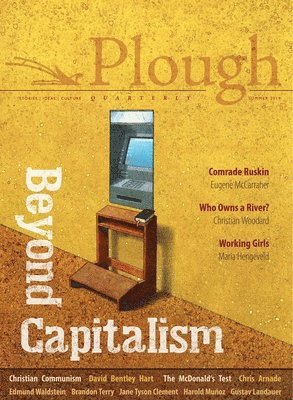
Is there a better way than capitalism?A much-cited recent poll found that more young Americans have a positive view of socialism than of capitalism. There’s a sense of newly opened possibilities: Might this be the moment for a mass movement of solidarity to overthrow the tyranny of concentrated power and wealth? But what exactly is this cause? Socialism’s champions know how to take effective whacks at capitalism, but diagnosis is not yet the cure.This issue of Plough springs from a conviction that there is a better answer beyond capitalism and socialism, a freely chosen life of sharing and caring that overcomes economic exploitation, a way of life that is both thoroughly practical and independent of the state. This vision is much older than Adam Smith and Karl Marx; it lies at the heart of Jesus’ Sermon on the Mount and throughout the New Testament, as well as in the writings of the Old Testament prophets. It is exemplified by the communal life of the first church in Jerusalem, in which “all who believed were together and had all things in common; they would sell their possessions and goods and distribute the proceeds to all, as any had need” (Acts 2:44–45).Also in this issue: poetry by Jane Tyson Clement; reviews of books by Jennifer Berry Hawes, Robert Macfarlane, Emily Bazelon, and John Connell; and art and photography by Wassily Kandinsky, N. C. Wyeth, Deborah Batt, Kari Nielsen, Chris Arnade, William Morris, Hilzías Salazar, Amedeo Modigliani, Benjamin Meader, Bianca Berends, Elise Palmigiani, and Danny Burrows.Plough Quarterly features stories, ideas, and culture for people eager to put their faith into action. Each issue brings you in-depth articles, interviews, poetry, book reviews, and art to help you put Jesus’ message into practice and find common cause with others.
117 kr
Tillfälligt slut
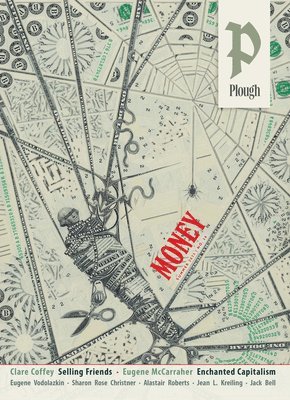
Main Description: This issue opens with the story of Melania and her real estate-magnatehusband, who decide to divest themselves of their entire wealth. These earlyChristians, who sold off their many estates and freed eight thousand slaves,were only exceptional in the amount they gave away. Jesus, after all, hadadvised a rich man, “Go, sell yourpossessions, and give the money to the poor.” And he emphatically warned thatyou cannot serve two masters: you cannot serve God and money. What does thatmean for Christians today, in a society and economy premised on theaccumulation of capital? How can we resist and subvert the power of money?On this theme:- Clare Coffey looks at how multilevel marketing commodifiesfriendship.- Sharon Rose Christner describes what happens when a Vatican palacebecomes a homeless shelter.- Alastair Roberts writes in praise of Mary of Bethany’s extravagantlove.- A photojournalist asks what’s left of the Cuban Revolutionseventy years after it began.- Jack Bell revisits William Cobbett’s spirited defense of thevanishing British commons.- Maria Weiss finds pain and friendship in the forced community ofa leper colony.- Maureen Swinger reveals the joys and pitfalls of owning twenty-twocars (collectively).- Robert Lockridge describes what he’s learned running a pay-as-you-cancafé.Also in the issue: - The winning poems in the 2023 Rhina Espaillat Poetry Awardcontest- An excerpt from Eugene Vodolazkin’s new novel, A History of the Island- Reviews of Kerri ní Dochartaigh’s Thin Places, Lydia Millet’s Dinosaurs,and Jennifer Banks’s Natality- Readings on Christianity and money from Eberhard Arnold, Peter Riedemann, Nicolai Berdyaev, Basilof Caesarea, Maria Skobtsova, C. S. Lewis, and Dorothy DayPlough Quarterly features stories, ideas, and culture for people eager to apply their faithto the challenges we face. Each issue includes in-depth articles, interviews,poetry, book reviews, and art.