Evan McKenzie - Böcker
Visar alla böcker från författaren Evan McKenzie. Handla med fri frakt och snabb leverans.
4 produkter
4 produkter
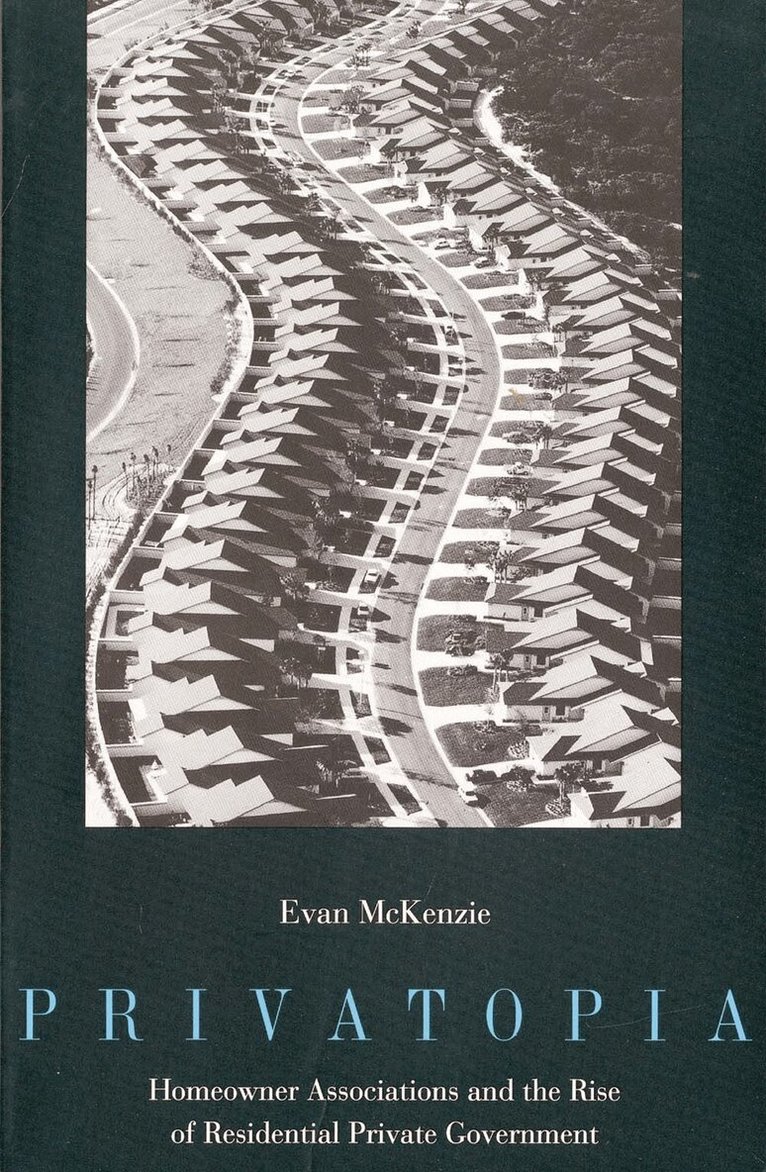
Privatopia
Homeowner Associations and the Rise of Residential Private Government
Häftad, Engelska, 1996
450 kr
Skickas inom 5-8 vardagar
Condominiums, co-ops, planned unit developments of single-family homes—these and other forms of common interest housing developments (CIDs) have become a familiar sight in America. Currently there are approximately 130,000 of these developments, housing some 30 million people. Residents are required to belong to homeowner associations, pay monthly fees, and live under the rule of residential private governments. These governments perform functions for their residents that were once the province of local government, providing, for example, police protection, trash collection, street maintenance, and lighting. They also place restrictions on ownership of property and enforce rigid and often repressive codes of conduct governing the most private aspects of residents' lives.This book is the first comprehensive study of the political and social issues posed by the rise of CIDs. Evan McKenzie shows how the developments diminish residents' sense of responsibility for the city as a whole by making them reluctant to pay taxes for the same public services that their fees provide. McKenzie also shows that the private governments of CIDs depart from accepted notions of liberal democracy, promoting a unique and limited version of citizenship that has serious implications for civil liberties. He argues that the spread of CID housing has important consequences for politics at all levels of government, because CID advocates now constitute a significant force in interest group politics in many states, often organizing to demand tax breaks or credits for CID residents. Tracing the history of CID housing from the nineteenth century to the present, he highlights the important but little-understood role public policy has played in advancing this large-scale "privatization for the few," and he concludes by considering the implications for urban politics.
434 kr
Skickas inom 10-15 vardagar
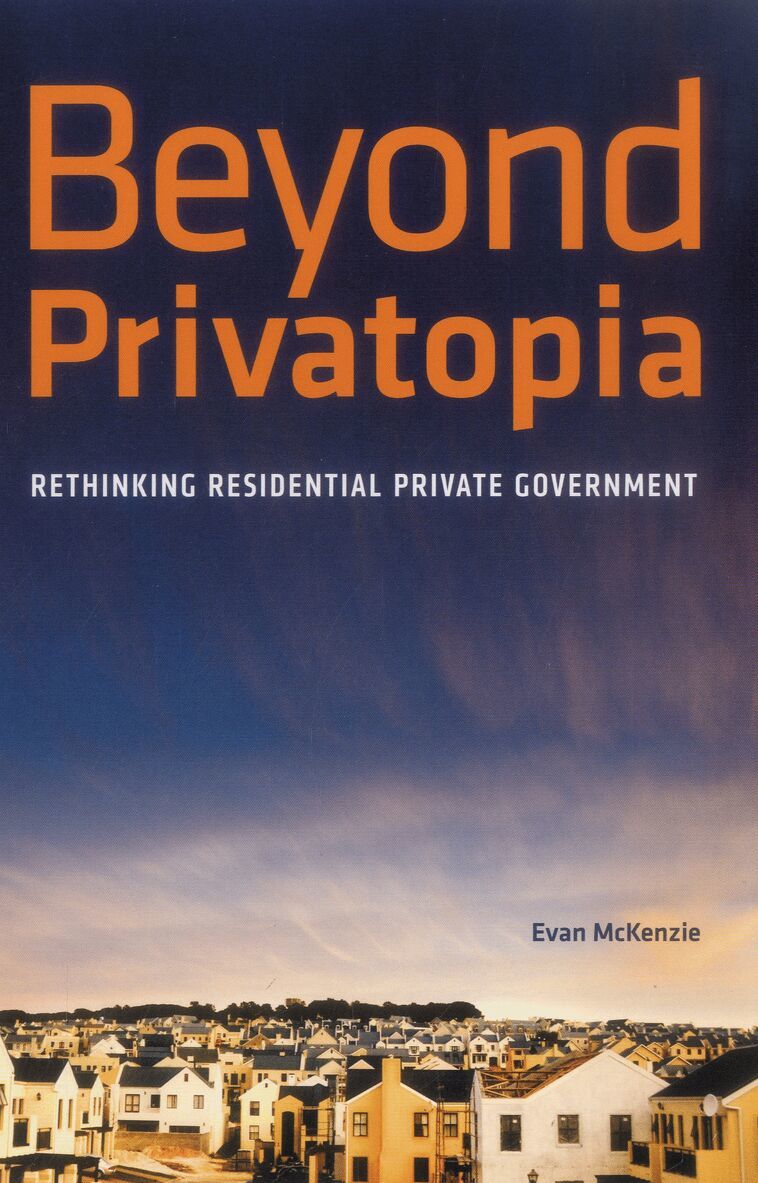
In Beyond Privatopia: Rethinking Residential Private Government, attorney and political science scholar Evan McKenzie explores emerging trends in private governments and competing schools of thought on how to operate them, from state oversight to laissez-faire libertarianism. The most common analyses see CIDs from a neoclassical economic, positive point of view. HoAs, this strain of analysis maintains, are more efficient and frugal than municipalities. And what could be more democratic than government of the neighbors, by the neighbors? But scholars coming from institutional analysis, communitarianism, and critical urban theory frameworks see possible repercussions. These include a development’s failure leaving residents on the hook for crippling sums, capture or extension of the local state, and convergence of public and private local governments
1 297 kr
Skickas inom 10-15 vardagar
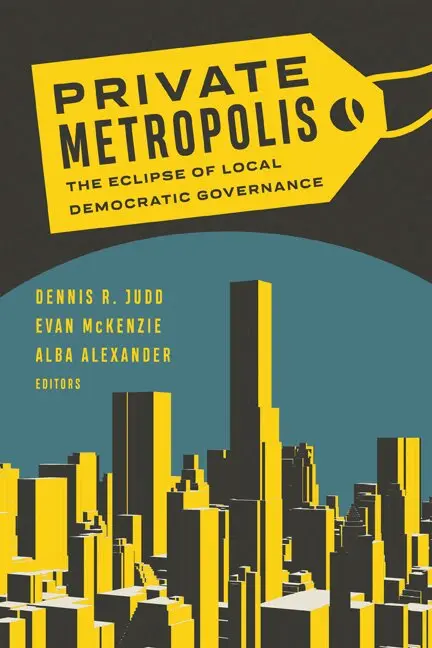
Examines the complex ecology of quasi-public and privatized institutions that mobilize and administer many of the political, administrative, and fiscal resources of today’s metropolitan regionsIn recent decades metropolitan regions in the United States have witnessed the rise of multitudes of “shadow governments” that often supersede or replace functions traditionally associated with municipalities and other local governments inherited from the urban past. Shadow governments take many forms, ranging from billion-dollar special authorities that span entire urban regions, to public–private partnerships and special districts created to accomplish particular tasks, to privatized gated communities, to neighborhood organizations empowered to receive private and public funds. They finance and administer public services ranging from the prosaic (garbage collection and water utilities) to the transformative (economic development and infrastructure). Private Metropolis demonstrates that this complex ecosystem of local governance has compromised and even eclipsed democratic processes by moving important policy decisions out of public sight. The quasi-public institutions of urban governance generally escape the budgetary and statutory restraints imposed on traditional local governments and protect policy decisions from the limitations and vagaries of electoral politics. Moving major policy decisions into a privatized and corporatized realm facilitates efficiency and speed, but at the cost of democratic oversight. Increasingly, the urban electorate is left debating symbolic issues only tangentially connected to the actual distribution of the resources that affect people’s lives. The essays in Private Metropolis grapple with the difficult and timely questions that arise from this new ecology of governance: What are the consequences of the proliferation of special authorities, privatized governments, and public–private arrangements? Is the trade-off between democratic accountability and efficiency worth it? Has the public sector, with its messiness and inefficiencies-but also its checks and balances-ceded too much power to these new institutions? By examining such questions, this book provokes a long-overdue debate about the future of urban governance.Contributors: Douglas Cantor, California State U, Long Beach; Ellen Dannin, Pennsylvania State U; Jameson W. Doig, Princeton U; Mary Donoghue; Peter Eisinger, New School; Steven P. Erie, U of California, San Diego; Rebecca Hendrick, U of Illinois at Chicago; Sara Hinkley, U of California, Berkeley; Amanda Kass, U of Illinois at Chicago; Scott A. MacKenzie, U of California, Davis; David C. Perry, U of Illinois at Chicago; James M. Smith, U of Indiana South Bend; Shu Wang, Michigan State U; Rachel Weber, U of Illinois at Chicago.
234 kr
Skickas
Examines the complex ecology of quasi-public and privatized institutions that mobilize and administer many of the political, administrative, and fiscal resources of today’s metropolitan regionsIn recent decades metropolitan regions in the United States have witnessed the rise of multitudes of “shadow governments” that often supersede or replace functions traditionally associated with municipalities and other local governments inherited from the urban past. Shadow governments take many forms, ranging from billion-dollar special authorities that span entire urban regions, to public–private partnerships and special districts created to accomplish particular tasks, to privatized gated communities, to neighborhood organizations empowered to receive private and public funds. They finance and administer public services ranging from the prosaic (garbage collection and water utilities) to the transformative (economic development and infrastructure). Private Metropolis demonstrates that this complex ecosystem of local governance has compromised and even eclipsed democratic processes by moving important policy decisions out of public sight. The quasi-public institutions of urban governance generally escape the budgetary and statutory restraints imposed on traditional local governments and protect policy decisions from the limitations and vagaries of electoral politics. Moving major policy decisions into a privatized and corporatized realm facilitates efficiency and speed, but at the cost of democratic oversight. Increasingly, the urban electorate is left debating symbolic issues only tangentially connected to the actual distribution of the resources that affect people’s lives. The essays in Private Metropolis grapple with the difficult and timely questions that arise from this new ecology of governance: What are the consequences of the proliferation of special authorities, privatized governments, and public–private arrangements? Is the trade-off between democratic accountability and efficiency worth it? Has the public sector, with its messiness and inefficiencies-but also its checks and balances-ceded too much power to these new institutions? By examining such questions, this book provokes a long-overdue debate about the future of urban governance.Contributors: Douglas Cantor, California State U, Long Beach; Ellen Dannin, Pennsylvania State U; Jameson W. Doig, Princeton U; Mary Donoghue; Peter Eisinger, New School; Steven P. Erie, U of California, San Diego; Rebecca Hendrick, U of Illinois at Chicago; Sara Hinkley, U of California, Berkeley; Amanda Kass, U of Illinois at Chicago; Scott A. MacKenzie, U of California, Davis; David C. Perry, U of Illinois at Chicago; James M. Smith, U of Indiana South Bend; Shu Wang, Michigan State U; Rachel Weber, U of Illinois at Chicago.