• Fri frakt över 249 kr
  • •
  • Snabba leveranser
  • •
  • Billiga böcker
Kundservice

Du är på sajten för privatpersoner.

Företag, bibliotek eller offentlig verksamhet?

Du handlar på classic.bokus.com, där alla dina funktioner finns intakta.
Till classic.bokus.com
Bokus logotyp. Gå till startsidan.
  • Erbjudanden
  • Nyheter
  • Student
  • Topplistor
  • Barn & ungdom
  • Bokus Play
  • E-böcker
  • Pocketböcker
  • Spel & pussel

10% rabatt på allt med kod NYSTART10 →

Sidfot

Mina sidor

    Hjälp

    • Kundservice
    • Vanliga frågor och svar
    • Frakt och leverans
    • Retur vid ångerrätt
    • Reklamera vara
    • Betalning
    • Köpvillkor
    • Allmänna villkor
    • Information om webbplatsens tillgänglighet

    Om Bokus

    • Om oss
    • Pressrum
    • För studenter
    • För företag
    • För bibliotek och offentlig verksamhet
    • För leverantörer
    • Hållbarhet

    Populärt

    • Aktuella erbjudanden
    • Presentkort
    • Studentlitteratur
    • Nya böcker
    • Topplistor
    • Signerade böcker
    • Engelska böcker

    Inspiration

    • Boktips
    • BookTok
    • Populära bokserier
    • Barnbokskaraktärer
    • Populära författare
    Logotyp för Bokus
    Följ oss på Facebook (extern länk)Följ oss på Instagram (extern länk)Följ oss på YouTube (extern länk)Följ oss på TikTok (extern länk)
    bokus @ CookiesAnpassa cookiesIntegritetspolicyKöpvillkor
    Till Citymail hemsida (extern länk)Till Budbee hemsida (extern länk)Till Postnord hemsida (extern länk)Till Schenker hemsida (extern länk)Till Early Bird hemsida (extern länk)Till Walleys hemsida (extern länk)
    1. Naturvetenskap och teknik
    2. Geovetenskap
    3. Regional planering

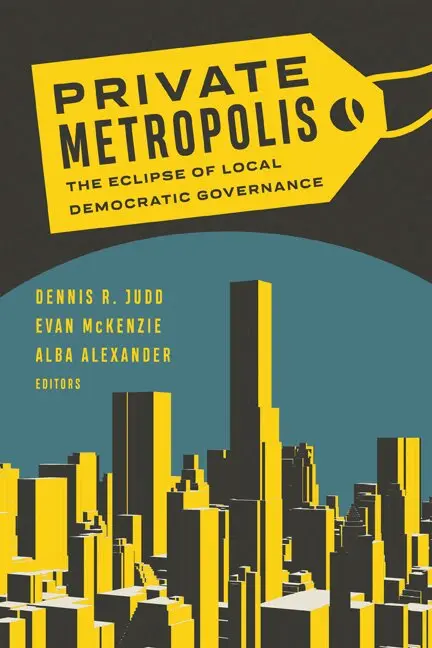
    Private Metropolis

    The Eclipse of Local Democratic Governance

    AvDennis R. Judd,Evan McKenzie

    Inbunden, Engelska, 2021

    Del i serien Globalization and Community

    1 340 kr

    Beställningsvara. Skickas inom 10-15 vardagar. Fri frakt över 249 kr.

    Beskrivning

    Examines the complex ecology of quasi-public and privatized institutions that mobilize and administer many of the political, administrative, and fiscal resources of today’s metropolitan regionsIn recent decades metropolitan regions in the United States have witnessed the rise of multitudes of “shadow governments” that often supersede or replace functions traditionally associated with municipalities and other local governments inherited from the urban past. Shadow governments take many forms, ranging from billion-dollar special authorities that span entire urban regions, to public–private partnerships and special districts created to accomplish particular tasks, to privatized gated communities, to neighborhood organizations empowered to receive private and public funds. They finance and administer public services ranging from the prosaic (garbage collection and water utilities) to the transformative (economic development and infrastructure). Private Metropolis demonstrates that this complex ecosystem of local governance has compromised and even eclipsed democratic processes by moving important policy decisions out of public sight. The quasi-public institutions of urban governance generally escape the budgetary and statutory restraints imposed on traditional local governments and protect policy decisions from the limitations and vagaries of electoral politics. Moving major policy decisions into a privatized and corporatized realm facilitates efficiency and speed, but at the cost of democratic oversight. Increasingly, the urban electorate is left debating symbolic issues only tangentially connected to the actual distribution of the resources that affect people’s lives. The essays in Private Metropolis grapple with the difficult and timely questions that arise from this new ecology of governance: What are the consequences of the proliferation of special authorities, privatized governments, and public–private arrangements? Is the trade-off between democratic accountability and efficiency worth it? Has the public sector, with its messiness and inefficiencies-but also its checks and balances-ceded too much power to these new institutions? By examining such questions, this book provokes a long-overdue debate about the future of urban governance.Contributors: Douglas Cantor, California State U, Long Beach; Ellen Dannin, Pennsylvania State U; Jameson W. Doig, Princeton U; Mary Donoghue; Peter Eisinger, New School; Steven P. Erie, U of California, San Diego; Rebecca Hendrick, U of Illinois at Chicago; Sara Hinkley, U of California, Berkeley; Amanda Kass, U of Illinois at Chicago; Scott A. MacKenzie, U of California, Davis; David C. Perry, U of Illinois at Chicago; James M. Smith, U of Indiana South Bend; Shu Wang, Michigan State U; Rachel Weber, U of Illinois at Chicago.

    Produktinformation

    • Utgivningsdatum:2021-06-22
    • Mått:140 x 216 x 38 mm
    • Format:Inbunden
    • Språk:Engelska
    • Serie:Globalization and Community
    • Antal sidor:312
    • Förlag:University of Minnesota Press
    • ISBN:9781517910815

    Utforska kategorier

    • Regional planering inom Naturvetenskap och teknik
    • Regionalt styre och förvaltning inom Samhälle och politik

    Mer om författaren

    Dennis R. Judd is professor emeritus of political science at the University of Illinois at Chicago. He is the author or editor of numerous books, including The City, Revisited: Urban Theory from Chicago, Los Angeles, New York (Minnesota, 2011).Evan McKenzie is professor and head of the Political Science Department at the University of Illinois at Chicago. He is author of Privatopia: Homeowner Associations and the Rise of Residential Private Government and Beyond Privatopia: Rethinking Residential Private Government.Alba Alexander is clinical associate professor in the Department of Political Science at the University of Illinois at Chicago.

    Recensioner i media

    "A valuable resource in graduate courses in urban politics and policy."-Journal of Urban Affairs

    Innehållsförteckning

    • ContentsIntroduction: Shadow Governments and the Remaking of the American Local StateDennis R. Judd, Evan McKenzie, and Alba AlexanderPart I. The Eclipse of the (Municipal) State1. City Building Capacity and Special-Purpose Authorities: Institutions, Interests, and the Local StateJames M. Smith2. Phantom Governments: Multiple Function Special Districts as Substitutes for MunicipalitiesEvan McKenzie3. Governing Detroit: The Withering of the (Municipal) StatePeter EisingerPart II. The Evolving Role of Public-Private Authorities4. Transportation Empires in the New York and Los Angeles Regions: From the Old to the New Politics of Governance and DevelopmentSteven P. Erie, Scott MacKenzie, and Jameson W. Doig5. Whetting Their Appetites: Privatization Schemes and the Case of WaterEllen Dannin and Douglas Cantor6. The Role of the State in Public-Private Initiatives: Lessons from Great BritainAlba AlexanderPart III. The Fiscal Politics of the New American Local State7. Financing Urban Infrastructure (and Services) under the New Normal: A Look at Special AssessmentsShu Wang and Rebecca Hendrick8. Devolution and Debt: Financing Public Facilities in an Age of AusterityRachel Weber, Amanda Kass, and Sara HinkleyPart IV. Bringing the (Public) State Back In9. Building the Public City, PrivatelyDavid Perry and Mary Donoghue10. The Fate of the Public Realm: ConclusionsDennis R. Judd, Evan McKenzie, and Alba Alexander  ContributorsIndex