F. Deven – författare
Visar alla böcker från författaren F. Deven. Handla med fri frakt och snabb leverans.
9 produkter
Population and Family in the Low Countries 1994
Selected Current Issues
Av Hans van den Brekel, F. Deven
Inbunden, 1995
1643 kr
Lägg i varukorg
Containing seven articles, this volume reflects a selection of current research issues on population and family in the Low Countries. With the permission of the Dutch and Belgian Governments, the national reports submitted to the 1994 International Conference on Population and Development (Cairo) …
Population and Family in the Low Countries 1995
Selected Current Issues
Av Hans van den Brekel, F. Deven
Inbunden, 1996
1098 kr
Lägg i varukorg
This volume includes seven contributions on a variety of current demographic issues, most of them treated from an international and/or European perspective. The idea behind this book series is to introduce scientific work on population issues in the Low Countries, the Netherlands and …
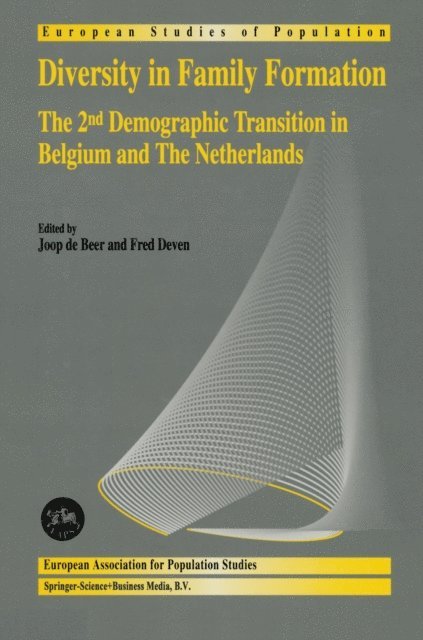
Diversity in Family Formation
The 2nd Demographic Transition in Belgium and The Netherlands
Av Joop de Beer, F. Deven
Inbunden, 2000
1098 kr
Lägg i varukorg
The aim of Diversity in Family Formation is to examine changes in the start of the family formation process. Rather than giving a rough overview of demographic changes in many countries, a comparison of differences in changes in family formation and fertility behaviour between Belgium and The …
Diversity in Family Formation
The 2nd Demographic Transition in Belgium and The Netherlands
Av Joop de Beer, F. Deven
Häftad, 2010
1094 kr
Lägg i varukorg
The aim of Diversity in Family Formation is to examine changes in the start of the family formation process. Rather than giving a rough overview of demographic changes in many countries, a comparison of differences in changes in family formation and fertility behaviour between Belgium and The …
Population and Family in the Low Countries 1995
Selected Current Issues
Av F. Deven, Hans van den Brekel
E-bok, 2012
1502 kr
Lägg i varukorg
EDITORS Hans V AN DEN BREKEL * and Fred DEVEN** * NIDI, P. O. Box 11650, 2502 AR The Hague, The Netherlands ** CBGS, Markiesstraat 1, 1000 Brussels, Belgium The series "Population and Family in the Low Countries" (POPFAM), established in 1976, aims to introduce selected issues of demographic …
Population and Family in the Low Countries 1994
Selected Current Issues
Av Hans van den Brekel, F. Deven
Häftad, 2012
1638 kr
Lägg i varukorg
EDITORS NIDI, P.O. Box 11650, 2502 AR The Hague, The Netherlands CBGS, Markiesstraat 1, 1000 Brussels, Belgium This volume is the tenth edition in the series "Population and Family in the Low Countries". It is published by the Netherlands Interdisciplinary Demo graphic Institute (NIDI, The Hague) …
Population and Family in the Low Countries 1995
Selected Current Issues
Av Hans van den Brekel, F. Deven
Häftad, 2011
1127 kr
Lägg i varukorg
EDITORS Hans V AN DEN BREKEL * and Fred DEVEN** * NIDI, P. O. Box 11650, 2502 AR The Hague, The Netherlands ** CBGS, Markiesstraat 1, 1000 Brussels, Belgium The series "Population and Family in the Low Countries" (POPFAM), established in 1976, aims to introduce selected issues of demographic …
Population and Family in the Low Countries 1994
Selected Current Issues
Av F. Deven, Hans van den Brekel
E-bok, 2012
2044 kr
Lägg i varukorg
EDITORS NIDI, P.O. Box 11650, 2502 AR The Hague, The Netherlands CBGS, Markiesstraat 1, 1000 Brussels, Belgium This volume is the tenth edition in the series "Population and Family in the Low Countries". It is published by the Netherlands Interdisciplinary Demo graphic Institute (NIDI, The Hague) …
Diversity in Family Formation
The 2nd Demographic Transition in Belgium and The Netherlands
Av F. Deven, Joop de Beer
E-bok, 2013
1459 kr
Lägg i varukorg
The aim of Diversity in Family Formation is to examine changes in the start of the family formation process. Rather than giving a rough overview of demographic changes in many countries, a comparison of differences in changes in family formation and fertility behaviour between Belgium and The …