Joop de Beer - Böcker
Visar alla böcker från författaren Joop de Beer. Handla med fri frakt och snabb leverans.
4 produkter
4 produkter
Europe - One Continent, Different Worlds
Population Scenarios for the 21st Century
Inbunden, Engelska, 1999
852 kr
Skickas inom 10-15 vardagar
Future demographic developments in Europe will be caused by the specific economic, social and cultural context, and will, in turn, have a major influence on future economic and social conditions. To the extent that demographic trends differ across countries, separate countries may face different social and economic problems. As demographic trends tend to have long-lasting effects, it is important to assess the possible consequences of future demographic developments at an early stage. Within the European context, the question can be raised whether the socioeconomic and cultural dimensions of society are dominated by convergent or divergent forces, and what the consequences are of these assumed convergent or divergent tendencies for long-term future demographic developments in the countries of Europe. Since there is no unambiguous answer to this question, this book describes two alternative scenarios for Europe's future population. In the Uniformity scenario, convergent forces are dominant. This will eventually lead to a situation where only marginal economic and cultural differences exist across Europe.Trends in fertility and mortality will converge up to the year 2050, although over time patterns may differ across countries as a result of their different initial states. In contrast to the Uniformity scenario, a Diversity scenario is constructed where cultural, economic and demographic characteristics remain significantly different across countries. This book is the result of close collaboration between researchers from the Netherlands Interdisciplinary Demographic Institute (NIDI) and Statistics Netherlands (SN). Although the project was a joint effort by all researchers involved, the book has assumed the form of an edited volume, with separate chapters by small groups of authors. The authors are, of course, responsible for writing their own contributions, but they were often involved to a certain extent in the realisation of some of the other chapters as well.
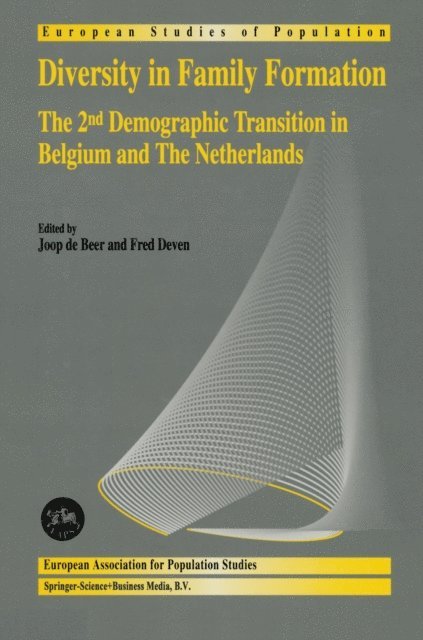
Diversity in Family Formation
The 2nd Demographic Transition in Belgium and The Netherlands
Inbunden, Engelska, 2000
1 064 kr
Skickas inom 10-15 vardagar
The aim of this text is to examine changes in the start of the family formation process. Rather than giving a overview of demographic changes in many countries, a comparison of differences in changes in family formation and fertility behaviour between Belgium and The Netherlands is interesting for various reasons. First, even though the economic and cultural differences between these countries are relatively small there is one important difference: Belgium is predominantly Catholic, whereas The Netherlands has about equal proportions of Catholics and Protestants. Second, if the Second Demographic Transition implies that there is one common pattern of change in different European countries and that differences across countries are due to the fact that countries are in a different stage of the transition process, and if it is assumed that the transition process started earlier in Protestant countries than in Catholic countries, one would expect The Netherlands to be in a further stage of the transition process than Belgium.Thus an in-depth comparison of changes in family formation and fertility behaviour between both countries may give us more insight in the question of whether there is one common transition process. The comparison of fertility and family survey-data in both countries brings us to the core question of whether there is one common explanation for differences between countries in various types of fertility and family behaviour under consideration, namely fertility regulation, the choice of living arrangement after leaving the parental home, and the labour force participation of mothers.
Diversity in Family Formation
The 2nd Demographic Transition in Belgium and The Netherlands
Häftad, Engelska, 2010
1 064 kr
Skickas inom 10-15 vardagar
The aim of Diversity in Family Formation is to examine changes in the start of the family formation process. Rather than giving a rough overview of demographic changes in many countries, a comparison of differences in changes in family formation and fertility behaviour between Belgium and The Netherlands is interesting for various reasons. First, even though the economic and cultural differences between these countries are relatively small there is one important difference: Belgium is predominantly Catholic, whereas The Netherlands has about equal proportions of Catholics and Protestants. Second, if the Second Demographic Transition implies that there is one common pattern of change in different European countries and that differences across countries are due to the fact that countries are in a different stage of the transition process, and if it is assumed that the transition process started earlier in Protestant countries than in Catholic countries, one would expect The Netherlands to be in a further stage of the transition process than Belgium.Thus an in-depth comparison of changes in family formation and fertility behaviour between both countries may give us more insight in the question of whether there is one common transition process. The comparison of fertility and family survey-data in both countries brings us to the core question of whether there is one common explanation for differences between countries in various types of fertility and family behaviour under consideration, namely fertility regulation, the choice of living arrangement after leaving the parental home, and the labour force participation of mothers.
Del 7 - European Studies of Population
Europe: One Continent, Different Worlds
Population Scenarios for the 21st Century
Häftad, Engelska, 2012
536 kr
Skickas inom 10-15 vardagar
On the threshold of a new century the organisers of the European Population Conference 1999 (EPC99) in The Hague decided not only to highlight the population trends that Europe is facing today but also the changes in the 2 pt century that are set to shape the future of Europe. They decided to focus on comparative issues, both in time and in space. In order to trace the degree of homogeneity and heterogeneity of European populations over time, converging and diverging population trends that are specific to contemporary and future Europe need to be explored. This is reflected in EPC99's motto: 'European Populations on the threshold of the new millennium; unity in diversity. ' Future demographic developments will be caused by specific economic, social and cultural conditions in Europe, and will, in turn, have a major influence on future economic and social conditions. To the extent that demographic trends differ across countries, separate countries may face different social and economic problems. As demographic trends tend to have long-lasting effects, it is important to assess the possible consequences of future demographic developments at an early stage. On the occasion of EPC99, two of the organisers, Statistics Netherlands (SN) and the Netherlands Interdisciplinary Demographic Institute (NIDI), decided to produce a set of two population scenarios, showing the possible impact of converging and diverging population trends in the next century .