Friederike Moltmann - Böcker
Visar alla böcker från författaren Friederike Moltmann. Handla med fri frakt och snabb leverans.
6 produkter
6 produkter
875 kr
Skickas inom 5-8 vardagar
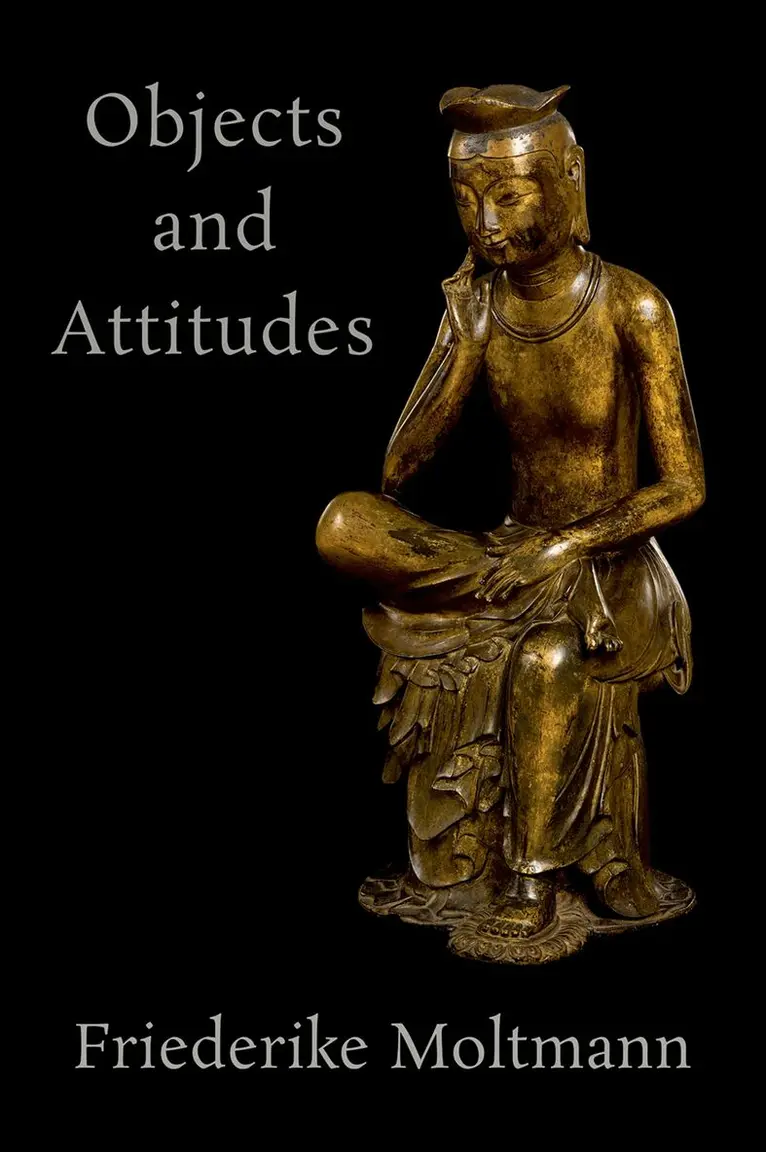
Objects and Attitudes develops a radically novel semantics of attitude reports, modal sentences, and quotation based on an ontology of attitudinal, modal, and phatic objects, entities such as claims, thoughts, intentions, desires, requests, utterances, as well as needs, obligations, permissions, offers, and abilities. It systematically pursues a methodology of descriptive metaphysics--specifically, natural language ontology--and argues that natural language reflects an ontology of attitudinal and modal objects rather than an ontology of abstract propositions. The book gives a new development of truthmaker semantics ("object-based truthmaker semantics"), for which attitudinal and modal objects provide specific support. The semantics of attitude reports, modal sentences and quotation pursues the emerging view that clausal complements do not generally act as proposition-referring terms but rather as predicates of the (content-bearing) object described by the embedding predicate. It also develops novel, truthmaker-based conceptions of facts and states of affairs, the referents of clauses on a secondary, nominal function.Objects and Attitudes pursues the syntactic view that attitude verbs are underlying complex predicates, consisting of a light verb and a noun for an attitudinal object. Within that view, it gives a new syntactic and semantic analysis of special quantifiers (something, several things) as complements of attitude verbs and verbs of saying, on which such quantifiers range over attitudinal or phatic objects.
1 056 kr
Skickas inom 5-8 vardagar
This book develops a unified account of expressions involving the notions of "part" and "whole " in which principles of the individuation of part structures play a central role. Moltmann presents a range of new empirical generalizations with data from English and a variety of other languages involving plurals, mass nouns, adnominal and adverbial modifiers such as as a whole, together, and alone, nominal and adverbial quantifiers ranging over parts, and expressions of completion such as completely and partly. She develops a new theory of part structures which differs from traditional mereological theories in that the notion of an integrated whole plays a central role and in that the part structure of an entity is allowed to vary across different situations, perspectives, and dimensions.
557 kr
Skickas inom 5-8 vardagar
This book develops a unified account of expressions involving the notions of "part" and "whole" in which principles of the individuation of part structures play a central role. Moltmann presents a range of new empirical generalizations with data from English and a variety of other languages involving plurals, mass nouns, adnominal and adverbial modifiers such as as a whole, together, and alone, nominal and adverbial quantifiers ranging over parts, and expressions of completion such as completely and partly. She develops a new theory of part structures which differs from traditional mereological theories in that the notion of an integrated whole plays a central role and in that the part structure of an entity is allowed to vary across different situations, perspectives, and dimensions.
1 456 kr
Skickas inom 3-6 vardagar
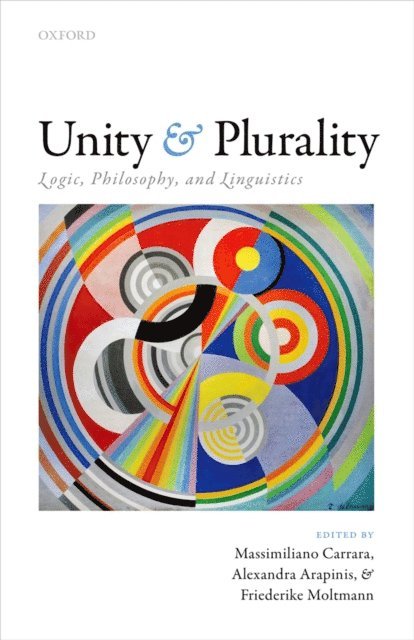
Unity and Plurality presents novel ways of thinking about plurality while casting new light on the interconnections among the logical, philosophical, and linguistic aspects of plurals. The volume brings together new work on the logic and ontology of plurality and on the semantics of plurals in natural language. Plural reference, the view that definite plurals such as 'the students' refer to several entities at once (the individual students), is an approach favoured by logicians and philosophers, who take sentences with plurals ('the students gathered') not to be committed to entities beyond individuals, entities such as classes, sums, or sets. By contrast, linguistic semantics has been dominated by a singularist approach to plurals, taking the semantic value of a definite plural such as 'the students' to be a mereological sum or set. Moreover, semantics has been dominated by a particular ontological view of plurality, that of extensional mereology. This volume aims to build a bridge between the two traditions and to show the fruitfulness of nonstandard mereological approaches. A team of leading experts investigates new perspectives that arise from plural logic and non-standard mereology and explore novel applications to natural language phenomena.
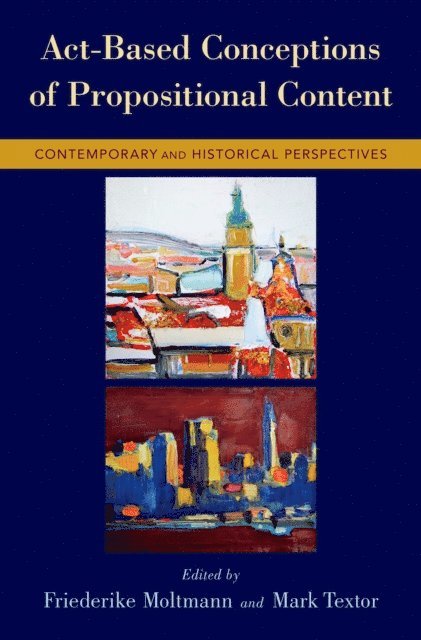
Act-Based Conceptions of Propositional Content
Contemporary and Historical Perspectives
Inbunden, Engelska, 2017
1 147 kr
Skickas inom 5-8 vardagar
The notion of a propositional content plays a central role in contemporary philosophy of language. Propositional content makes up both the meaning of sentences and the content of propositional attitudes such as belief. One particular view about propositional content has been dominant in analytic philosophy, namely the Fregean conception of propositions as abstract mind-independent objects that come with truth conditions. But propositions in this sense raise a range of issues, which have become a center of debate in current philosophy of language. In particular, how should propositions as abstract objects be understood and how can they represent things and be true or false? A number of philosophers in contemporary analytic philosophy as well as in early analytic philosophy and phenomenology have approached the notion of a propositional content in a different way, not by starting out with an abstract truth berarer, but by focusing on cognitive acts of agents, such as acts of judging. It is in terms of such acts that the notion of a propositional content, on their view, should be understood. The act-based perspective historically goes back to the work of Central European philosophers, in particular that of Husserl, Twardowski, Meinong, and Reinach. However, their work has been unduly neglected and is in fact largely inaccessible to contemporary analytic philosophers. The volume presents a central selection of work of these philosophers that bear on an act-based conception of philosophical content, some of which in new translations (one paper by Reinach), some of which published in English for the very first time (two papers by Twardowski). In addition, the volume presents new work by leading contemporary philosophers of language pursuing or discussing an act-based conception of propositional content. Moreover, the book contains a crosslinguistic study of nominalizations for actions and products, a distinction that plays a central role in the philosophy of language of Twardowski.
1 217 kr
Skickas inom 5-8 vardagar
Abstract objects have been a central topic in philosophy since antiquity. Philosophers have defended various views about abstract objects by appealing to metaphysical considerations, considerations regarding mathematics or science, and, not infrequently, intuitions about natural language. This book pursues the question of how and whether natural language allows for reference to abstract objects in a fully systematic way. By making full use of contemporary linguistic semantics, it presents a much greater range of linguistic generalizations than has previously been taken into consideration in philosophical discussions, and it argues for an ontological picture is very different from that generally taken for granted by philosophers and semanticists alike. Reference to abstract objects such as properties, numbers, propositions, and degrees is considerably more marginal than generally held. Instead, natural language is rather generous in allowing reference to particularized properties (tropes), the use of nonreferential expressions in apparent referential position, and the use of 'nominalizing expressions', such as quantifiers like 'something'. Reference to abstract objects is achieved generally only by the use of 'reifying terms', such as 'the number eight'.