Mark Textor - Böcker
Visar alla böcker från författaren Mark Textor. Handla med fri frakt och snabb leverans.
13 produkter
13 produkter
1 105 kr
Skickas inom 5-8 vardagar
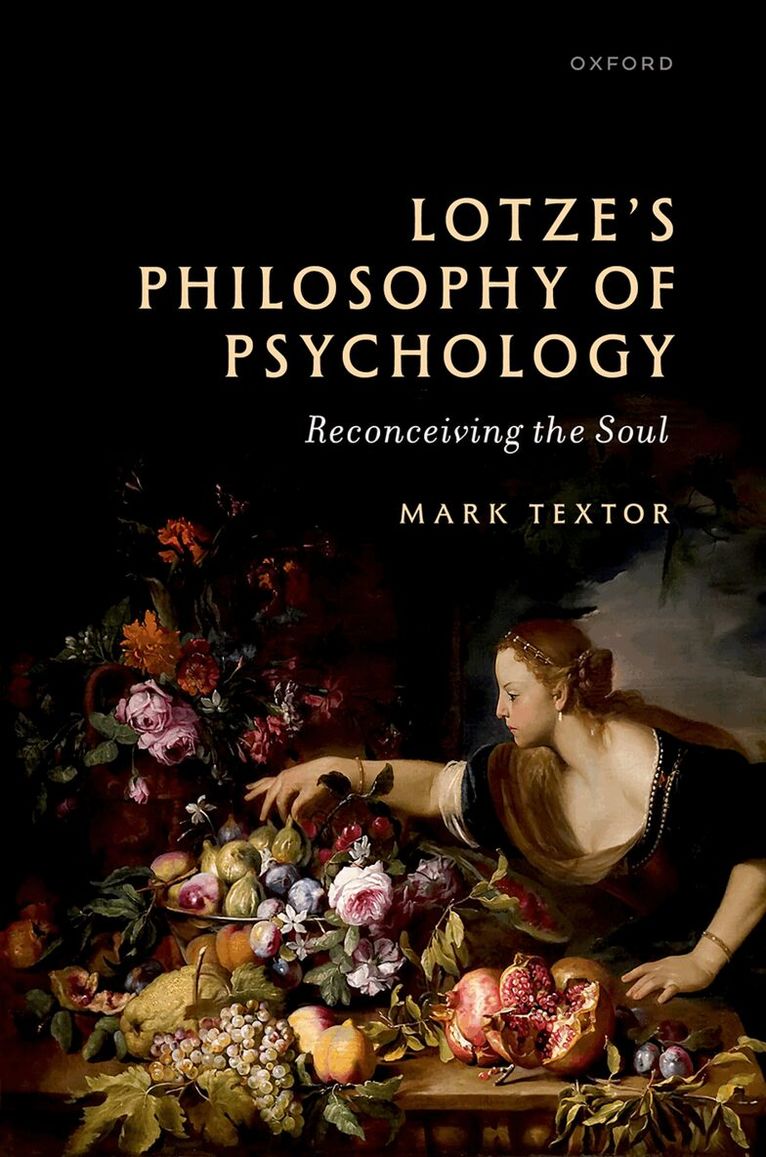
This book introduces and assesses the main contributions of Hermann Lotze (1817-1881) to philosophy of psychology and philosophy of mind. Lotze was the most influential thinker of his time; he revitalised German philosophy after Hegel's death, inspiring American pragmatists as well as British idealists. He brought medical research, metaphysics, and psychology together in his work to argue for an approach to psychology in which the soul is central. Lotze defended the soul, the irreducibility of the mental, and the interaction between soul and body; in doing so, he proposed views of feeling, attention, self-consciousness, and the unity of consciousness. While Lotze's views were widely discussed at the end of the nineteenth and the beginning of the twentieth century, they are now unjustly neglected. In this volume, Mark Textor provides a rational reconstruction of Lotze's philosophy of psychology. He examines in detail Lotze's affective theory of self-consciousness and his account of comparing, the activity in which we attain awareness of relations. The latter fuels an original argument for the existence of the soul and its importance for psychology. This argument is also seen as a refutation of panpsychism, the view that fundamental reality is made of 'mind-stuff'. The book pays close attention to the historical background of Lotze's thought, as well as discussions of his work in American and British philosophy, and thereby sheds light on how his thought shaped American Pragmatism and British Idealism.
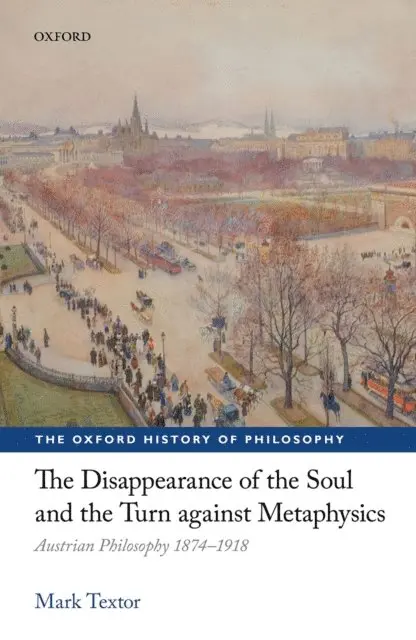
The Disappearance of the Soul and the Turn against Metaphysics
Austrian Philosophy 1874-1918
Inbunden, Engelska, 2021
478 kr
Skickas inom 5-8 vardagar
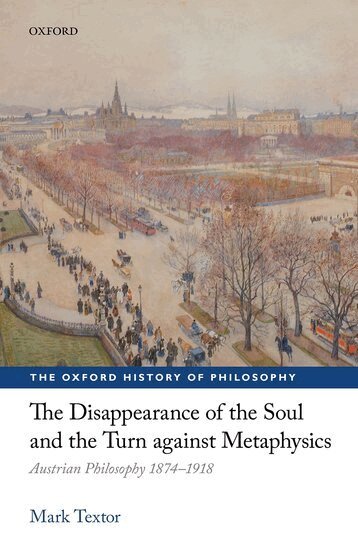
In the twentieth century English-language philosophy came to be science- and logic-oriented, and was suspicious of metaphysics. The Disappearance of the Soul and the Turn against Metaphysics traces our present philosophical outlook back to debates in Austro-German philosophy about the relation between empirical science and metaphysics: does empirical psychology depend on the metaphysics of the soul, the mental substance? The negative answer - that there is 'a psychology without a soul' - shaped Austrian philosophy and provided a model for ontologies that dispense with substances. Mark Textor tells the story of how and why (Austrian) philosophy turned against metaphysics . He introduces the key thinkers of the time, including the 'fathers of Austrian philosophy' Franz Brentano and Ernst Mach, whose Intentionalism (Brentano) and Neutral Monism (Mach) became distinctive and influential positions in the philosophy of mind. Textor goes on to use the 'psychology without a soul' view as a vantage point from which to reconstruct and assess the immediate pre-history and formation of analytic philosophy (Ward, Stout, Moore, Russell). While Austrian philosophers retired the soul, early analytic philosophers were happy to introduce a successor, the subject, and conceive of the mental as constituted by subject-object relations. The final part of the book returns to the theme of anti-metaphysics from a different perspective. In this part the early Moritz Schlick, who would soon become the leading figure of the Vienna Circle, takes centre stage. The final part of the book reconstructs Schlick's arguments for the conclusion that metaphysics lies beyond the limits of knowledge that are rooted in the philosophy of mind discussed in previous parts.
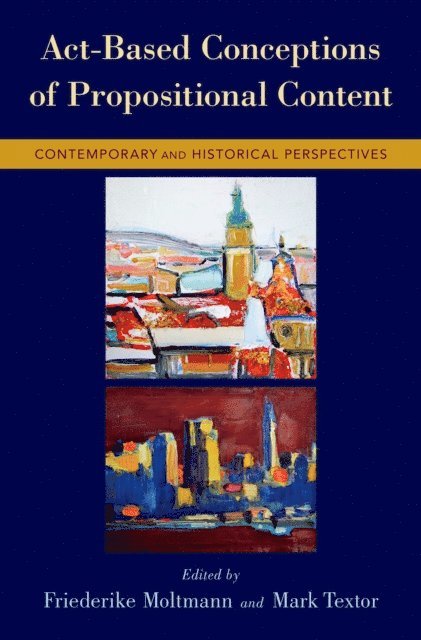
Act-Based Conceptions of Propositional Content
Contemporary and Historical Perspectives
Inbunden, Engelska, 2017
1 147 kr
Skickas inom 5-8 vardagar
The notion of a propositional content plays a central role in contemporary philosophy of language. Propositional content makes up both the meaning of sentences and the content of propositional attitudes such as belief. One particular view about propositional content has been dominant in analytic philosophy, namely the Fregean conception of propositions as abstract mind-independent objects that come with truth conditions. But propositions in this sense raise a range of issues, which have become a center of debate in current philosophy of language. In particular, how should propositions as abstract objects be understood and how can they represent things and be true or false? A number of philosophers in contemporary analytic philosophy as well as in early analytic philosophy and phenomenology have approached the notion of a propositional content in a different way, not by starting out with an abstract truth berarer, but by focusing on cognitive acts of agents, such as acts of judging. It is in terms of such acts that the notion of a propositional content, on their view, should be understood. The act-based perspective historically goes back to the work of Central European philosophers, in particular that of Husserl, Twardowski, Meinong, and Reinach. However, their work has been unduly neglected and is in fact largely inaccessible to contemporary analytic philosophers. The volume presents a central selection of work of these philosophers that bear on an act-based conception of philosophical content, some of which in new translations (one paper by Reinach), some of which published in English for the very first time (two papers by Twardowski). In addition, the volume presents new work by leading contemporary philosophers of language pursuing or discussing an act-based conception of propositional content. Moreover, the book contains a crosslinguistic study of nominalizations for actions and products, a distinction that plays a central role in the philosophy of language of Twardowski.
983 kr
Skickas inom 7-10 vardagar
Mark Textor presents a critical study of the work of Franz Brentano, one of the most important thinkers of the nineteenth century. His work has influenced analytic philosophers like Russell as well as phenomenologists like Husserl and Sartre, and continues to shape debates in the philosophy of mind. Brentano made intentionality a central topic in the philosophy of mind by proposing that 'directedness' is the distinctive feature of the mental. The first part of the book investigates Brentano's intentionalism as well as attempts to improve or develop it. Textor argues that there is no plausible version of this doctrine, and rejects it in favour of a mark of the mental proposed by Brentano's student Husserl: mental phenomena have no appearances. The second part of the book develops and defends Brentano's view about the structure of perceptual awareness. Awareness of a mental activity and this mental activity are not distinct mental acts, the first representing the second. They are one and the same activity that has several objects. Textor shows that Brentano held that intentionality is plural - directedness is directedness on some objects - and shows how the plural conception solves thorny problems. The third part of the book is devoted to Brentano's view of pleasure and pain. Textor draws out parallels between enjoying an activity and awareness of it and argues that enjoying an activity and the activity enjoyed are not distinct. The final part of the book extends the plural view to the conscious mental life of a thinker at a time (the unity of synchronic consciousness): it is one mental act with many objects.
2 171 kr
Skickas inom 10-15 vardagar
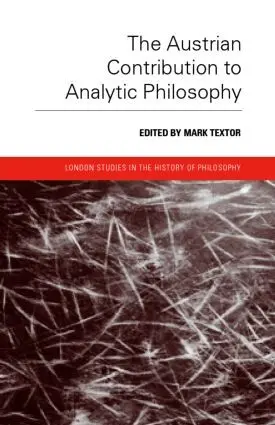
Although an important part of the origins of analytic philosophy can be traced back to philosophy in Austria in the first part of the twentieth century, remarkably little is known about the specific contribution made by Austrian philosophy and philosophers.In The Austrian Contribution to Analytic Philosophy, prominent analytic philosophers take a fresh look at the roots of analytic philosophy in the thought of influential but often overlooked Austrian philosophers including Brentano, Meinong, Bolzano, Husserl, and Witasek. The contributors to this volume investigate central topics in theoretical philosophy such as intentionality, consciousness, memory, attributes, and truth as well as political philosophy and aesthetics. This original collection will be of interest to anyone studying the origins of analytic philosophy as well as contemporary debates in philosophy of language, metaphysics and mind.
1 698 kr
Skickas inom 10-15 vardagar
Gottlob Frege (1848-1925) is considered the father of modern logic and one of the founding figures of analytic philosophy. He was first and foremost a mathematician, but his major works also made important contributions to the philosophy of language.Frege’s writings are difficult and deal with technical, abstract concepts. The Routledge Philosophy Guidebook to Frege On Sense and Reference helps the student to get to grips with Frege’s thought, and introduces and assesses: the background of Frege’s philosophical workFrege’s main papers and arguments, focussing on his distinction between sense and referencethe continuing importance of Frege’s work to philosophy of logic and language. Ideal for those coming to Frege for the first time, and containing fresh insights for anyone interested in his philosophy, this Guidebook is essential reading for all students of philosophy of language, philosophical logic and the history of analytic philosophy.
413 kr
Skickas inom 10-15 vardagar
Gottlob Frege (1848-1925) is considered the father of modern logic and one of the founding figures of analytic philosophy. He was first and foremost a mathematician, but his major works also made important contributions to the philosophy of language.Frege’s writings are difficult and deal with technical, abstract concepts. The Routledge Philosophy Guidebook to Frege On Sense and Reference helps the student to get to grips with Frege’s thought, and introduces and assesses: the background of Frege’s philosophical workFrege’s main papers and arguments, focussing on his distinction between sense and referencethe continuing importance of Frege’s work to philosophy of logic and language. Ideal for those coming to Frege for the first time, and containing fresh insights for anyone interested in his philosophy, this Guidebook is essential reading for all students of philosophy of language, philosophical logic and the history of analytic philosophy.
751 kr
Skickas inom 10-15 vardagar
Although an important part of the origins of analytic philosophy can be traced back to philosophy in Austria in the first part of the twentieth century, remarkably little is known about the specific contribution made by Austrian philosophy and philosophers.In The Austrian Contribution to Analytic Philosophy, prominent analytic philosophers take a fresh look at the roots of analytic philosophy in the thought of influential but often overlooked Austrian philosophers including Brentano, Meinong, Bolzano, Husserl, and Witasek. The contributors to this volume investigate central topics in theoretical philosophy such as intentionality, consciousness, memory, attributes, and truth as well as political philosophy and aesthetics. This original collection will be of interest to anyone studying the origins of analytic philosophy as well as contemporary debates in philosophy of language, metaphysics and mind.
499 kr
Kommande
Uncovering an aspect of Gottlob Frege’s linguistic theorizing that has until now received little attention, this volume offers the first detailed exposition of Frege’s pragmatics. Thorsten Sander explores his views on colouring, side-thoughts, presuppositions, indexicals and illocutionary force and closely relates these to current research in philosophy of language and linguistics.Throughout his career, Frege was concerned with various secondary aspects of meaning. He claims, for instance, that the two words ‘dog’ and ‘cur’ differ not in what he calls sense, but merely in colouring. By contrast, the difference between ‘morning star’ and ‘evening star’ is supposed to be a matter of sense. How exactly does sense differ from colouring? Frege also claims that by using a proper name one presupposes the existence of its bearer and that our utterances are frequently associated with side-thoughts. What exactly does he mean by these terms, and wherein lies the difference between these phenomena?Frege's Pragmatics answers questions such as these, providing a fresh perspective on Frege’s account of various pragmatic aspects of language. In this first book-length treatment, Sander makes the case that Frege’s groundbreaking ideas are an essential part of his overall philosophical enterprise.
468 kr
Kommande
What makes time interesting and what is time? Graeme A. Forbes presents a robust defence of the metaphysical asymmetry between past and future, providing a compelling argument for the acceptance of the Growing-Block view.Taking us from the armchair to philosophy of physics, and then out to the human world Forbes considers the ontological questions that have been the focus of most of the literature on the metaphysics of time.Across three parts, he addresses questions central to the philosophy of time. Part I asks why we should think that time does something that space does not; Part II examines why we should think that the past differs in some metaphysically interesting way from the future and Part III shows why we should accept the Growing-Block view – the view on which the past exists, the future doesn’t, and the passage of time is causation bringing about events in accordance with the laws of nature. This wide-ranging and engaging exploration of persistence, experience, agency, and more, makes a radical contribution to our understanding of the philosophy of time.
Del 2 - Philosophische Forschung / Philosophical Research
Semantik und Ontologie
Inbunden, Tyska, 2004
2 036 kr
Skickas inom 5-8 vardagar
2 206 kr
Skickas inom 5-8 vardagar
We are supposed to wage war against Terrorism - but exactly what we are fighting against in this war, there is nearly no consensus about. And, much worse, nearly nobody cares about this conceptual disaster - the main thing being, whether or not you are taking sides with the good guys. This volume is an analytical attempt to end this disaster. What is Terrorism? Are terrorist acts to be defined exclusively on the basis of the characteristics of the respective actions? Or should we restrict such actions to acts performed by non-state organisations? And, most important, is terrorism already by its very nature to be morally condemned? But, having a clear idea of what Terrorism is, would be only the beginning. Rational moral assessment still needs two further components: The relevant facts; and the relevant values and norms. Now, in a field where systematic disinformation has been even proclaimed to be the official policy, facts are obviously very hard to get at. This volume is mainly interested in Ethics: What's wrong with Terrorism? And what is morally right or morally wrong, respectively, with all the different means of Counter-Terrorism? What are the moral boundaries for waging war agains terrorism? What are the right ways of dealing with terrorists? And what about the alleged anti-terrorism wars on Afghanistan and Iraq? With contributions from Marcelo Dascal, Tomis Kapitan, Daniel Messelken, Seumas Miller, Olaf L. Mueller, Igor Primoratz, Charles P. Webel, Per Bauhn, Rüdiger Bittner, C. A. J. (Tony) Coady, Haig Khatchadourian, Georg Meggle, Peter Simpson, Carolin Emcke, Ralf Groetker, Laurence Lustgarten, Thomas Mertens, Aleksandar Pavkovic, Filimon Peonidis, Janna Thompson, Véronique Zanetti
1 618 kr
Skickas inom 5-8 vardagar
Perception and its puzzles have given rise to philosophical reflection from antiquity to recent times: What do we perceive? How do we talk about what we perceive? What is the nature of our subjective experience? How can we talk about our subjective experience? In this book a distinguished group of philosophers addresses questions like these by drawing on historical and contemporary sources, illuminating the intersections between historical and contemporary philosophical discussion. They ask about the way things look; about how we can perceive a particular object (and no other); about self-perception; and about the nature and explanation of our phenomenal experience, and our talk about it. The book provides important new work in a central philosophical area.