Gabrielle Vail - Böcker
Visar alla böcker från författaren Gabrielle Vail. Handla med fri frakt och snabb leverans.
9 produkter
9 produkter
721 kr
Skickas inom 10-15 vardagar
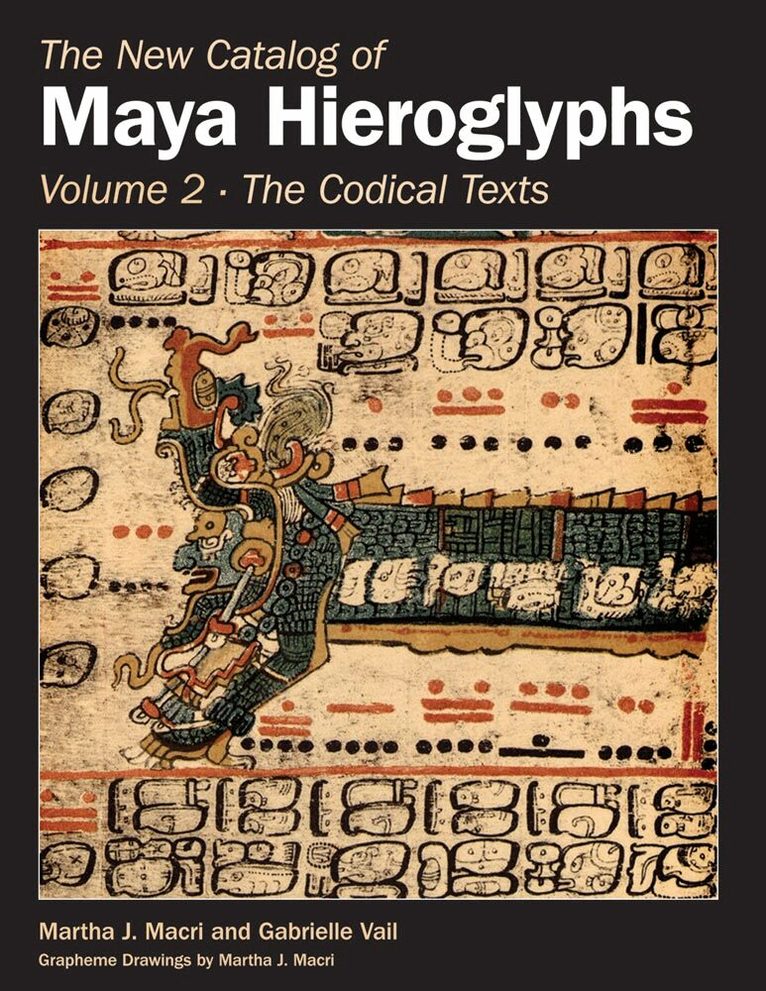
This long-awaited resource complements its companion volume on Classic Period monumental inscriptions. Authors Martha J. Macri and Gabrielle Vail provide a comprehensive listing of graphemes found in the Dresden, Madrid, and Paris codices, 40 percent of which are unique to these painted manuscripts, and discuss current and past interpretations of these graphemes.The New Catalog uses an original coding system developed for the Maya Hieroglyphic Database Project. The new three-digit codes group the graphemes according to their visual, rather than functional, characteristics to allow readers to see distinctions between similar signs. Each entry contains the grapheme's New Catalog code, an image, the corresponding Thompson number, proposed syllabic and logographic values, calendrical significance, and bibliographical citations. Appendices and an index of signs from both volumes contain images of all graphemes and variants ordered by code, allowing readers to search for graphemes by visual form or by their proposed logographic and phonetic values.Together the two volumes of the New Catalog represent the most significant updating of the sign lists for the Maya script proposed in half a century. They provide a cutting-edge reference tool critical to the research of Mesoamericanists in the fields of archaeology, art history, ethnohistory, and linguistics, and a valuable resource to scholars specializing in comparative studies of writing systems and related disciplines.
378 kr
Skickas inom 10-15 vardagar
This long-awaited resource complements its companion volume on Classic Period monumental inscriptions. Authors Martha J. Macri and Gabrielle Vail provide a comprehensive listing of graphemes found in the Dresden, Madrid, and Paris codices, 40 percent of which are unique to these painted manuscripts, and discuss current and past interpretations of these graphemes.The New Catalog uses an original coding system developed for the Maya Hieroglyphic Database Project. The new three-digit codes group the graphemes according to their visual, rather than functional, characteristics to allow readers to see distinctions between similar signs. Each entry contains the grapheme’s New Catalog code, an image, the corresponding Thompson number, proposed syllabic and logographic values, calendrical significance, and bibliographical citations. Appendices and an index of signs from both volumes contain images of all graphemes and variants ordered by code, allowing readers to search for graphemes by visual form or by their proposed logographic and phonetic values.Together the two volumes of the New Catalog represent the most significant updating of the sign lists for the Maya script proposed in half a century. They provide a cutting-edge reference tool critical to the research of Mesoamericanists in the fields of archaeology, art history, ethnohistory, and linguistics, and a valuable resource to scholars specializing in comparative studies of writing systems and related disciplines.
New Catalog of Maya Hieroglyphs, Volume 3 Volume 285
The Complete Illustrated Guide
Inbunden, Engelska, 2026
733 kr
Kommande
Among their celebrated achievements, the ancient Maya are renowned for developing a highly sophisticated writing system. Their unique hieroglyphic script adorns stone and wood monuments, as well as portable objects. Drawing on a wealth of research, this remarkable book—the third and final volume in The New Catalog of Maya Hieroglyphs series—offers a comprehensive and up-to-date visual reference of the Maya script.As the culmination of The New Catalog, the current volume both summarizes information from the previous volumes and expands on the discussions of decipherment and grapheme functions. Incorporating the most recent research on the script, it reclassifies several signs and adds many more, including those appearing in newly discovered inscriptions. Along with explanatory text, it presents in visual form each individual sign used in the Maya script along with its corresponding three- or four-digit code.Combining cutting-edge scholarship with accessible presentation, this volume serves as a concise reference tool critical for the ongoing research of scholars and students of Mesoamerican writing systems. For enhanced interactivity, readers can also use the guide in coordination with the online Maya Hieroglyphic Database.
1 004 kr
Skickas inom 5-8 vardagar
387 kr
Tillfälligt slut
This volume offers new calendrical models and methodologies for reading, dating, and interpreting the general significance of the Madrid Codex. The longest of the surviving Maya codices, this manuscript includes texts and images painted by scribes conversant in Maya hieroglyphic writing, a written means of communication practiced by Maya elites from the second to the fifteenth centuries A.D. Some scholars have recently argued that the Madrid Codex originated in the Petén region of Guatemala and postdates European contact. The contributors to this volume challenge that view by demonstrating convincingly that it originated in northern Yucatán and was painted in the Pre-Columbian era. In addition, several contributors reveal provocative connections among the Madrid and Borgia group of codices from Central Mexico.Contributors include: Harvey M. Bricker, Victoria R. Bricker, John F. Chuchiak IV, Christine L. Hernández, Bryan R. Just, Merideth Paxton, and John Pohl. Additional support for this publication was generously provided by the Eugene M. Kayden Fund at the University of Colorado.
Astronomers, Scribes, and Priests
Intellectual Interchange between the Northern Maya Lowlands and Highland Mexico in the Late Postclassic Period
Inbunden, Engelska, 2010
412 kr
Skickas inom 7-10 vardagar
Del 1 - Indigenous Cultures of Latin America
Mesoamerican Rituals and the Solar Cycle
New Perspectives on the Veintena Festivals
Inbunden, Engelska, 2021
1 187 kr
Skickas inom 5-8 vardagar
This book explores a seminal topic concerning the Mesoamerican past: the religious festivals that took place during the eighteen periods of twenty days, or veintenas, into which the solar year was divided. Pre-Columbian societies celebrated these festivals through complex rituals, involving the priests and gods themselves, embodied in diverse beings and artifacts. Specific sectors of society also participated in the festivals, while city inhabitants usually attended public ceremonies. As a consequence, this ritual cycle played a significant role in Mesoamerican religious life; at the same time, it informs us about social relations in pre-Columbian societies. Both religious and social aspects of the solar cycle festivals are tackled in the twelve contributions in this book, which aims to address the entire veintena sequence and as much of the territory and history of Mesoamerica as possible. Specifically, the book revisits long-standing discussions of the solar cycle festivals, but also explores these religious practices in original ways, in particular through investigating understudied rituals and offering new interpretations of rites that have previously been extensively analyzed. Other chapters consider the entire veintena sequence through the prism of specific topics, providing multiple though often complementary analyses. As a consequence, this book will attract the attention of scholars and graduate students with interests in Mesoamerica and early Latin America, as well as ethnohistory, cultural history, history of religions, art history, archaeology and anthropology.
Del 2 - Indigenous Cultures of Latin America
Migration and Creation in Aztec and Maya literature
Häftad, Engelska, 2023
485 kr
Skickas inom 5-8 vardagar
Migration and Creation in Aztec and Maya Literature provides a new perspective on migration and creation episodes in the Popol Vuh of the Quiché Maya Indians of highland Guatemala, demonstrating that they are largely borrowed from Aztec sources. These findings upend previous interpretations resulting from the widely held belief that the Popol Vuh is the most "authentic" Maya book. Victoria Bricker’s careful historical analysis explains the origin of these borrowings, which stemmed from the expansion of the Aztec empire southward from the Central Valley of Mexico into the highlands of what is today the Mexican state of Chiapas and continuing into highland Guatemala as far south as the town of Utatlán, whose rulers then intermarried with members of the Aztec royal family.This innovative volume explores new ground, comparing Aztec pictorial representations of migration with Maya written descriptions of the same events and showing that they have much in common. Bricker’s exploration of creation narratives demonstrates that the Aztec treatment of multiple creations is more coherent than the Popol Vuh version because it describes the end of each creation before embarking on a new creation, whereas the Popol Vuh version refers to the end of all creations only once. Bricker also provides a new interpretation of creation texts from the archaeological sites of Quirigua and Palenque that challenges models suggesting that the Precolumbian Maya, like the Aztecs, believed in multiple creations. Students of Latin American history will find fresh insights regarding interactions and cultural contact in Late Prehispanic Mesoamerica in Bricker’s study. Victoria Bricker, one of the most accomplished scholars in the field of Mesoamerican studies, presents a fascinating hypothesis about creation legends in this new book. Synthesizing references to Mesoamerican migration and creation accounts in the Colonial period and ethnographic literature, she concludes that the multiple creation events recorded in the Popol Vuh, a colonial-period Quiché Maya text, were derived from Central Mexican traditions. Bricker finds no evidence for multiple creation events in Classic period Maya texts, and suggests that the narrative recorded in the Popol Vuh was probably transferred from the Aztec outpost in Zinacantán, Chiapas, to Quiché nobility, who aspired to increase their status by linking their creation narrative to Aztec accounts. This book provides a stimulating new look at the exchange of ideas across Mesoamerica, and will certainly lead scholars to reexamine the often-claimed link between the Popol Vuh and Classic Maya iconography.—Dr. Susan Milbrath, Emeritus Curator of Latin American Art and Archaeology Florida Museum of Natural History, University of Florida, GainesvilleThis is an extraordinary book. Only Victoria Bricker–with her mastery of Maya linguistics, hieroglyphics, and colonial sources, and her knowledge of Aztec texts–could have compared Aztec and Maya creation literature in the probing and thoughtful way she has. The short chapters, each with its clear focus, carry her analysis naturally forward to a deeper understanding of the Popol Vuh and, indeed, much migration and creation literature in Mesoamerica.—Dr. Elizabeth Hill Boone, Professor Emerita, Tulane University
Re-Creating Primordial Time
Foundation Rituals and Mythology in the Postclassic Maya Codices
Inbunden, Engelska, 2013
1 043 kr
Tillfälligt slut
Re-Creating Primordial Time offers a new perspective on the Maya codices, documenting the extensive use of creation mythology and foundational rituals in the hieroglyphic texts and iconography of these important manuscripts. Focusing on both pre-Columbian codices and early colonial creation accounts, Vail and Hernández show that in spite of significant cultural change during the Postclassic and Colonial periods, the mythological traditions reveal significant continuity, beginning as far back as the Classic period. Remarkable similarities exist within the Maya tradition, even as new mythologies were introduced through contact with the Gulf Coast region and highland central Mexico. Vail and Hernández analyze the extant Maya codices within the context of later literary sources such as the Books of Chilam Balam, the Popol Vuh, and the Códice Chimalpopoca to present numerous examples highlighting the relationship among creation mythology, rituals, and lore. Compiling and comparing Maya creation mythology with that of the Borgia codices from highland central Mexico, Re-Creating Primordial Time is a significant contribution to the field of Mesoamerican studies and will be of interest to scholars of archaeology, linguistics, epigraphy, and comparative religions alike.