Gil Anidjar – Författare
Visar alla böcker från författaren Gil Anidjar. Handla med fri frakt och snabb leverans.
11 produkter
11 produkter
1 272 kr
Skickas inom 7-10 vardagar
Blood, according to Gil Anidjar, maps the singular history of Christianity. As a category for historical analysis, blood can be seen through its literal and metaphorical uses as determining, sometimes even defining Western culture, politics, and social practices and their wide-ranging incarnations in nationalism, capitalism, and law. Engaging with a variety of sources, Anidjar explores the presence and the absence, the making and unmaking of blood in philosophy and medicine, law and literature, and economic and political thought from ancient Greece to medieval Spain, from the Bible to Shakespeare and Melville. The prevalence of blood in the social, juridical, and political organization of the modern West signals that we do not live in a secular age into which religion could return. Flowing across multiple boundaries, infusing them with violent precepts that we must address, blood undoes the presumed oppositions between religion and politics, economy and theology, and kinship and race. It demonstrates that what we think of as modern is in fact imbued with Christianity. Christianity, Blood fiercely argues, must be reconsidered beyond the boundaries of religion alone.
323 kr
Skickas inom 7-10 vardagar
Blood, according to Gil Anidjar, maps the singular history of Christianity. As a category for historical analysis, blood can be seen through its literal and metaphorical uses as determining, sometimes even defining Western culture, politics, and social practices and their wide-ranging incarnations in nationalism, capitalism, and law. Engaging with a variety of sources, Anidjar explores the presence and the absence, the making and unmaking of blood in philosophy and medicine, law and literature, and economic and political thought from ancient Greece to medieval Spain, from the Bible to Shakespeare and Melville. The prevalence of blood in the social, juridical, and political organization of the modern West signals that we do not live in a secular age into which religion could return. Flowing across multiple boundaries, infusing them with violent precepts that we must address, blood undoes the presumed oppositions between religion and politics, economy and theology, and kinship and race. It demonstrates that what we think of as modern is in fact imbued with Christianity. Christianity, Blood fiercely argues, must be reconsidered beyond the boundaries of religion alone.
956 kr
Skickas inom 7-10 vardagar
Paternal, patriarchal, and fraternal concepts, metaphors, and images have long dominated thinking about politics. But the political, Gil Anidjar argues, has always been maternal.In a series of finely woven meditations on slavery, sovereignty, and the social contract, this book places mothers and mothering at the crux of political thought. Anidjar identifies a maternal sovereignty and a maternal contract, showing that without motherhood, there could be no constitution, preservation, or reproduction of collective existence in time. And maternal power is also power over life and death, as he reveals through a nuanced consideration of abortion.Through the concept of the maternal, Anidjar offers new insights into abiding sources from the Bible and ancient Greece to classical and modern political philosophy—the story of Hagar and Sarah, Oedipus and his two mothers, Hegel’s dialectic of master and slave—reinterpreted in light of Black and feminist criticism, psychoanalytic theory, and autotheoretical reflection. Elegantly written and provocative, On the Sovereignty of Mothers offers the maternal as a new frame for understanding the political order.
229 kr
Skickas inom 7-10 vardagar
Paternal, patriarchal, and fraternal concepts, metaphors, and images have long dominated thinking about politics. But the political, Gil Anidjar argues, has always been maternal.In a series of finely woven meditations on slavery, sovereignty, and the social contract, this book places mothers and mothering at the crux of political thought. Anidjar identifies a maternal sovereignty and a maternal contract, showing that without motherhood, there could be no constitution, preservation, or reproduction of collective existence in time. And maternal power is also power over life and death, as he reveals through a nuanced consideration of abortion.Through the concept of the maternal, Anidjar offers new insights into abiding sources from the Bible and ancient Greece to classical and modern political philosophy—the story of Hagar and Sarah, Oedipus and his two mothers, Hegel’s dialectic of master and slave—reinterpreted in light of Black and feminist criticism, psychoanalytic theory, and autotheoretical reflection. Elegantly written and provocative, On the Sovereignty of Mothers offers the maternal as a new frame for understanding the political order.
2 045 kr
Skickas inom 10-15 vardagar
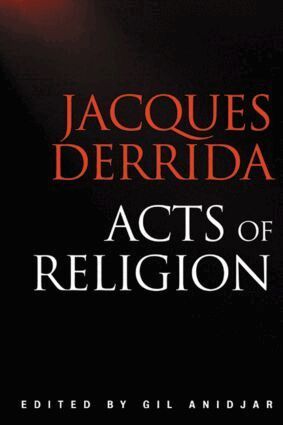
Acts of Religion, compiled in close association with Jacques Derrida, brings together for the first time a number of Derrida's writings on religion and questions of faith and their relation to philosophy and political culture. The essays discuss religious texts from Jewish, Christian, and Muslim traditions, as well as religious thinkers such as Kant, Levinas, and Gershom Scholem, and comprise pieces spanning Derrida's career. The collection includes two new essays by Derrida that appear here for the first time in any language, as well as a substantial introduction by Gil Anidjar that explores Derrida's return to his own "religious" origins and his attempts to bring to light hidden religious dimensions of the social, cultural, historical, and political.
632 kr
Skickas inom 10-15 vardagar
Acts of Religion, compiled in close association with Jacques Derrida, brings together for the first time a number of Derrida's writings on religion and questions of faith and their relation to philosophy and political culture. The essays discuss religious texts from Jewish, Christian, and Muslim traditions, as well as religious thinkers such as Kant, Levinas, and Gershom Scholem, and comprise pieces spanning Derrida's career. The collection includes two new essays by Derrida that appear here for the first time in any language, as well as a substantial introduction by Gil Anidjar that explores Derrida's return to his own "religious" origins and his attempts to bring to light hidden religious dimensions of the social, cultural, historical, and political.
'Our Place in Al-Andalus'
Kabbalah, Philosophy, Literature in Arab Jewish Letters
Inbunden, Engelska, 2002
1 730 kr
Skickas inom 10-15 vardagar
The year 1492 is only the last in a series of "ends" that inform the representation of medieval Spain in modern Jewish historical and literary discourses. These ends simultaneously mirror the traumas of history and shed light on the discursive process by which hermetic boundaries are set between periods, communities, and texts. This book addresses the representation of the twelfth and thirteenth centuries as the end of al-Andalus (Islamic Spain). Here, the end works to locate and separate Muslim from Christian Spain, Jews from Arabs, philosophy from Kabbalah, Kabbalah from literature, and texts from contexts.The book offers a reading of texts that emerge from its Andalusi, Jewish, and Arabic cultural sphere: Maimonides' Guide of the Perplexed; the major text of Kabbalah, the Zohar; and the Arabic rhymed prose narrative of Ibn al-Astarkuwi. The author argues that these texts are written in a language that disrupts the possibility of locating it in a pre-existing cultural situation, a recognizable literary tradition, or a particular genre.At stake are issues—texts and contexts—that have gained particular urgency in the writings of such recent thinkers as Walter Benjamin, Jacques Derrida, Giorgio Agamben, Jean-Luc Nancy, and Avital Ronell. The book reads the place and taking place of language, interrogating the notion of disappearing contexts and the view that language is derivative of its true place, the context that, having ended, is mourned as silent and lost.
'Our Place in Al-Andalus'
Kabbalah, Philosophy, Literature in Arab Jewish Letters
Häftad, Engelska, 2002
417 kr
Skickas inom 7-10 vardagar
The year 1492 is only the last in a series of "ends" that inform the representation of medieval Spain in modern Jewish historical and literary discourses. These ends simultaneously mirror the traumas of history and shed light on the discursive process by which hermetic boundaries are set between periods, communities, and texts. This book addresses the representation of the twelfth and thirteenth centuries as the end of al-Andalus (Islamic Spain). Here, the end works to locate and separate Muslim from Christian Spain, Jews from Arabs, philosophy from Kabbalah, Kabbalah from literature, and texts from contexts.The book offers a reading of texts that emerge from its Andalusi, Jewish, and Arabic cultural sphere: Maimonides' Guide of the Perplexed; the major text of Kabbalah, the Zohar; and the Arabic rhymed prose narrative of Ibn al-Astarkuwi. The author argues that these texts are written in a language that disrupts the possibility of locating it in a pre-existing cultural situation, a recognizable literary tradition, or a particular genre.At stake are issues—texts and contexts—that have gained particular urgency in the writings of such recent thinkers as Walter Benjamin, Jacques Derrida, Giorgio Agamben, Jean-Luc Nancy, and Avital Ronell. The book reads the place and taking place of language, interrogating the notion of disappearing contexts and the view that language is derivative of its true place, the context that, having ended, is mourned as silent and lost.
1 291 kr
Skickas inom 10-15 vardagar
Is there a concept of the enemy? To what discursive sphere would it belong? Or, if there is no concept of the enemy, what are the factors that could have prevented its articulation? Following the reflections of Carl Schmitt and Jacques Derrida on the theologico-political, and reading canonical texts from the Western philosophical, political, and religious traditions, the author seeks to account for the absence of a history of the enemy.The question of the enemy emerges in this book as contingent on the way Europe has related to both Jew and Arab as concrete enemies. Moreover, the author provocatively argues that the Jew and the Arab constitute the condition of religion and politics. Among the many strengths of the book is the timeliness of its profound study of contemporary actuality: the volume provides a basis for a philosophical understanding of the forces at work that produced and kindled current conflicts in Europe, the U.S., and the Middle East.
310 kr
Skickas inom 7-10 vardagar
Is there a concept of the enemy? To what discursive sphere would it belong? Or, if there is no concept of the enemy, what are the factors that could have prevented its articulation? Following the reflections of Carl Schmitt and Jacques Derrida on the theologico-political, and reading canonical texts from the Western philosophical, political, and religious traditions, the author seeks to account for the absence of a history of the enemy.The question of the enemy emerges in this book as contingent on the way Europe has related to both Jew and Arab as concrete enemies. Moreover, the author provocatively argues that the Jew and the Arab constitute the condition of religion and politics. Among the many strengths of the book is the timeliness of its profound study of contemporary actuality: the volume provides a basis for a philosophical understanding of the forces at work that produced and kindled current conflicts in Europe, the U.S., and the Middle East.
207 kr
Skickas inom 5-8 vardagar
This collection of essays explores the now mostly extinct notion of "Semites." Invented in the nineteenth century and essential to the making of modern conceptions of religion and race, the strange unity of Jew and Arab under one term, "Semite" (the opposing term was "Aryan"), and the circumstances that brought about its disappearance constitute the subject of this volume. With a focus on the history of disciplines (including religious studies and Jewish studies), as well as on lingering political, theological, and cultural effects (secularism, anti-Semitism, Israel/Palestine), Semites: Race, Religion, and Literature turns to the literary imagination as the site of a fragile and tenuous alternative, the promise of something like a "Semitic perspective."