Gila Safran Naveh – författare
Visar alla böcker från författaren Gila Safran Naveh. Handla med fri frakt och snabb leverans.
3 produkter
3 produkter
Biblical Parables and Their Modern Re-creations
From "Apples of Gold in Silver Settings" to "Imperial Messages"
Häftad, Engelska, 1999
440 kr
Tillfälligt slut
Offers a penetrating cross-cultural analysis of the enduring genre of parables, revealing a dramatic social, cultural, and political shift in the way we view the divine.In Biblical Parables and Their Modern Re-creations, Gila Safran Naveh carefully charts the historical transformation of these deceptively simple narratives to reveal fundamental shifts in their form, function, and most significantly, their readers' cognitive processes. Bringing together for the first time parables from the Scriptures, the synoptic Gospels, Chassidic tales, and medieval philosophy with the mashal, the rabbinic parables commonly used to interpret Scripture, this book brilliantly contrasts the rhetorical strategies of ancient parables with more recent examples of the genre by Kafka, Borges, Calvino, and Agnon. By using an interdisciplinary approach and insights from current semiotic, linguistic, psychoanalytic, and gender theories, Naveh reveals a dramatic social, cultural, and political shift in the way we view the divine.
Del 33 - Studies in Linguistics and Philosophy
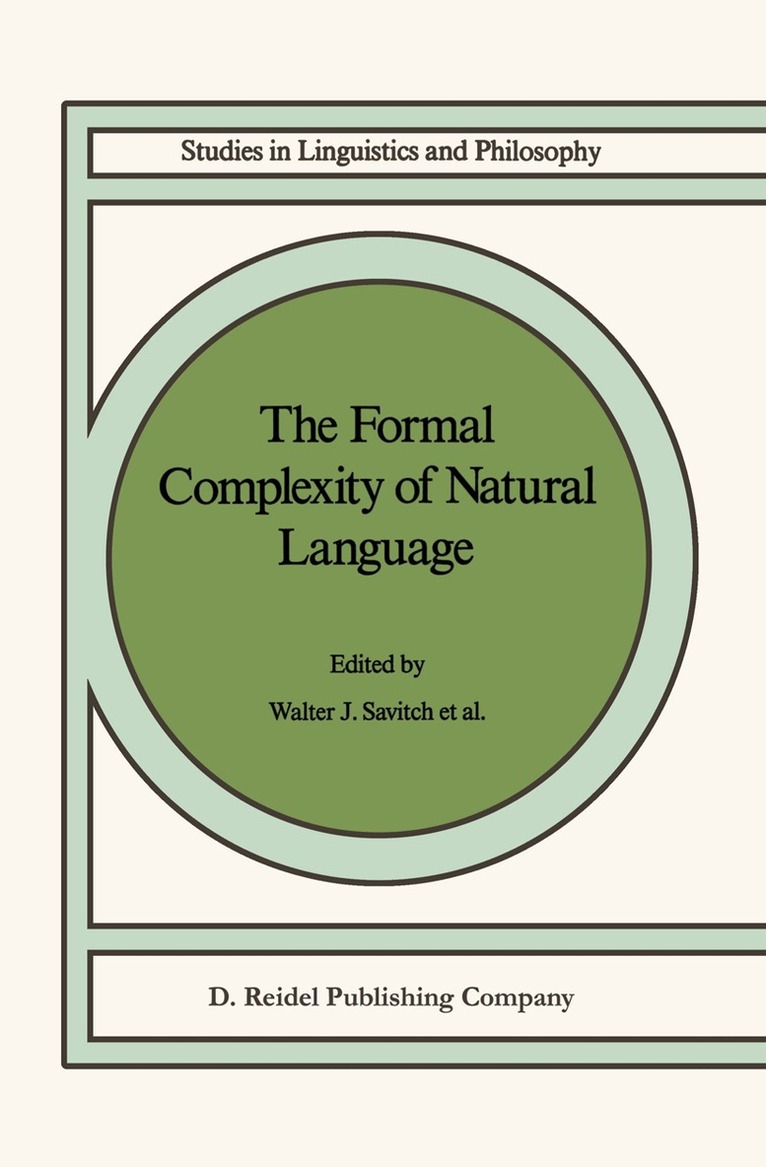
Formal Complexity of Natural Language
Inbunden, Engelska, 1987
1 637 kr
Skickas inom 10-15 vardagar
Ever since Chomsky laid the framework for a mathematically formal theory of syntax, two classes of formal models have held wide appeal. The finite state model offered simplicity. At the opposite extreme numerous very powerful models, most notable transformational grammar, offered generality. As soon as this mathematical framework was laid, devastating arguments were given by Chomsky and others indicating that the finite state model was woefully inadequate for the syntax of natural language. In response, the completely general transformational grammar model was advanced as a suitable vehicle for capturing the description of natural language syntax. While transformational grammar seems likely to be adequate to the task, many researchers have advanced the argument that it is "too adequate. " A now classic result of Peters and Ritchie shows that the model of transformational grammar given in Chomsky's Aspects [IJ is powerful indeed. So powerful as to allow it to describe any recursively enumerable set. In other words it can describe the syntax of any language that is describable by any algorithmic process whatsoever. This situation led many researchers to reasses the claim that natural languages are included in the class of transformational grammar languages. The conclu sion that many reached is that the claim is void of content, since, in their view, it says little more than that natural language syntax is doable algo rithmically and, in the framework of modern linguistics, psychology or neuroscience, that is axiomatic.
1 637 kr
Skickas inom 10-15 vardagar
Ever since Chomsky laid the framework for a mathematically formal theory of syntax, two classes of formal models have held wide appeal. The finite state model offered simplicity. At the opposite extreme numerous very powerful models, most notable transformational grammar, offered generality. As soon as this mathematical framework was laid, devastating arguments were given by Chomsky and others indicating that the finite state model was woefully inadequate for the syntax of natural language. In response, the completely general transformational grammar model was advanced as a suitable vehicle for capturing the description of natural language syntax. While transformational grammar seems likely to be adequate to the task, many researchers have advanced the argument that it is "too adequate. " A now classic result of Peters and Ritchie shows that the model of transformational grammar given in Chomsky's Aspects [IJ is powerful indeed. So powerful as to allow it to describe any recursively enumerable set. In other words it can describe the syntax of any language that is describable by any algorithmic process whatsoever. This situation led many researchers to reasses the claim that natural languages are included in the class of transformational grammar languages. The conclu sion that many reached is that the claim is void of content, since, in their view, it says little more than that natural language syntax is doable algo rithmically and, in the framework of modern linguistics, psychology or neuroscience, that is axiomatic.