H. Segers - Böcker
Visar alla böcker från författaren H. Segers. Handla med fri frakt och snabb leverans.
4 produkter
4 produkter
2 101 kr
Skickas inom 10-15 vardagar
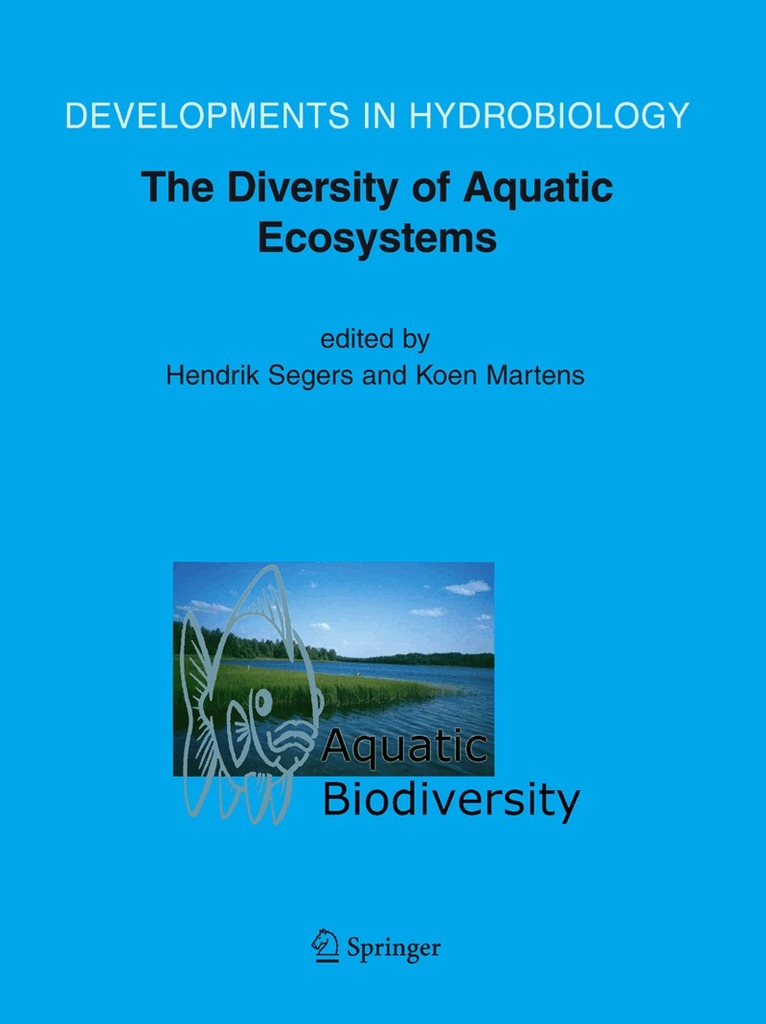
Freshwater Biodiversity is a much underestimated component of global biodiversity, both in its diversity and in its potential to act as models for fundamental research in evolutionary biology and ecosystem studies. Freshwater organisms also reflect quality of water bodies and can thus be used to monitor changes in ecosystem health. The present book comprises a unique collection of primary research papers spanning a wide range of topics in aquatic biodiversity studies, and including a first global assessment of specific diversity of freshwater animals. The book also presents a section on the interaction between scientists and science policy managers. A target opinion paper lists priorities in aquatic biodiversity research for the next decade and several reactions from distinguished scientists discuss the relevance of these items from different points of view: fundamental ecology, taxonomy and systematics, needs of developing countries, present-day biodiversity policy at European andat global scales. It is believed that such a platform for the interaction between science and science policy is an absolute necessity for the efficient use of research budgets in the future.
2 101 kr
Skickas inom 10-15 vardagar
such as ?oodplains and temporary ponds) challenge this de?nition. Our decision has been to include such The term 'aquatic macrophytes' refers to a diverse species as "aquatic macrophytes", only if their group of aquatic photosynthetic organisms, all large environmental survival is clearly dependent upon enough to see with the naked eye. It includes regular re?lling of their aquatic habitat with a source macroalgae of the divisions Chlorophyta (green of fresh to brackish water. algae), Xanthophyta (yellow-green algae) and Rho- The freshwater macroalgae are primarily rep- dophyta (red algae) and the "blue-green algae" (more sented by the green algae, especially the Charales, correctly known as Cyanobacteria), Bryophyta commonly known as the stoneworts or brittleworts (mosses and liverworts), Pteridophyta (ferns) and (e.g., Chara and Nitella spp.).The Charales are often Spermatophyta (seed-bearing plants), the vegetative mistaken for higher plants because they have erect parts of which actively grow either permanently or central stalks that are divided into short nodes and periodically (for at least several weeks each year) long internodes of elongated multinucleate cells, with submerged below, ?oating on, or growing up through a whorl of "branchlets" at each node (Fig. 1).
2 101 kr
Skickas inom 10-15 vardagar
Freshwater Biodiversity is a much underestimated component of global biodiversity, both in its diversity and in its potential to act as models for fundamental research in evolutionary biology and ecosystem studies. Freshwater organisms also reflect quality of water bodies and can thus be used to monitor changes in ecosystem health. The present book comprises a unique collection of primary research papers spanning a wide range of topics in aquatic biodiversity studies, and including a first global assessment of specific diversity of freshwater animals. The book also presents a section on the interaction between scientists and science policy managers. A target opinion paper lists priorities in aquatic biodiversity research for the next decade and several reactions from distinguished scientists discuss the relevance of these items from different points of view: fundamental ecology, taxonomy and systematics, needs of developing countries, present-day biodiversity policy at European andat global scales. It is believed that such a platform for the interaction between science and science policy is an absolute necessity for the efficient use of research budgets in the future.
2 101 kr
Skickas inom 10-15 vardagar
such as ?oodplains and temporary ponds) challenge this de?nition. Our decision has been to include such The term 'aquatic macrophytes' refers to a diverse species as "aquatic macrophytes", only if their group of aquatic photosynthetic organisms, all large environmental survival is clearly dependent upon enough to see with the naked eye. It includes regular re?lling of their aquatic habitat with a source macroalgae of the divisions Chlorophyta (green of fresh to brackish water. algae), Xanthophyta (yellow-green algae) and Rho- The freshwater macroalgae are primarily rep- dophyta (red algae) and the "blue-green algae" (more sented by the green algae, especially the Charales, correctly known as Cyanobacteria), Bryophyta commonly known as the stoneworts or brittleworts (mosses and liverworts), Pteridophyta (ferns) and (e.g., Chara and Nitella spp.).The Charales are often Spermatophyta (seed-bearing plants), the vegetative mistaken for higher plants because they have erect parts of which actively grow either permanently or central stalks that are divided into short nodes and periodically (for at least several weeks each year) long internodes of elongated multinucleate cells, with submerged below, ?oating on, or growing up through a whorl of "branchlets" at each node (Fig. 1).