Henning Grosse Ruse-Khan - Böcker
Visar alla böcker från författaren Henning Grosse Ruse-Khan. Handla med fri frakt och snabb leverans.
7 produkter
7 produkter
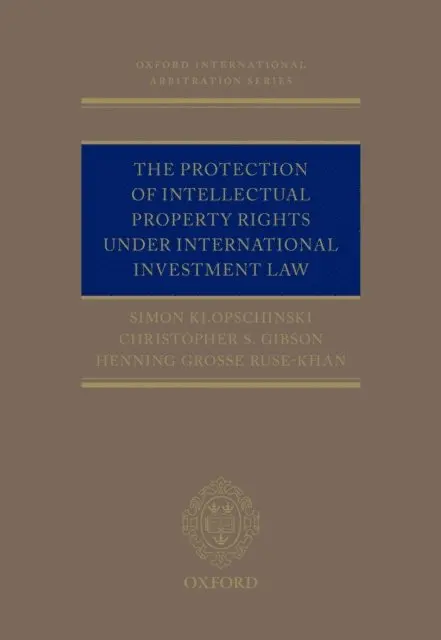
The Protection of Intellectual Property Rights Under International Investment Law
Inbunden, Engelska, 2020
2 821 kr
Skickas inom 3-6 vardagar
In recent decades, foreign direct investment (FDI) has played an increasingly significant role in world economic activity and development. In economic terms, the accumulated stock of FDI and its generation of commercial activity by foreign affiliates have made FDI comparatively more important than international trade in goods and services. At the same time, the globalization of markets and the development of consumer brands in many domestic markets has brought an increasingly international approach to the management, and value, of intellectual property (IP) rights. IP Rights have therefore become increasingly enmeshed with international investment and the subject of transnational disputes as evidenced by cases that concern, inter alia, various limitations for trademarks used on tobacco packaging, or the invalidation of pharmaceutical patents by domestic courts. FDI is increasingly involved with the exploitation of IP which underpins highly valued products and services and this has shifted the balance of return on FDI from physical to intellectual property. Thus, IP rights have never been more economically and politically important or controversial than they are today.There have long been international treaties that protect IP, but in recent years other international treaties have come into being that protect IP rights along with other property rights. These treaties include various international investment agreements (IIAs), which regard IP rights as a protected investment.This book analyses the standards of treatment and protection enshrined in IIAs for IP rights and their relationship to the key international treaties in IP Rights, with reference to topics such as the fragmentation of international law; investor-host-state dispute resolution; investors and investments; relative standards of treatment (such as most favoured nation); absolute standards of treatment (such as fair and equitable treatment); and expropriation. The work fills the significant gaps left by the comparably small amount of intellectual property related ISDS case-law. As IP Rights are a more recent concern in FDI, many questions regarding the relevance of IIA for IP rights are yet to be decided by investment tribunals. To assist the practitioner in understanding how IP Rights will be treated in investment disputes, the work sets out a number of hypothetical cases based on actual cases decided by other adjudicating bodies in different legal contexts, such the European Court of Human Rights or the European Court of Justice and the work also engages with the issues and applicable law for disputes involving IP Rights arising from the actions relating to Philip Morris trademarks in Australia and Uruguay, and Eli Lilly.
2 979 kr
Skickas inom 5-8 vardagar
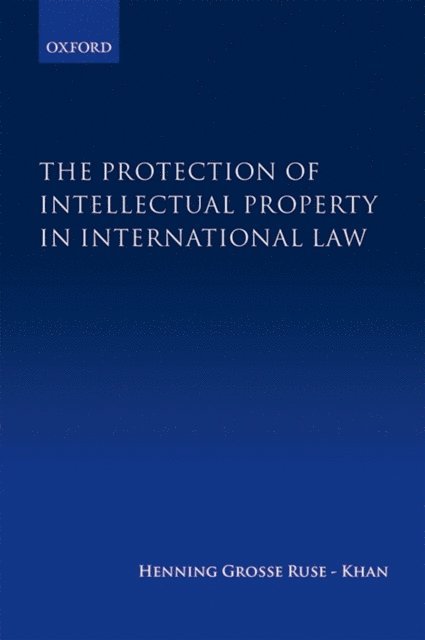
This book examines intellectual property (IP) protection in the broader context of international law. Against the background of the debate about norm relations within and between different rule systems in international law, it construes a holistic view of international IP law as an integral part of the international legal system. The first part sets out the theoretical foundation for such a holistic view by offering several methodological frameworks for the analysis of norm relations in international law. These frameworks allow for different ways to conceptualise the linkages amongst international IP rules and those to other areas of international law. Part two then considers norm relations within the international IP system. It analyses the relationship of the two main IP conventions to the World Trade Organisation (WTO) Agreement on Trade Related Aspects of International Property Rights (TRIPS), as well as the relationship between TRIPS and Free Trade Agreements (FTAs). The third part discusses alternative rule systems for the protection of IP in international law: the intellectual creations element of IP is captured by the concept of creator's rights in international human rights law; while the property aspect of IP is protected by international investment agreements as well as European human rights treaties. Part four focuses on three core intersections between the international IP system and other areas of international law related to environmental, social and economic concerns. The areas examined concern international law on trade, biological diversity and climate change. As in part three, the perspective taken is that of the 'other' area and how it perceives its relations with international IP norms. In part five finally, the focus shifts back to the international IP system and the mechanisms it provides for taking into account the interests protected in other areas of international law.
1 387 kr
Skickas inom 7-10 vardagar
During the past century, intellectual property (IP) law has expanded within and beyond national borders. The field of IP law was once a niche area concerning authors, inventors, and trademark owners. Today, IP law acts as a complex regime of instruments, institutions, and actors that negotiate overlapping, diverging, and occasionally competing public policies on a global scale. As IP continues to expand beyond borders, the instruments and tools utilised for its global protection rely on public international law as the common denominator and unifying frame. Intellectual Property Ordering Beyond Borders provides an evaluation of the most pertinent public international law questions raised by this multidimensional expansion. This comprehensive and far-reaching volume tackles problems such as generalist approaches under the law of treaties; custom and general principles; interfaces between IP and other normative orders, such as trade and investment; and interdisciplinary accounts from the economic, political, and social science perspectives. This title is also available as open access on Cambridge Core.
Del 3994 - Europaeische Hochschulschriften Recht
Der Europaeische Investitionsschutz Fuer Datenbanken VOR Dem Hintergrund Internationaler Abkommen
Häftad, Tyska, 2004
731 kr
Tillfälligt slut
Nutzergenerierte Inhalte als Gegenstand des Privatrechts
Aktuelle Probleme des Web 2.0
Inbunden, Tyska, 2010
825 kr
Skickas inom 10-15 vardagar
Das Phänomen der nutzergenerierten Inhalte, erlangt immer stärkere Bedeutung und stellt das Recht täglich vor neue Herausforderungen. Es umfasst nicht nur Blogs, Wikis und Videoportale wie YouTube und MyVideo, sondern auch soziale Netzwerke wie MySpace sowie andere Plattformen, in denen Nutzer interagieren und/oder kollektiv Inhalte schaffen und somit zunehmend die Rolle des passiven Rezipienten verlassen und zum Produzenten ihrer eigenen Beiträge werden. Der „Prosument“ hat also die Bühne betreten und er hat eine Menge juristischer Probleme und Fragen in seinem Gepäck, denn das veränderte Nutzerverhalten und die neuartigen Rahmenbedingungen bei der Produktion von Medieninhalten birgt nicht nur aus urheberrechtlicher sondern auch aus kollisionsrechtlicher und haftungsrechtlicher Sicht eine Vielzahl von Fragen, welchen die Autoren dieses Bandes nachgehen und welche sie zu lösen versuchen.
Del 20 - MPI Studies on Intellectual Property and Competition Law
EU Bilateral Trade Agreements and Intellectual Property: For Better or Worse?
Inbunden, Engelska, 2013
1 452 kr
Skickas inom 10-15 vardagar
This book focuses on a new generation of bilateral and regional agreements negotiated by the EU with developing countries and which include intellectual property (IP) provisions setting standards exceeding those of the TRIPS Agreement. The contributions critically analyse the IP standards found in these agreements; their potential for reforming the international IP system; the implications for the multilateral IP system and other areas of international law such as human rights; and the often neglected topic of implementing the IP obligations in these agreements.
1 452 kr
Skickas inom 10-15 vardagar
This book focuses on a new generation of bilateral and regional agreements negotiated by the EU with developing countries and which include intellectual property (IP) provisions setting standards exceeding those of the TRIPS Agreement. The contributions critically analyse the IP standards found in these agreements; their potential for reforming the international IP system; the implications for the multilateral IP system and other areas of international law such as human rights; and the often neglected topic of implementing the IP obligations in these agreements.