Hugh T. Patrick - Böcker
Visar alla böcker från författaren Hugh T. Patrick. Handla med fri frakt och snabb leverans.
6 produkter
6 produkter
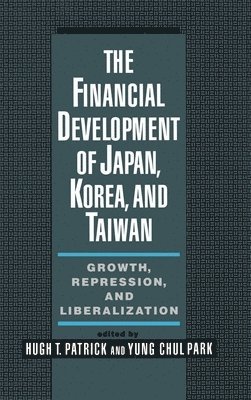
The Financial Development of Japan, Korea, and Taiwan
Growth, Repression, and Liberalization
Inbunden, Engelska, 1994
2 438 kr
Skickas inom 5-8 vardagar
This path-breaking comparative study of the economies of Japan, Korea, and Taiwan analyses the evolution of the financial systems of each country in relation to their last four decades of dynamic economic growth. Each country study is addressed in two chapters, the first covering macroeconomic aspects of the financial system and the second chapter focusing on commercial banking. The analysis shows how financial development has occurred in two distinct phases. Initially interest rates were regulated to remain below market levels, entry of new financial institutions was restricted, financial markets were segmented, and domestic finance was insulated from world financial markets. The second phase has seen a steady, if sometimes slow, removal of these restrictions. This liberalization has meant regulation now focuses on prudential measures for system safety while financial resources are increasingly allocated through the marketplace. The evaluation of the financial development of Japan, Korea and Taiwan provides significant insights for economists and policymakers. In particular, there are many lessons for less developed markets and transforming socialist economics.
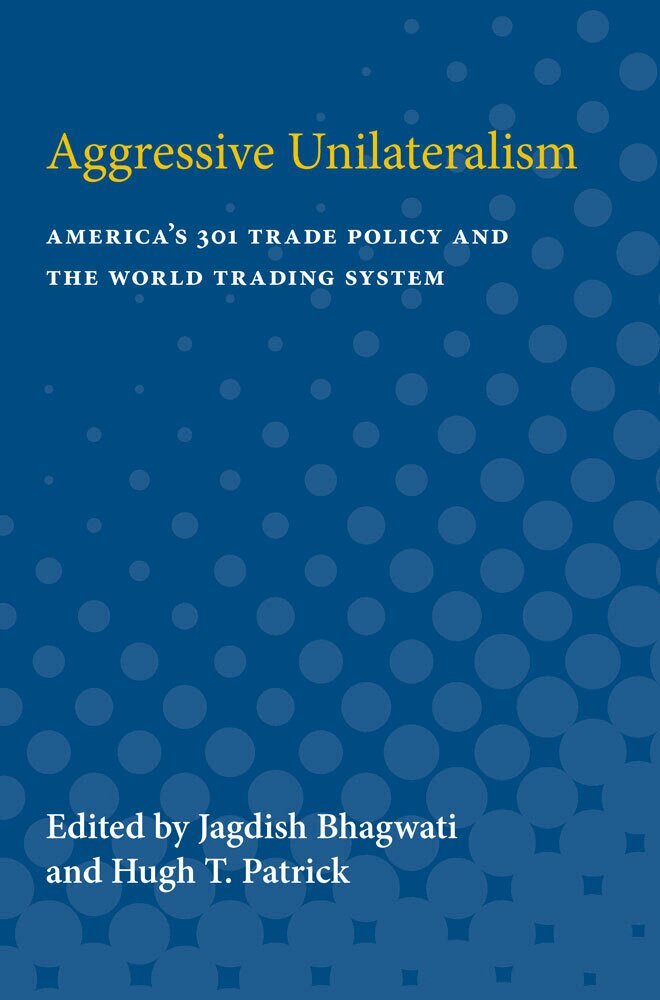
Aggressive Unilateralism
America's 301 Trade Policy and the World Trading System
Häftad, Engelska, 1991
271 kr
Skickas inom 7-10 vardagar
United States trade policy has moved in recent years toward aggressive unilateralism. This volume provides the most comprehensive, coherent, and insightful analysis of this dramatic development. The essays collected here explain the legislative history of this policy as expressed in Section 301 and the more recent Super 301 and explore the political forces driving their adoption on Capitol Hill. The targeting of Japan, India, and Brazil by the administration using Super 301 powers is discussed, as are the reactions of those countries to this targeting. These American actions raise questions about the legality of such tariff retaliation under GATT rules and about America’s simultaneous support of multilateral talks at the Uruguay Round intended to reconstitute and revitalize the GATT.
2 181 kr
Skickas inom 10-15 vardagar
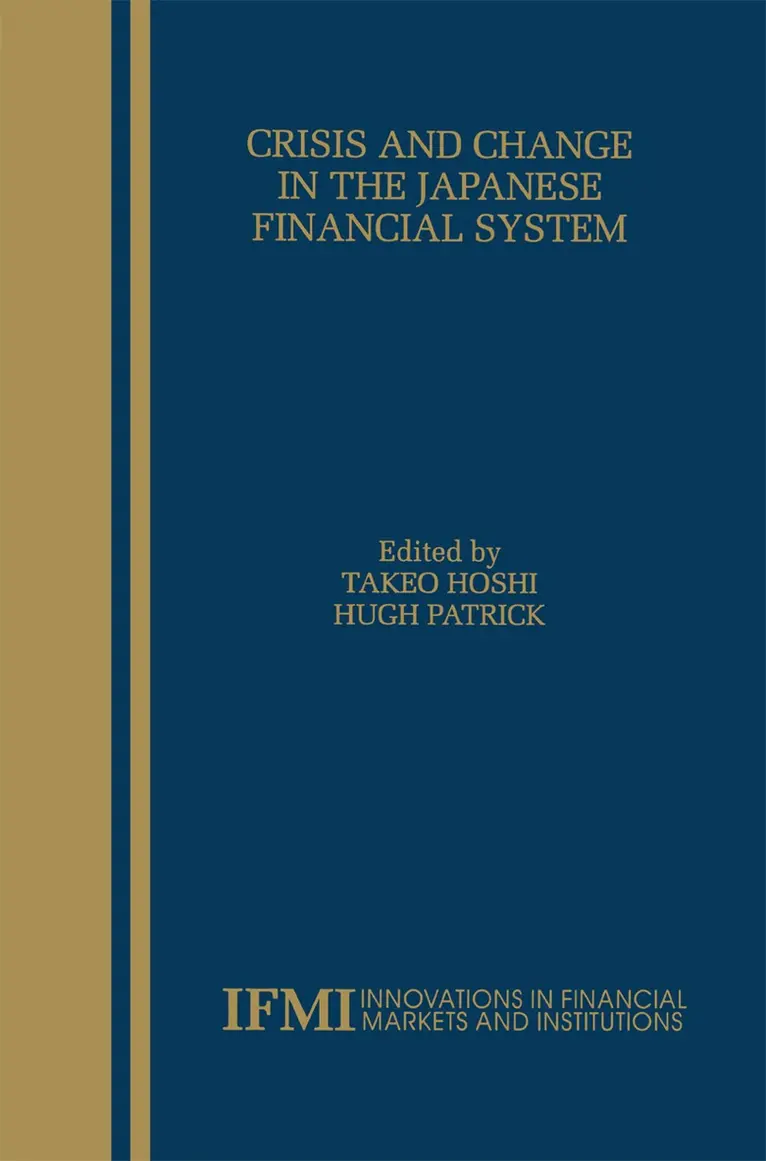
At the start of the 21st century, the Japanese financial system is undergoing a major transformation. This process is spurred by a sense of crisis. Dominated by large institutions, the Japanese banking system has suffered from serious problems with non-performing loans since the early 1990s, when the Japanese stock market and urban real estate market both crashed. Delays in responding to these twin asset bubbles, by both regulatory authorities and the banks themselves, made matters worse and led to a banking crisis in late 1997 and early 1998. Not anticipating this setback, in late 1996 the Japanese government inaugurated its Big Bang of comprehensive financial deregulation designed to complete the process of creating "free, fair, and open financial markets". Beginning in late 1998 and early 1999 the government finally embarked on a major rehabilitation of the Japanese banking system, including making available some 60 trillion yen (approximately US$ 500 billion) of government funds to recapitalize 15 major banks, adequately fund the deposit insurance programme, and write off the bad loans of nationalized or bankrupted banks.One result of this reform process is that the Ministry of Finance (MOF), which dominated Japanese financial system policy for most of the post-war period, has been stripped of the majority of its former regulatory powers. The purpose of this book is to describe, analyze and evaluate the process that is transforming the Japanese financial system. The chapters address various issues relating to the transition of the Japanese financial system from a bank-centered and relationship-based system to a competitive market-based system. Questions taken up include: Why did Japanese banks get into such serious trouble? Why has the MOF lost its immense power? How will the Big Bang's financial deregulation further change the Japanese financial system, including the huge government financial institutions and postal savings system? What are some of the broader implications of this transition? The book is divided into three parts: Part I considers the origins of Japan's banking crisis; Part II focuses on five particularly important areas of major actual and potential changes; Part III addresses the effects of the Big Bang, including its potential systemic externalities.Taken together, this book offers comprehensive and thorough appraisal and evaluation of the profound changes occurring in Japan's financial system.
1 638 kr
Skickas inom 10-15 vardagar
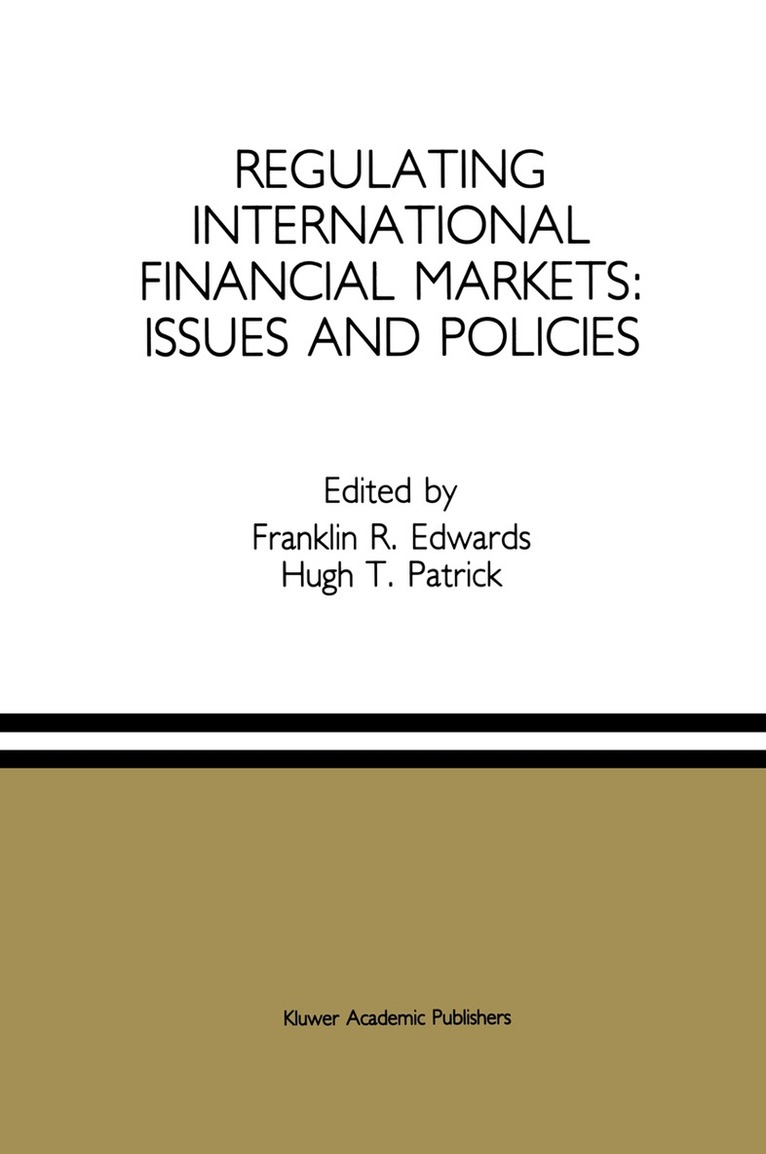
Franklin R. Edwards Hugh T. Patrick As the 19908 unfold, we stand on the threshold of a new age of global financial markets. The seeminglyinevitable, market-driven dynamicofthe international integration of banking, securities, and futures markets is bringing about a profound transformation of financial flows and the efficiency and effectiveness of the domestic and international markets serving them. Propelled in the 1980s by a variety offorces-technological, economic, political, and (de)regulatory-the implications of international financial market integration are pervasive. This new era promises to raise a host of new public and business policy issues as well as opportunities. These include issues of financial market integrity, international competitiveness, and regulatory harmony. What will the rules of the game be? How will prudential concerns for the safety as well as the efficiency of international financial markets, and their national counterparts, be met? What are the appropriate new institutional arrangements? How and to what degree will international financial mar kets be supervised, harmonized, and regulated, and for what purposes? Whowill be makingthese decisions andimplementingthem?Thesearethe issues that confront-and bedevil-policymakers, practitioners, and scho lars alike. 1 2 INTRODUcnON The Context The 1980s were witness to major transformations of the international political, economic, andfinancial environment. Amongthe majordevelop ments was rapidly increasing international financial market integration across major nations and across financial product markets. The major sources of financial change were several, interrelated, and reinforcing.
2 163 kr
Skickas inom 10-15 vardagar
At the start of the twenty-first century, the Japanese financial system is undergoing a major transformation. This process is spurred by a sense of crisis. Dominated by large institutions, the Japanese banking system has suffered from serious problems with non-performing loans since the early 1990s, when the Japanese stock market and urban real estate market both crashed. Delays in responding to these twin asset bubbles, by both regulatory authorities and the banks themselves, made matters worse and led to a banking crisis in late 1997 and early 1998. Not anticipating this setback, in late 1996 the Japanese government inaugurated its Big Bang of comprehensive financial deregulation designed to complete the process of creating `free, fair, and open financial markets'. Beginning in late 1998 and early 1999 the government finally embarked on a major rehabilitation of the Japanese banking system, including making available some Yen 60 trillion (approximately USD 500 billion) of government funds to recapitalize fifteen major banks, adequately fund the deposit insurance program, and write off the bad loans of nationalized or bankrupted banks. One result of this reform process is that the Ministry of Finance (MOF), which dominated Japanese financial system policy for most of the post-war period, has been stripped of most of its former regulatory powers. The purpose of this book is to describe, analyze, and evaluate the process that is transforming the Japanese financial system. The chapters address various issues relating to the transition of the Japanese financial system from a bank-centered and relationship-based system to a competitive market-based system. Questions taken up include: Why did Japanese banks get into such serious trouble? Why has the MOF lost its immense power? How will the Big Bang's financial deregulation further change the Japanese financial system, including the huge government financial institutions and postal savings system? What are some of the broader implications of this transition? The book is divided into three parts: Part I considers the origins of Japan's banking crisis; Part II focuses on five particularly important areas of major actual and potential changes; Part III addresses the effects of the Big Bang, including its potential systemic externalities. Taken together, this book offers an unusually up-to-date, comprehensive and thorough appraisal and evaluation of the profound changes occurring in Japan's financial system.
1 624 kr
Skickas inom 10-15 vardagar
Franklin R. Edwards Hugh T. Patrick As the 19908 unfold, we stand on the threshold of a new age of global financial markets. The seeminglyinevitable, market-driven dynamicofthe international integration of banking, securities, and futures markets is bringing about a profound transformation of financial flows and the efficiency and effectiveness of the domestic and international markets serving them. Propelled in the 1980s by a variety offorces-technological, economic, political, and (de)regulatory-the implications of international financial market integration are pervasive. This new era promises to raise a host of new public and business policy issues as well as opportunities. These include issues of financial market integrity, international competitiveness, and regulatory harmony. What will the rules of the game be? How will prudential concerns for the safety as well as the efficiency of international financial markets, and their national counterparts, be met? What are the appropriate new institutional arrangements? How and to what degree will international financial mar kets be supervised, harmonized, and regulated, and for what purposes? Whowill be makingthese decisions andimplementingthem?Thesearethe issues that confront-and bedevil-policymakers, practitioners, and scho lars alike. 1 2 INTRODUcnON The Context The 1980s were witness to major transformations of the international political, economic, andfinancial environment. Amongthe majordevelop ments was rapidly increasing international financial market integration across major nations and across financial product markets. The major sources of financial change were several, interrelated, and reinforcing.