Jack H. Botting – författare
Visar alla böcker från författaren Jack H. Botting. Handla med fri frakt och snabb leverans.
10 produkter
Selective COX-2 Inhibitors
Av William Harvey Research Conference, J.R. Vane m. fl.
Inbunden, 1998
1241 kr
Lägg i varukorg
This volume is the proceedings of the William Harvey Research Conference held in Cannes, France, on the 20th and 21st March, 1997. It describes the present knowledge of the structures of the cyclooxygenase isoforms and the experimental and clinical effects of selective inhibitors of …
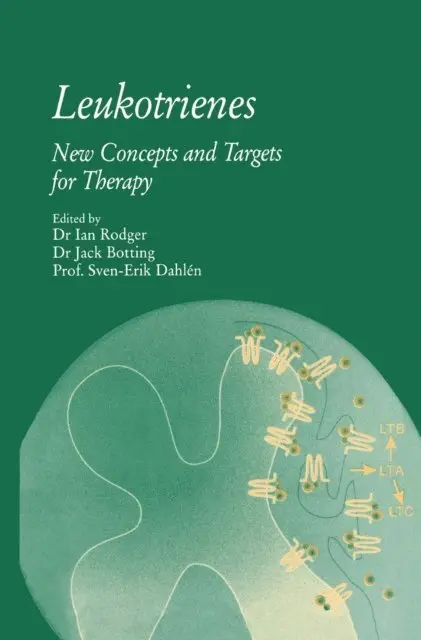
Leukotrienes
New Concepts and Targets for Therapy
Av Ian Rodger, Jack H. Botting m. fl.
Inbunden, 1998
1690 kr
Lägg i varukorg
This volume contains the proceedings of the William Harvey Research Conference held in London on the 12th and 13th June 1997. It covers the biosynthesis of leukotrienes, their release in pathological conditions, progress in the characterization of leukotriene receptors, and the elucidation of …
Selective COX-2 Inhibitors
Pharmacology, Clinical Effects and Therapeutic Potential
Av Sir John R. Vane, Jack H. Botting
Häftad, 2012
1126 kr
Lägg i varukorg
The mainstay of therapy for rheumatoid disease is the non-steroid antiinflammatory drugs (NSAIDs), despite their inherent gastrointestinal toxicity and ability to cause renal damage in susceptible patients. The theory that the beneficial and toxic effects of NSAIDs stem from a reduction in …
Leukotrienes
New Concepts and Targets for Therapy
Av Ian Rodger, Jack H. Botting m. fl.
Häftad, 2013
1685 kr
Lägg i varukorg
In the two decades since the elusive "slow reacting substance of anaphylaxis" (SRS-A) was identified as a product of the action of the 5-lipoxygenase enzyme on arachidonic acid, it has been well established that the leukotrienes are key mediators of both alIergy and inflammation. Their release by …
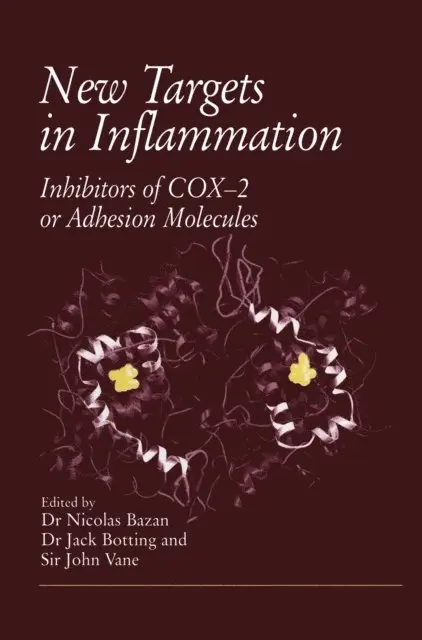
New Targets in Inflammation
Inhibitors of COX-2 or Adhesion Molecules Proceedings of a conference held on April 15–16, 1996, in New Orleans, USA, supported by an educational grant from Boehringer Ingelheim
Av N. Bazan, Jack H. Botting m. fl.
Häftad, 2012
1126 kr
Lägg i varukorg
For the past 100 years the mainstay of therapy for rheumatoid arthritis (RA) has been aspirin or other drugs of the non-steroid anti-inflammatory group. In 1971 Vane pro posed that both the beneficial and toxic actions of these drugs was through inhibition of prostaglandin synthesis. The recent …
Improved Non-Steroid Anti-Inflammatory Drugs: COX-2 Enzyme Inhibitors
Av R.M. Botting, Jack H. Botting m. fl.
E-bok, 2012
1502 kr
Lägg i varukorg
In 1971, Vane proposed that the mechanism of action of the aspirin-like drugs was through their inhibition of prostaglandin biosynthesis. Since then, there has been intense interest in the interaction between this diverse group of inhibitors and the enzyme known as cyclooxygenase (COX). It exists …
Improved Non-Steroid Anti-Inflammatory Drugs: COX-2 Enzyme Inhibitors
Av Sir John R. Vane, Jack H. Botting m. fl.
Häftad, 2011
1126 kr
Lägg i varukorg
In 1971, Vane proposed that the mechanism of action of the aspirin-like drugs was through their inhibition of prostaglandin biosynthesis. Since then, there has been intense interest in the interaction between this diverse group of inhibitors and the enzyme known as cyclooxygenase (COX). It exists …
Selective COX-2 Inhibitors
Pharmacology, Clinical Effects and Therapeutic Potential
Av Jack H. Botting, Sir John R. Vane
E-bok, 2012
1502 kr
Lägg i varukorg
The mainstay of therapy for rheumatoid disease is the non-steroid antiinflammatory drugs (NSAIDs), despite their inherent gastrointestinal toxicity and ability to cause renal damage in susceptible patients. The theory that the beneficial and toxic effects of NSAIDs stem from a reduction in …
Leukotrienes
New Concepts and Targets for Therapy
Av Sven-Erik Dahlen, Jack H. Botting m. fl.
E-bok, 2012
2174 kr
Lägg i varukorg
In the two decades since the elusive "slow reacting substance of anaphylaxis" (SRS-A) was identified as a product of the action of the 5-lipoxygenase enzyme on arachidonic acid, it has been well established that the leukotrienes are key mediators of both alIergy and inflammation. Their release by …
New Targets in Inflammation
Inhibitors of COX-2 or Adhesion Molecules Proceedings of a conference held on April 15–16, 1996, in New Orleans, USA, supported by an educational grant from Boehringer Ingelheim
Av Sir John R. Vane, Jack H. Botting m. fl.
E-bok, 2012
1455 kr
Lägg i varukorg
For the past 100 years the mainstay of therapy for rheumatoid arthritis (RA) has been aspirin or other drugs of the non-steroid anti-inflammatory group. In 1971 Vane pro posed that both the beneficial and toxic actions of these drugs was through inhibition of prostaglandin synthesis. The recent …