John Guillory - Böcker
Visar alla böcker från författaren John Guillory. Handla med fri frakt och snabb leverans.
8 produkter
8 produkter
281 kr
Skickas inom 7-10 vardagar
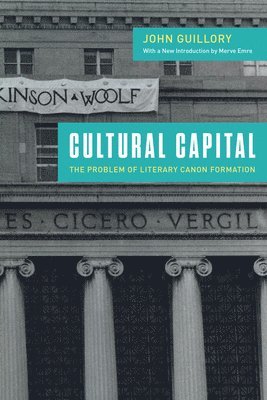
An enlarged edition to celebrate the thirtieth anniversary of John Guillory’s formative text on the literary canon.Since its publication in 1993, John Guillory’s Cultural Capital has been a signal text for understanding the codification and uses of the literary canon. Cultural Capital reconsiders the social basis for aesthetic judgment and exposes the unequal distribution of symbolic and linguistic knowledge on which culture has long been based. Drawing from Pierre Bourdieu’s sociology, Guillory argues that canon formation must be understood less as a question of the representation of social groups and more as a question of the distribution of cultural capital in schools, which regulate access to literacy, to the practices of reading and writing. Now, as the crisis of the canon has evolved into the so-called crisis of the humanities, Guillory’s groundbreaking, incisive work has never been more urgent. As scholar and critic Merve Emre writes in her introduction to this enlarged edition: “Exclusion, selection, reflection, representation—these are the terms on which the canon wars of the last century were fought, and the terms that continue to inform debates about, for instance, decolonizing the curriculum and the rhetoric of antiracist pedagogy.”
664 kr
Skickas inom 3-6 vardagar
John Guillory challenges the most fundamental premises of the canon debate by resituating the problem of canon formation in an entirely new theoretical framework. The result is a book that promises to recast not only the debate about the literary curriculum but also the controversy over "multiculturalism" and the current "crisis of the humanities." Employing concepts drawn from Pierre Bourdieu's sociology, Guillory argues that canon formation must be understood less as a question of the representation of social groups than as a question of the distribution of "cultural capital" in the schools, which regulate access to literacy, to the practices of reading and writing.
1 144 kr
Skickas inom 7-10 vardagar
A sociological history of literary study—both as a discipline and as a profession. As the humanities in higher education struggle with a labor crisis and with declining enrollments, the travails of literary study are especially profound. No scholar has analyzed the discipline’s contradictions as authoritatively as John Guillory. In this much-anticipated new book, Guillory shows how the study of literature has been organized, both historically and in the modern era, both before and after its professionalization. The traces of this volatile history, he reveals, have solidified into permanent features of the university. Literary study continues to be troubled by the relation between discipline and profession, both in its ambivalence about the literary object and in its anxious embrace of a professionalism that betrays the discipline’s relation to its amateur precursor: criticism. In a series of timely essays, Professing Criticism offers an incisive explanation for the perennial churn in literary study, the constant revolutionizing of its methods and objects, and the permanent crisis of its professional identification. It closes with a robust outline of five key rationales for literary study, offering a credible account of the aims of the discipline and a reminder to the professoriate of what they already do, and often do well.
272 kr
Skickas inom 7-10 vardagar
A sociological history of literary study—both as a discipline and as a profession. As the humanities in higher education struggle with a labor crisis and with declining enrollments, the travails of literary study are especially profound. No scholar has analyzed the discipline’s contradictions as authoritatively as John Guillory. In this much-anticipated new book, Guillory shows how the study of literature has been organized, both historically and in the modern era, both before and after its professionalization. The traces of this volatile history, he reveals, have solidified into permanent features of the university. Literary study continues to be troubled by the relation between discipline and profession, both in its ambivalence about the literary object and in its anxious embrace of a professionalism that betrays the discipline’s relation to its amateur precursor: criticism. In a series of timely essays, Professing Criticism offers an incisive explanation for the perennial churn in literary study, the constant revolutionizing of its methods and objects, and the permanent crisis of its professional identification. It closes with a robust outline of five key rationales for literary study, offering a credible account of the aims of the discipline and a reminder to the professoriate of what they already do, and often do well.
1 053 kr
Skickas inom 7-10 vardagar
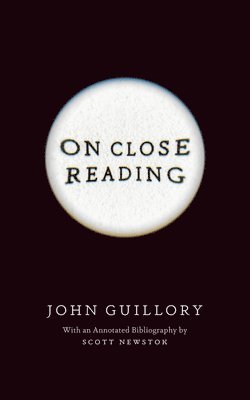
John Guillory considers close reading within the larger history of reading and writing as cultural techniques. At a time of debate about the future of “English” as a discipline and the fundamental methods of literary study, few terms appear more frequently than “close reading,” now widely regarded as the core practice of literary study. But what exactly is close reading, and where did it come from? Here John Guillory, author of the acclaimed Professing Criticism, takes up two puzzles. First, why did the New Critics—who supposedly made close reading central to literary study—so seldom use the term? And second, why have scholars not been better able to define close reading? For Guillory, these puzzles are intertwined. The literary critics of the interwar period, he argues, weren’t aiming to devise a method of reading at all. These critics were most urgently concerned with establishing the judgment of literature on more rigorous grounds than previously obtained in criticism. Guillory understands close reading as a technique, a particular kind of methodical procedure that can be described but not prescribed, and that is transmitted largely by demonstration and imitation. Guillory’s short book will be essential reading for all college teachers of literature. An annotated bibliography, curated by Scott Newstok, provides a guide to key documents in the history of close reading along with valuable suggestions for further research.
213 kr
Skickas inom 7-10 vardagar
John Guillory considers close reading within the larger history of reading and writing as cultural techniques. At a time of debate about the future of “English” as a discipline and the fundamental methods of literary study, few terms appear more frequently than “close reading,” now widely regarded as the core practice of literary study. But what exactly is close reading, and where did it come from? Here John Guillory, author of the acclaimed Professing Criticism, takes up two puzzles. First, why did the New Critics—who supposedly made close reading central to literary study—so seldom use the term? And second, why have scholars not been better able to define close reading? For Guillory, these puzzles are intertwined. The literary critics of the interwar period, he argues, weren’t aiming to devise a method of reading at all. These critics were most urgently concerned with establishing the judgment of literature on more rigorous grounds than previously obtained in criticism. Guillory understands close reading as a technique, a particular kind of methodical procedure that can be described but not prescribed, and that is transmitted largely by demonstration and imitation. Guillory’s short book will be essential reading for all college teachers of literature. An annotated bibliography, curated by Scott Newstok, provides a guide to key documents in the history of close reading along with valuable suggestions for further research.
2 412 kr
Skickas inom 10-15 vardagar
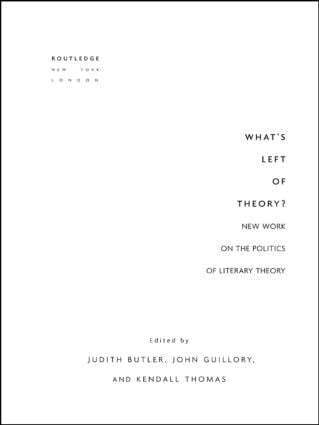
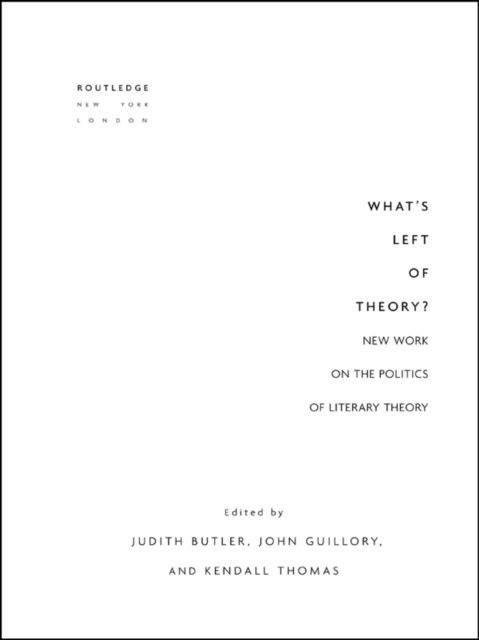
For several years, write the editors of What's Left of Theory , a debate on the politics of theory has been conducted energetically within literary studies. The terms of the debate, however, are far from clear. What is meant by politics? What is meant by theory? What's Left of Theory is a vigorous engagement with that thorniest of critical questions: how today are theory and progressive thought connected? Michael Warner, activist and critic, examines 'zones of privacy and zones of theory' while law professor Janet Halley considers theory and its applicability to sex harassment. Jeff Nunokawa examines Oscar Wilde, Marjorie Levinson reads Elizabeth Bishop alongside National Geographic ; John Brenkman considers 'extreme criticism', Michael Berube the 'future of contingency'; William Connolly addresses the matter of secularism, Gayatri Spivak explores what she calls 'theory-remains', and Jonathan Culler demonstrates once again his gift for explaining the complex in an essay that identifies 'the literary in theory'. Editors Butler, Guillory, and Thomas have brought together not only outstanding questioners, but outstanding questions. As their introduction puts it, Are there ways of pursuing a politically reflective literary analysis that have definitively left theory behind, and must 'theory' be left behind for left literary analysis to emerge? Has the study of literature passed beyond its encounter with theory? If so, in passing beyond theory, has it remained unchanged? Does the recent cry for a 'return to literature' signal the surpassing of theory, the fact that literature remains after theory? Does literature remain (the same) after theory? For students of literature and the humanities in general, these questions are not only left: they endure.
650 kr
Skickas inom 10-15 vardagar
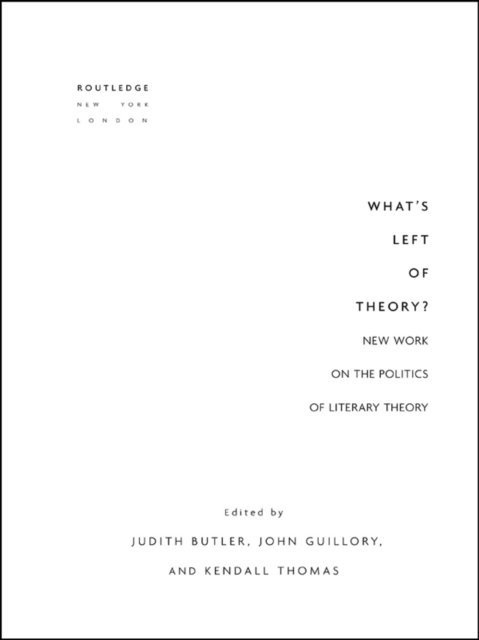
For several years, write the editors of What's Left of Theory , a debate on the politics of theory has been conducted energetically within literary studies. The terms of the debate, however, are far from clear. What is meant by politics? What is meant by theory? What's Left of Theory is a vigorous engagement with that thorniest of critical questions: how today are theory and progressive thought connected? Michael Warner, activist and critic, examines 'zones of privacy and zones of theory' while law professor Janet Halley considers theory and its applicability to sex harassment. Jeff Nunokawa examines Oscar Wilde, Marjorie Levinson reads Elizabeth Bishop alongside National Geographic ; John Brenkman considers 'extreme criticism', Michael Berube the 'future of contingency'; William Connolly addresses the matter of secularism, Gayatri Spivak explores what she calls 'theory-remains', and Jonathan Culler demonstrates once again his gift for explaining the complex in an essay that identifies 'the literary in theory'. Editors Butler, Guillory, and Thomas have brought together not only outstanding questioners, but outstanding questions. As their introduction puts it, Are there ways of pursuing a politically reflective literary analysis that have definitively left theory behind, and must 'theory' be left behind for left literary analysis to emerge? Has the study of literature passed beyond its encounter with theory? If so, in passing beyond theory, has it remained unchanged? Does the recent cry for a 'return to literature' signal the surpassing of theory, the fact that literature remains after theory? Does literature remain (the same) after theory? For students of literature and the humanities in general, these questions are not only left: they endure.