• Fri frakt över 249 kr
  • •
  • Snabba leveranser
  • •
  • Billiga böcker
Kundservice

Du är på sajten för privatpersoner.

Företag, bibliotek eller offentlig verksamhet?

Du handlar på classic.bokus.com, där alla dina funktioner finns intakta.
Till classic.bokus.com
Bokus logotyp. Gå till startsidan.
  • Erbjudanden
  • Nyheter
  • Student
  • Topplistor
  • Barn & ungdom
  • Bokus Play
  • E-böcker
  • Pocketböcker
  • Spel & pussel

10% rabatt på allt med kod NYSTART10 →

Sidfot

Mina sidor

    Hjälp

    • Kundservice
    • Vanliga frågor och svar
    • Frakt och leverans
    • Retur vid ångerrätt
    • Reklamera vara
    • Betalning
    • Köpvillkor
    • Allmänna villkor
    • Information om webbplatsens tillgänglighet

    Om Bokus

    • Om oss
    • Pressrum
    • För studenter
    • För företag
    • För bibliotek och offentlig verksamhet
    • För leverantörer
    • Hållbarhet

    Populärt

    • Aktuella erbjudanden
    • Presentkort
    • Studentlitteratur
    • Nya böcker
    • Topplistor
    • Signerade böcker
    • Engelska böcker

    Inspiration

    • Boktips
    • BookTok
    • Populära bokserier
    • Barnbokskaraktärer
    • Populära författare
    Logotyp för Bokus
    Följ oss på Facebook (extern länk)Följ oss på Instagram (extern länk)Följ oss på YouTube (extern länk)Följ oss på TikTok (extern länk)
    bokus @ CookiesAnpassa cookiesIntegritetspolicyKöpvillkor
    Till Citymail hemsida (extern länk)Till Budbee hemsida (extern länk)Till Postnord hemsida (extern länk)Till Schenker hemsida (extern länk)Till Early Bird hemsida (extern länk)Till Walleys hemsida (extern länk)
    1. Skönlitteratur
    2. Litteraturvetenskap

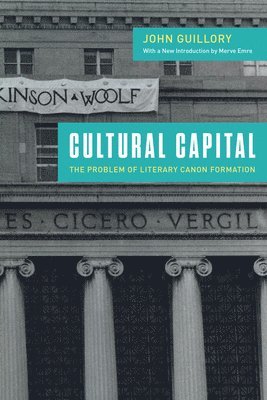
    Cultural Capital

    The Problem of Literary Canon Formation

    AvJohn Guillory

    Häftad, Engelska, 2023

    289 kr

    Beställningsvara. Skickas inom 5-8 vardagar. Fri frakt över 249 kr.

    Fler format och utgåvor

    Häftad

    667 kr

    E-bok

    565 kr

    Beskrivning

    An enlarged edition to celebrate the thirtieth anniversary of John Guillory’s formative text on the literary canon.Since its publication in 1993, John Guillory’s Cultural Capital has been a signal text for understanding the codification and uses of the literary canon. Cultural Capital reconsiders the social basis for aesthetic judgment and exposes the unequal distribution of symbolic and linguistic knowledge on which culture has long been based. Drawing from Pierre Bourdieu’s sociology, Guillory argues that canon formation must be understood less as a question of the representation of social groups and more as a question of the distribution of cultural capital in schools, which regulate access to literacy, to the practices of reading and writing.  Now, as the crisis of the canon has evolved into the so-called crisis of the humanities, Guillory’s groundbreaking, incisive work has never been more urgent. As scholar and critic Merve Emre writes in her introduction to this enlarged edition: “Exclusion, selection, reflection, representation—these are the terms on which the canon wars of the last century were fought, and the terms that continue to inform debates about, for instance, decolonizing the curriculum and the rhetoric of antiracist pedagogy.”

    Produktinformation

    • Utgivningsdatum:2023-10-21
    • Mått:152 x 229 x 43 mm
    • Vikt:653 g
    • Format:Häftad
    • Språk:Engelska
    • Antal sidor:440
    • Förlag:The University of Chicago Press
    • ISBN:9780226830599

    Utforska kategorier

    • Litteraturvetenskap inom Skönlitteratur

    Mer om författaren

    John Guillory is the Julius Silver Professor of English at New York University. He is coeditor of What’s Left of Theory? New Work on the Politics of Literary Theory and author of Poetic Authority: Spenser, Milton, and Literary History and Professing Criticism: Essays on the Organization of Literary Study, the latter of which is also published by the University of Chicago Press.

    Recensioner i media

    “Cultural Capital has become a stealth classic. . . . The canon, Guillory argued, wasn’t an impregnable monument, but an imaginary construct that had always been contested.”

    Innehållsförteckning

    • Introduction to the New Edition by Merve EmrePrefaceAcknowledgmentsPart One: Critique1 Canonical and Noncanonical: The Current DebatePart Two: Case Studies2 Mute Inglorious Miltons: Gray, Wordsworth, and the Vernacular Canon3 Ideology and Canonical Form: The New Critical Canon4 Literature after Theory: The Lesson of Paul de ManPart Three: Aesthetics5 The Discourse of Value: From Adam Smith to Barbara Herrnstein SmithNotesIndex