Jonathan E. Abel - Böcker
Visar alla böcker från författaren Jonathan E. Abel. Handla med fri frakt och snabb leverans.
7 produkter
7 produkter
1 098 kr
Skickas inom 7-10 vardagar
For decades, we have been told we live in the “information age”—a time when disruptive technological advancement has reshaped the categories and social uses of knowledge and when quantitative assessment is increasingly privileged. Such methodologies and concepts of information are usually considered the provenance of the natural and social sciences, which present them as politically and philosophically neutral. Yet the humanities should and do play an important role in interpreting and critiquing the historical, cultural, and conceptual nature of information.This book is one of two companion volumes that explore theories and histories of information from a humanistic perspective. They consider information as a long-standing feature of social, cultural, and conceptual management, a matter of social practice, and a fundamental challenge for the humanities today. Bringing together essays by prominent critics, Information: Keywords highlights the humanistic nature of information practices and concepts by thinking through key terms. It describes and anticipates directions for how the humanities can contribute to our understanding of information from a range of theoretical, historical, and global perspectives. Together with Information: A Reader, it sets forth a major humanistic vision of the concept of information.
281 kr
Skickas inom 7-10 vardagar
For decades, we have been told we live in the “information age”—a time when disruptive technological advancement has reshaped the categories and social uses of knowledge and when quantitative assessment is increasingly privileged. Such methodologies and concepts of information are usually considered the provenance of the natural and social sciences, which present them as politically and philosophically neutral. Yet the humanities should and do play an important role in interpreting and critiquing the historical, cultural, and conceptual nature of information.This book is one of two companion volumes that explore theories and histories of information from a humanistic perspective. They consider information as a long-standing feature of social, cultural, and conceptual management, a matter of social practice, and a fundamental challenge for the humanities today. Bringing together essays by prominent critics, Information: Keywords highlights the humanistic nature of information practices and concepts by thinking through key terms. It describes and anticipates directions for how the humanities can contribute to our understanding of information from a range of theoretical, historical, and global perspectives. Together with Information: A Reader, it sets forth a major humanistic vision of the concept of information.
1 354 kr
Skickas inom 7-10 vardagar
Unlocking a vital understanding of how literary studies and media studies overlap and are bound togetherA synthetic history of new media reception in modern and contemporary Japan, The New Real positions mimesis at the heart of the media concept. Considering both mimicry and representation as the core functions of mediation and remediation, Jonathan E. Abel offers a new model for media studies while explaining the deep and ongoing imbrication of Japan in the history of new media.From stereoscopy in the late nineteenth century to emoji at the dawn of the twenty-first, Abel presents a pioneering history of new media reception in Japan across the analog and digital divide. He argues that there are two realities created by new media: one marketed to us through advertising that proclaims better, faster, and higher-resolution connections to the real; and the other experienced by users whose daily lives and behaviors are subtly transformed by the presence and penetration of the content carried through new media. Intervening in contemporary conversations about virtuality, copyright, copycat violence, and social media, each chapter unfolds with a focus on a single medium or technology, including 3D photographs, the phonograph, television, videogames, and emoji.By highlighting the tendency of the mediated to copy the world and the world to copy the mediated, The New Real provides a new path for analysis of media, culture, and their function in the world.
311 kr
Skickas inom 7-10 vardagar
Unlocking a vital understanding of how literary studies and media studies overlap and are bound togetherA synthetic history of new media reception in modern and contemporary Japan, The New Real positions mimesis at the heart of the media concept. Considering both mimicry and representation as the core functions of mediation and remediation, Jonathan E. Abel offers a new model for media studies while explaining the deep and ongoing imbrication of Japan in the history of new media.From stereoscopy in the late nineteenth century to emoji at the dawn of the twenty-first, Abel presents a pioneering history of new media reception in Japan across the analog and digital divide. He argues that there are two realities created by new media: one marketed to us through advertising that proclaims better, faster, and higher-resolution connections to the real; and the other experienced by users whose daily lives and behaviors are subtly transformed by the presence and penetration of the content carried through new media. Intervening in contemporary conversations about virtuality, copyright, copycat violence, and social media, each chapter unfolds with a focus on a single medium or technology, including 3D photographs, the phonograph, television, videogames, and emoji.By highlighting the tendency of the mediated to copy the world and the world to copy the mediated, The New Real provides a new path for analysis of media, culture, and their function in the world.
407 kr
Skickas inom 3-6 vardagar
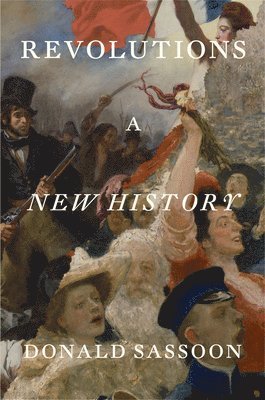
Revolutions is a sparkling account of political upheaval and the power of history. We think of revolutions in terms of fleeting events, such as the Fall of the Bastille or the Storming of the Winter Palace. In reality they take decades to burn out, if they ever do. One of our great historians, Donald Sassoon, takes the long view of some of the most celebrated upheavals: the English Civil War, which killed a king; the American War of Independence, which ejected the British but allowed slavery to persist; the French Revolution, which produced the Rights of Man and years of instability; the national revolutions that unified Italy and Germany; and the Russian and Chinese revolutions, which transformed the twentieth century. Revolutions adroitly compares these historical juggernauts to the many rebellions, coups and tumults that time forgot.It is a history rich in irony and surprises. 'Yankee Doodle Dandy' was first sung by English troopers to make fun of dishevelled American colonials. The Long March of retreating Chinese Communists assumed a mythical dimension on a par with Washington crossing the Delaware. As Sassoon shows in this tour de force account, revolutions usually catch revolutionaries them-selves by surprise, and the consequences are difficult to fathom.Revolutions will change how you think about the transformative moments in history, both big and small.'Unique and encyclopaedic.a monument to streetwise and cosmopolitan scholarship' Guardian (for The Culture of the Europeans)'Sometimes playful, sometimes caustic, but always to the point. The doyen of comparative historians'Ferdinand Mount, Times Literary Supplement (for The Anxious Triumph)
247 kr
Kommande
Revolutions is a sparkling account of political upheaval and the power of history. We think of revolutions in terms of fleeting events, such as the Fall of the Bastille or the Storming of the Winter Palace. In reality they take decades to burn out, if they ever do. One of our great historians, Donald Sassoon, takes the long view of some of the most celebrated upheavals: the English Civil War, which killed a king; the American War of Independence, which ejected the British but allowed slavery to persist; the French Revolution, which produced the Rights of Man and years of instability; the national revolutions that unified Italy and Germany; and the Russian and Chinese revolutions, which transformed the twentieth century. Revolutions adroitly compares these historical juggernauts to the many rebellions, coups and tumults that time forgot.It is a history rich in irony and surprises. 'Yankee Doodle Dandy' was first sung by English troopers to make fun of dishevelled American colonials. The Long March of retreating Chinese Communists assumed a mythical dimension on a par with Washington crossing the Delaware. As Sassoon shows in this tour de force account, revolutions usually catch revolutionaries them-selves by surprise, and the consequences are difficult to fathom.Revolutions will change how you think about the transformative moments in history, both big and small.'Unique and encyclopaedic.a monument to streetwise and cosmopolitan scholarship' Guardian (for The Culture of the Europeans)'Sometimes playful, sometimes caustic, but always to the point. The doyen of comparative historians'Ferdinand Mount, Times Literary Supplement (for The Anxious Triumph)
275 kr
Kommande
What Comes After LiteratureWhen the Left enjoys the most active resurgence since the end of the Cold War thanks to the disasters of neoliberalism, The End of Modern Literature offers viewpoints or "parallax views" that enable the reevaluation of literature's significance in society, an opportunity to reimagine what has been called "literature."Sartre once conceived literature as the expression of people's revolutionary subjectivity, but today there are no more global or even society-wide must-read novels. Everyone knows literature is dead, but no one knows how it died. Kojin Karatani, the author of Transcritique and The Structure of World History and the winner of the Berggruen Prize, examines the corpse, investigates the cause of death, and offers glimpses at its afterlives from multiple viewpoints of the theory of the novel, Sartre, the 18th century aesthetics, modernization of Japanese literature, and modern world system.To Karatani's insightful analysis, this volume includes responses by Fredric Jameson, Bruce Robbins, Kenneth W. Warren, Gauri Viswanathan, Andrew Gibson, Young-il Cho, Yoshiki Tajiri, Michael K. Bourdaghs, and Joanathan E. Abel, along with an introduction that situates Karatani's essay on literature in his theoretical oeuvre. Thinking on the end of literature is also thinking on something new that is different from literature, something that comes out of what once made literature possible and meaningful.