Joshua Scodel - Böcker
Visar alla böcker från författaren Joshua Scodel. Handla med fri frakt och snabb leverans.
3 produkter
3 produkter
626 kr
Skickas inom 7-10 vardagar
England's Virgin Queen, Elizabeth Tudor, had a reputation for proficiency in foreign languages, repeatedly demonstrated in multilingual exchanges with foreign emissaries at court and in the extemporized Latin she spoke on formal visits to Cambridge and Oxford. But the supreme proof of her mastery of other tongues is the sizable body of translations she made over the course of her lifetime. This two-volume set is the first complete collection of Elizabeth's translations from and into Latin, French, and Italian.Presenting original and modernized spellings in a facing-page format, these two volumes will answer the call to make all of Elizabeth's writings available. They include her renderings of epistles of Cicero and Seneca, religious writings of John Calvin and Marguerite de Navarre, and Horace's Ars poetica, as well as Elizabeth's Latin Sententiae on the responsibilities of sovereign rule and her own perspectives on the monarchy. Editors Janel Mueller and Joshua Scodel offer introductions to each of the translated selections, describing the source text, its cultural significance, and the historical context in which Elizabeth translated it.Their annotations identify obscure meanings, biblical and classical references, and Elizabeth's actual or apparent deviations from her sources.The translations collected here trace Elizabeth's steady progression from youthful evangelical piety to more mature reflections on morality, royal responsibility, public and private forms of grief, and the right way to rule. "Elizabeth I: Translations" is the queen's personal legacy, an example of the very best that a humanist education can bring to the conduct of sovereign rule.
626 kr
Skickas inom 7-10 vardagar
England's Virgin Queen, Elizabeth Tudor, had a reputation for proficiency in foreign languages, repeatedly demonstrated in multilingual exchanges with foreign emissaries at court and in the extemporized Latin she spoke on formal visits to Cambridge and Oxford. But the supreme proof of her mastery of other tongues is the sizable body of translations she made over the course of her lifetime. This two-volume set is the first complete collection of Elizabeth's translations from and into Latin, French, and Italian.Presenting original and modernized spellings in a facing-page format, these two volumes will answer the call to make all of Elizabeth's writings available. They include her renderings of epistles of Cicero and Seneca, religious writings of John Calvin and Marguerite de Navarre, and Horace's Ars poetica, as well as Elizabeth's Latin Sententiae on the responsibilities of sovereign rule and her own perspectives on the monarchy. Editors Janel Mueller and Joshua Scodel offer introductions to each of the translated selections, describing the source text, its cultural significance, and the historical context in which Elizabeth translated it.Their annotations identify obscure meanings, biblical and classical references, and Elizabeth's actual or apparent deviations from her sources.The translations collected here trace Elizabeth's steady progression from youthful evangelical piety to more mature reflections on morality, royal responsibility, public and private forms of grief, and the right way to rule. "Elizabeth I: Translations" is the queen's personal legacy, an example of the very best that a humanist education can bring to the conduct of sovereign rule.
2 665 kr
Skickas inom 3-6 vardagar
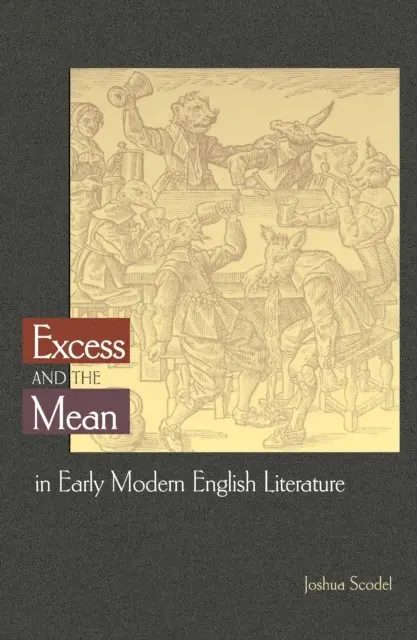
This book examines how English writers from the Elizabethan period to the Restoration transformed and contested the ancient ideal of the virtuous mean. As early modern authors learned at grammar school and university, Aristotle and other classical thinkers praised "golden means" balanced between extremes: courage, for example, as opposed to cowardice or recklessness. By uncovering the enormous variety of English responses to this ethical doctrine, Joshua Scodel revises our understanding of the vital interaction between classical thought and early modern literary culture. Scodel argues that English authors used the ancient schema of means and extremes in innovative and contentious ways hitherto ignored by scholars. Through close readings of diverse writers and genres, he shows that conflicting representations of means and extremes figured prominently in the emergence of a self-consciously modern English culture. Donne, for example, reshaped the classical mean to promote individual freedom, while Bacon held extremism necessary for human empowerment.Imagining a modern rival to ancient Rome, georgics from Spenser to Cowley exhorted England to embody the mean or lauded extreme paths to national greatness. Drinking poetry from Jonson to Rochester expressed opposing visions of convivial moderation and drunken excess, while erotic writing from Sidney to Dryden and Behn pitted extreme passion against the traditional mean of conjugal moderation. Challenging his predecessors in various genres, Milton celebrated golden means of restrained pleasure and self-respect. Throughout this groundbreaking study, Scodel suggests how early modern treatments of means and extremes resonate in present-day cultural debates.