Julie Candler Hayes - Böcker
Visar alla böcker från författaren Julie Candler Hayes. Handla med fri frakt och snabb leverans.
7 produkter
7 produkter
897 kr
Skickas inom 5-8 vardagar
Early modern women writers left their mark in multiple domains--novels, translations, letters, history, and science. Although recent scholarship in literary and cultural studies has enriched our understanding of these accomplishments, less attention has been paid to other forms of women's writing. Women Moralists in Early Modern France explores the contributions of seventeenth and eighteenth-century French women philosophers and intellectuals to moralist writing, the observation of human motives and behavior. This distinctively French genre draws on philosophical and literary traditions extending back to classical antiquity. Moralist short forms such as the maxim, dialogue, character portrait, and essay engage social and political questions, epistemology, moral psychology, and virtue ethics. Although moralist writing was closely associated with the salon culture in which women played a major role, women's contributions to the genre have received scant scholarly attention.Julie Candler Hayes examines major moralist writers such as Madeleine de Scudéry, Anne-Thérèse de Lambert, Émilie Du Châtelet, and Germaine de Staël, as well as nearly two dozen of their contemporaries. Their reflections range from traditional topics such as the nature of the self, friendship, happiness, and old age, to issues that were very much part of their own lifeworld, such as the institution of marriage and women's nature and capabilities. Each chapter traces the evolution of women's moralist thought on a given topic from the late seventeenth century to the Enlightenment and the decades immediately following the French Revolution, a period of tremendous change in the horizon of possibilities for women as public figures and intellectuals. Hayes demonstrates how, through their critique of institutions and practices, their valorization of introspection and self-expression, and their engagement with philosophical issues, women moralists carved out an important space for the public exercise of their reason.
Del 60 - Cambridge Studies in French
Reading the French Enlightenment
System and Subversion
Häftad, Engelska, 2006
523 kr
Skickas inom 7-10 vardagar
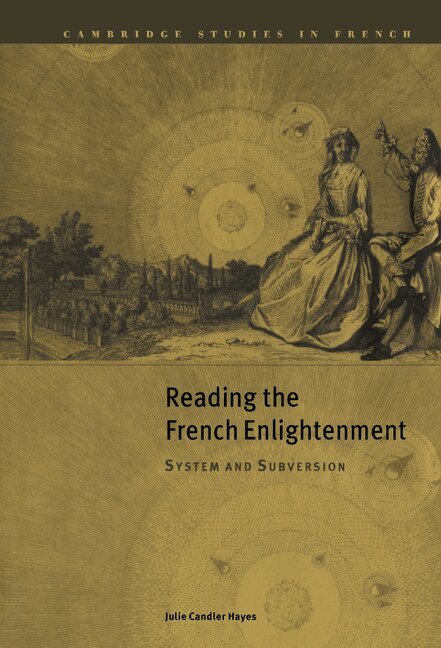
In this 1999 book, Julie Candler Hayes offers an ambitious reinterpretation of a crucial aspect of Enlightenment thought, the rationalizing and classifying impulse. Taking issue both with traditional liberal and contemporary critical accounts of the Enlightenment, she analyses the writings of Denis Diderot, Emilie Du Châtelet, the Abbé de Condillac, Buffon, d'Alembert and numerous others, to argue for a new understanding of 'systematic reason' as complex, paradoxical and ultimately liberating. Hayes examines the tensions between freedom and constraint, abstraction and materialism, linear and synoptic order, that pervade not only philosophic and scientific discourse, but also epistolary writing, fiction and criticism. Drawing on the insights of a wide range of theorists from Adorno, Habermas and Foucault to Deleuze and Derrida, she offers a dialogue between the eighteenth century and our own, an ongoing exploration of the question, 'what is Enlightenment?'.
Del 60 - Cambridge Studies in French
Reading the French Enlightenment
System and Subversion
Inbunden, Engelska, 1999
1 643 kr
Skickas inom 7-10 vardagar
In this 1999 book, Julie Candler Hayes offers an ambitious reinterpretation of a crucial aspect of Enlightenment thought, the rationalizing and classifying impulse. Taking issue both with traditional liberal and contemporary critical accounts of the Enlightenment, she analyses the writings of Denis Diderot, Emilie Du Châtelet, the Abbé de Condillac, Buffon, d'Alembert and numerous others, to argue for a new understanding of 'systematic reason' as complex, paradoxical and ultimately liberating. Hayes examines the tensions between freedom and constraint, abstraction and materialism, linear and synoptic order, that pervade not only philosophic and scientific discourse, but also epistolary writing, fiction and criticism. Drawing on the insights of a wide range of theorists from Adorno, Habermas and Foucault to Deleuze and Derrida, she offers a dialogue between the eighteenth century and our own, an ongoing exploration of the question, 'what is Enlightenment?'.
1 526 kr
Skickas inom 7-10 vardagar
As editors of the Encyclopédie, Diderot and D'Alembert claimed that one of the work's greatest strengths was that the knowledge it contained was useful. It was indeed, for the Encyclopédie assembled existing knowledge from a wide range of fields, making that knowledge potentially accessible to a broad readership. In addition, the Encyclopédie contributed to creating new areas of inquiry and forming new knowledge in vast fields now called science and technology, the arts and humanities. The sheer amount of knowledge contained in the pages of the Encyclopédie is impressive enough. But what the encyclopedists aimed for was a way to put knowledge to work. What they sought above all was a way to fashion critical knowledge, the kind designed to demystify readers, to ‘undeceive them’ as Diderot put it, and thus to free them from the reign of superstition, doctrine, and received ideas. The Encyclopédiedoes aim to advance the Enlightenment project in this fashion. It also contains voices that are hostile or merely indifferent to such a grandiose project. Yet ultimately, the encyclopedists are correct in their claim that the Encyclopédie provides a stronger, more powerful way of knowing things, one more able to resist or at least to situate critically prior ways of knowing. A century and a half after the appearance of the first volume of the Encyclopédie in 1751, as we open its pages – or view them on-line or from a CD-Rom – what the encyclopedists knew is of less importance to us now than how they knew.Or rather, to understand what the Encyclopédie presents to its readers in the way of knowledge, we must also consider how that knowledge is to be read. For us today, the most fascinating, compelling, and challenging aspect of this daring, monumental experiment is the way it entwines what the present volume calls ways of knowing and ways of reading. Thanks to the extensive scholarship of literary and cultural historians, we now know more than ever about the Encyclopédie project, from the socio-intellectual networks to which individual encyclopedists belonged, to the print culture networks through which their work circulated. Building on that contextual knowledge, the present volume returns to the text of the Encyclopédie in a series of essays that consider, in various ways, the encyclopedic relation to knowledge. The range of topics treated here is broad, corresponding quite naturally to the breadth of the Encyclopédie itself. But these essays call us to reflect on the twin issues of epistemology and history, exploring the questions, debates, and paradigms in terms of which critical knowledge is produced in the eighteenth century, as well as in our own.
1 644 kr
Skickas inom 7-10 vardagar
Until recently, the marquise Du Châtelet (1706-1749) was more remembered as the companion of Voltaire than as an intellectual in her own right. While much has been written about his extraordinary output during the years he spent in her company, her own work has often been overshadowed. This volume brings renewed attention to Du Châtelet's intellectual achievements, including her free translation of selections from Bernard Mandeville's Fable of the bees; her dissertation on the nature and propagation of fire for the 1738 prize competition of the Académie des sciences; the 1740 Institutions de physique and ensuing exchange with the perpetual secretary of the Académie, Dortous de Mairan; her two-volume exegesis of the Bible; the translation of and commentary on Isaac Newton's Principia; and her semi-autobiographical Discours sur le bonheur. It is a measure of the breadth of her interests that the contributions to this volume come from experts in a wide range of disciplines: comparative literature, art history, the history of mathematics and science, philosophy, the history of publishing and translation studies. Du Châtelet's partnership with Voltaire is reflected in a number of the essays; they borrowed from each other's writings, from the discussions they had together, and from their shared readings. Essays examine representations of her by her contemporaries and posterity that range from her inclusion in a German portrait gallery of learned men and women, to the scathing portrait in Françoise de Graffigny's correspondence, and nineteenth-century accounts coloured by conflicted views of the ancien régime. Other essays offer close readings of her work, and set her activities and writings in their intellectual and social contexts. Finally, they speculate on the ways in which she presented herself and what that might tell us about the challenges and possibilities facing an exceptional woman of rank and privilege in eighteenth-century society.
1 051 kr
Skickas inom 10-15 vardagar
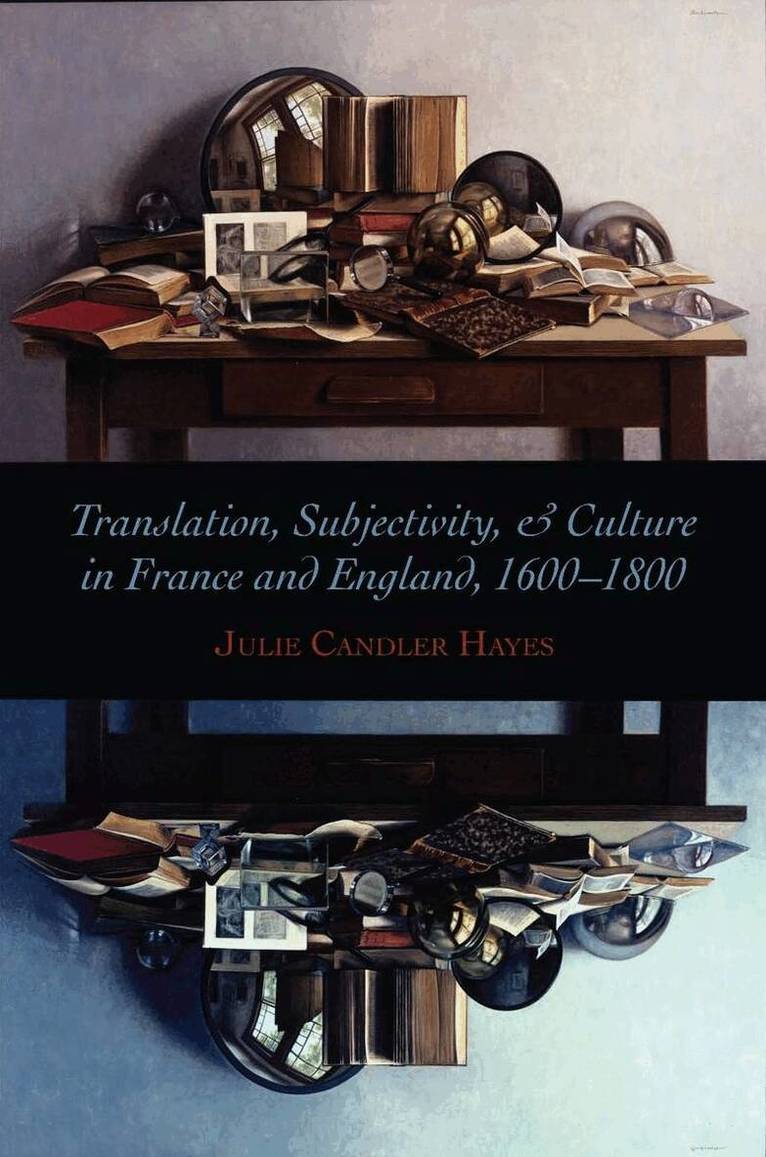
Translation, Subjectivity, and Culture examines the evolution of neoclassical translation theory from its origins among the first generation of French Academicians to its subsequent importation to England by royalist exiles, its development under the influence of such translator-critics as John Dryden and Anne Dacier, and its evolution in response to the philosophical and political ideas of the Enlightenment. Hayes shows how translators working from a range of literary, political, and philosophical viewpoints speak to such issues as the relationship of past to present, authorship and the status of women writers, the role of language in national identity, and Anglo-French intellectual exchange. Responding to recent translation historians who describe neoclassical translation as ethnocentric, she uncovers within these translators' projects not only openness to cultural others but constant and multiple reformulations of the very concept of otherness. Her book is a sustained reflection on the aims and methods of contemporary translation studies and the most complete account available of the role of translation during a critical period in European history.The French originals of many of the sources cited in Translation, Subjectivity, and Culture can be found in "French Translators, 1600-1800: An Online Anthology of Prefaces and Criticism," ed. Julie Candler Hayes. To access this resource please visit http://scholarworks.umass.edu/french_translators/.
371 kr
Skickas inom 7-10 vardagar
Marie-Geneviève-Charlotte Thiroux d’Arconville combined fierce intellectual ambition with the proper demeanor of the wife of a leading magistrate. Bemoaning her lack of a formal education in childhood, as an adult she read widely, studied languages, and sought out mentors among the scientific elite of the day. Always publishing anonymously, her works included moralist philosophy, scientific and literary translations, original scientific research, fiction, and history. Recently, a trove of unpublished essays and autobiographical writings from her final years, long thought to have been lost, has come to light, revealing her as a writer of insight, wit, and feeling.Edited and translated by Julie Candler HayesThe Other Voice in Early Modern Europe: The Toronto Series, volume 58