Laurence T. Maloney – författare
Visar alla böcker från författaren Laurence T. Maloney. Handla med fri frakt och snabb leverans.
5 produkter
Exploratory Vision
The Active Eye
Av Michael S. Landy, Laurence T. Maloney m. fl.
Inbunden, 1995
1098 kr
Lägg i varukorg
This book is a dialogue between researchers who study biological visual and computer scientists and engineers who seek to build computer vision systems that actively explore the environment. By describing new and important ways to design robots analogous to biological visual systems, it provides …
Exploratory Vision
The Active Eye
Av Misha Pavel, Laurence T. Maloney m. fl.
E-bok, 2012
1427 kr
Lägg i varukorg
Advances in sensing, signal processing, and computer technology during the past half century have stimulated numerous attempts to design general-purpose ma chines that see. These attempts have met with at best modest success and more typically outright failure. The difficulties encountered in …
Exploratory Vision
The Active Eye
Av Michael S. Landy, Laurence T. Maloney m. fl.
Häftad, 2011
1101 kr
Lägg i varukorg
Advances in sensing, signal processing, and computer technology during the past half century have stimulated numerous attempts to design general-purpose ma chines that see. These attempts have met with at best modest success and more typically outright failure. The difficulties encountered in …
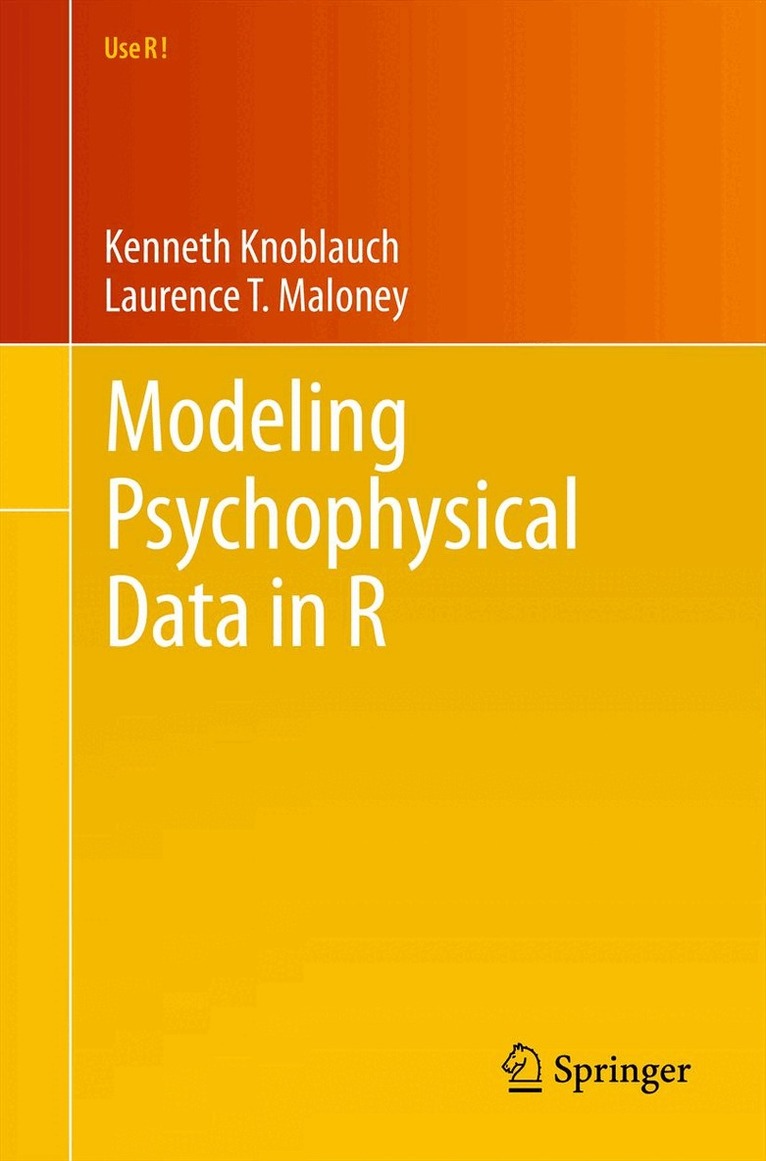
Modeling Psychophysical Data in R
Av Kenneth Knoblauch, Laurence T. Maloney
Häftad, 2012
937 kr
Lägg i varukorg
Many of the commonly used methods for modeling and fitting psychophysical data are special cases of statistical procedures of great power and generality, notably the Generalized Linear Model (GLM). This book illustrates how to fit data from a variety of psychophysical paradigms using modern …
Modeling Psychophysical Data in R
Av Laurence T. Maloney, Kenneth Knoblauch
E-bok, 2012
1188 kr
Lägg i varukorg
Many of the commonly used methods for modeling and fitting psychophysical data are special cases of statistical procedures of great power and generality, notably the Generalized Linear Model (GLM). This book illustrates how to fit data from a variety of psychophysical paradigms using modern …