Michael S. Landy – författare
Visar alla böcker från författaren Michael S. Landy. Handla med fri frakt och snabb leverans.
7 produkter
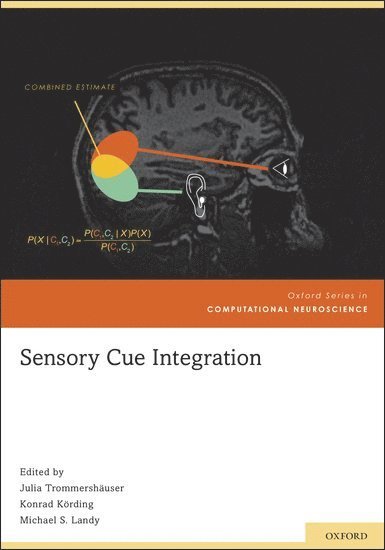
Sensory Cue Integration
Av Julia Trommershauser, Konrad Kording m. fl.
Inbunden, 2011
2411 kr
Lägg i varukorg
This book provides an introduction into both computational models and experimental paradigms that are concerned with sensory cue integration both within and between sensory modalities. Importantly, across behavioral, electrophysiological and theoretical approaches, Bayesian statistics is emerging …
Sensory Cue Integration
Av Michael S. Landy, Konrad Kording m. fl.
E-bok, 2011
1485 kr
Lägg i varukorg
This book is concerned with sensory cue integration both within and between sensory modalities, and focuses on the emerging way of thinking about cue combination in terms of uncertainty. These probabilistic approaches derive from the realization that our sensors are noisy and moreover are often …
Exploratory Vision
The Active Eye
Av Michael S. Landy, Laurence T. Maloney m. fl.
Inbunden, 1995
1098 kr
Lägg i varukorg
This book is a dialogue between researchers who study biological visual and computer scientists and engineers who seek to build computer vision systems that actively explore the environment. By describing new and important ways to design robots analogous to biological visual systems, it provides …
Brief Survey of Knowledge Aggregation Methods
Av Michael S Landy, Robert a Hummel
Inbunden, 2015
423 kr
Lägg i varukorg
Statistical Viewpoint on the Theory of Evidence
Av Michael S Landy, Robert a Hummel
Inbunden, 2015
410 kr
Lägg i varukorg
Exploratory Vision
The Active Eye
Av Misha Pavel, Laurence T. Maloney m. fl.
E-bok, 2012
1427 kr
Lägg i varukorg
Advances in sensing, signal processing, and computer technology during the past half century have stimulated numerous attempts to design general-purpose ma chines that see. These attempts have met with at best modest success and more typically outright failure. The difficulties encountered in …
Exploratory Vision
The Active Eye
Av Michael S. Landy, Laurence T. Maloney m. fl.
Häftad, 2011
1101 kr
Lägg i varukorg
Advances in sensing, signal processing, and computer technology during the past half century have stimulated numerous attempts to design general-purpose ma chines that see. These attempts have met with at best modest success and more typically outright failure. The difficulties encountered in …