Lenore Langsdorf - Böcker
Visar alla böcker från författaren Lenore Langsdorf. Handla med fri frakt och snabb leverans.
3 produkter
3 produkter
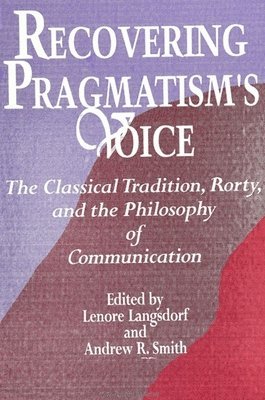
Recovering Pragmatism's Voice
The Classical Tradition, Rorty, and the Philosophy of Communication
Häftad, Engelska, 1994
402 kr
Tillfälligt slut
This book focuses on what pragmatism tells us about the nature and function of communication. Its goals are to recover a singular voice of pragmatism, and to identify and develop alternative methods and aims for the philosophy of communication. It shows how pragmatism assumes and proposes a philosophy of communication that can lead to a reconceptualization of contemporary communication studies.The authors explore recurrent themes in the tradition's various classical extensions that commend pragmatism as a methodology for social change and human development. They show that pragmatism fosters inquiry and pluralism by rejecting strategies for closure, questioning prevailing metanarratives, and encouraging the development of new habits of conduct through a critical practice that is fundamentally self-reflective.Contributors to this volume include Mitchell Aboulafia, Thomas Alexander, Arthur Bochner and Joanne Waugh, Isaac Catt, Vincent Colapietro, Janet Horne, Richard Lanigan, Frank Macke, Mick Presnell, Charlene Haddock Seigfried, and Leonard Shyles.
382 kr
Tillfälligt slut
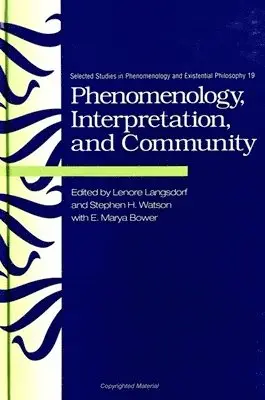
This collection examines the relationship between phenomenology, interpretation, and community, considering the issues from several viewpoints including German idealism, the discourses of the Frankfurt School, and post-structuralist thought.This book re-examines the relationship between phenomenology, interpretation, and the problem of community, a topic that has been at the center of recent debates in Continental thought. From the outset, phenomenology was intimately connected with the issues of interpretation and community, both by theoretical paradigm and substance. Indeed, Husserl sought to distinguish his own foundational investigations from others that stressed the interpretive and historical character of the rational or that contested such foundational enterprises out of a concern for the critique of ideology and the "hermeneutics of suspicion." He argued equally as stringently for the primacy of such theoretical issues over other studies, such as ethics, political theory, or aesthetics, that shaped the itinerary of philosophical inquiry. In a similar manner, the essays encountered here continue the debates that accompany the complex phenomenologies of post-Kantian Continental thought concerning the rational status of the self and its ambiguous relationship with the community-and thus, in turn, the ambiguous relationship between the "rational community," civil society, and the contested dynamics of its conceptualization and adjudication. Because it considers these issues from several viewpoints, including the legacy of German idealism and the discourses emerging from the Frankfurt School and contemporary post-structuralist thought, this volume serves both as an introduction to Continental philosophy on these issues as well as a guide to the status of recent debates.
402 kr
Tillfälligt slut
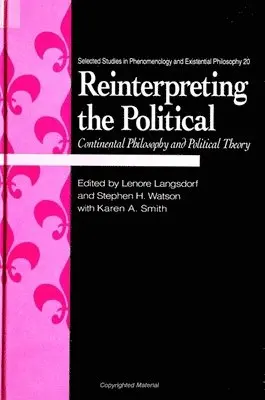
Rereads classical figures in continental thought, takes up current topics in the legacy of political theory, and analyzes and evaluates Foucault's work as a prime manifestation of the complicated modern interface between truth and power, institution and liberation.The task of reinterpretation arises from recognition, within continental philosophy, of a certain abandonment of political philosophy for historicism or a scientistic search for laws. Contemporary debate over the death of the possibility of the subject now focuses on the links among knowledge, virtue and power. As a result, the ancient problem of the institution of the form of the political becomes linked with struggles intrinsic to the task of representation and recognition. The problem now becomes one of understanding the meaning of judgment, autonomy, and consensus in the midst of the fragmentation of the hierarchies that structure the political, and have structured the thinking (from Plato to Hegel) that we identify as metaphysical. Such fragmentation doubtless is the ancient inheritance of democracy, but now without the metaphysical assurance of a transcendental authority, whether resident in nature, community, or the monarch as embodiment of the sacred. Perhaps it is in Foucault's work, more than anywhere else, that the investigation of the complicated modern interface between truth and power, and institution and liberation, occurs.In reinterpreting the political, recognition of ideological forces in the legacy of modernity in its theoretical and institutional forms cannot be escaped-particularly in recognizing the underdetermined character of the subject matter. This collection represents rich examples of such reinterpretations. It begins with rereading the classical figures in continental thought and then takes up current topics in the legacy of political theory. The final section provides analyses and evaluations of Foucault's work.