Louis H. Feldman - Böcker
Visar alla böcker från författaren Louis H. Feldman. Handla med fri frakt och snabb leverans.
9 produkter
9 produkter
1 341 kr
Skickas inom 10-15 vardagar
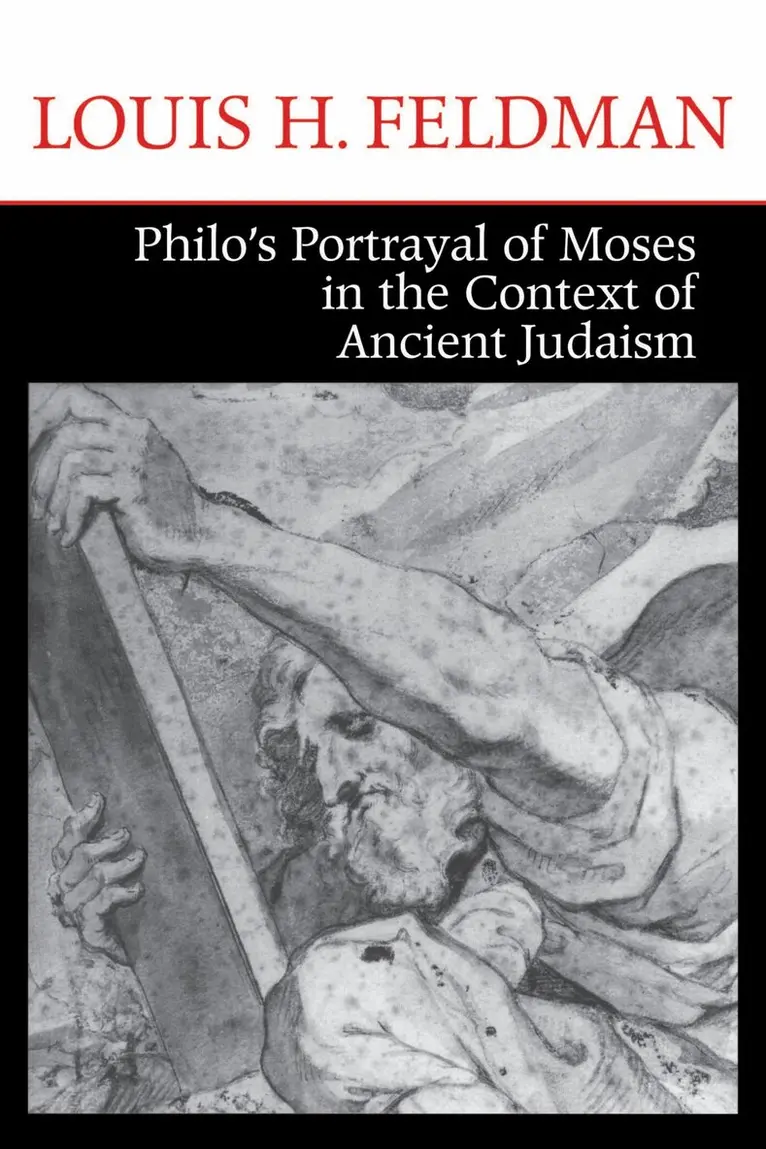
Philo's Portrayal of Moses in the Context of Ancient Judaism presents the most comprehensive study of Philo's De Vita Mosis that exists in any language. Feldman, well known for his work on Josephus and ancient Judaism, here paves new ground using rabbinic material with philological precision to illuminate important parallels and differences between Philo's writing on Moses and rabbinic literature. One way in which Hellenistic culture marginalized Judaism was by exposing the apparent defects in Moses' life and character. Philo's De Vita Mosis is a counterattack to these charges and is a vital piece of his attempt to reconcile Judaism and Hellenism. Feldman rigorously examines the text and shows how Philo presents a narrative of Moses's life similar to that of a mythical divine and heroic figure, glorifying his birth, education, and virtues. Feldman demonstrates that Philo is careful to explain in a scientific way those portions of the Bible, particularly miracles, that appear incredible to his skeptical Hellenistic readers. Through Feldman's careful analysis, Moses emerges as unique among ancient lawgivers.Philo's Portrayal of Moses in the Context of Ancient Judaism mirrors the organization of Philo's biography of Moses, which is in two books, the first, in the style of Plutarch, proceeding chronologically, and the second, in the style of Suetonius, arranged topically. Following an introductory chapter, Feldman's study discusses the life of Moses chronologically in the second chapter and examines his virtues topically in the third. Feldman compares the particular features of Philo's portrait of Moses with the way in which Moses is viewed both by Jewish sources in antiquity (including Pseudo-Philo; Josephus; Graeco-Jewish historians, poets, and philosophers; and in the Apocrypha, Pseudepigrapha, Samaritan tradition, Dead Sea Scrolls, and rabbinic tradition) and by non-Jewish sources, notably the Greek and Roman writers who mention him.
567 kr
Skickas inom 10-15 vardagar
Philo's Portrayal of Moses in the Context of Ancient Judaism presents the most comprehensive study of Philo's De Vita Mosis that exists in any language. Feldman, well known for his work on Josephus and ancient Judaism, here paves new ground using rabbinic material with philological precision to illuminate important parallels and differences between Philo's writing on Moses and rabbinic literature. One way in which Hellenistic culture marginalized Judaism was by exposing the apparent defects in Moses' life and character. Philo's De Vita Mosis is a counterattack to these charges and is a vital piece of his attempt to reconcile Judaism and Hellenism. Feldman rigorously examines the text and shows how Philo presents a narrative of Moses's life similar to that of a mythical divine and heroic figure, glorifying his birth, education, and virtues. Feldman demonstrates that Philo is careful to explain in a scientific way those portions of the Bible, particularly miracles, that appear incredible to his skeptical Hellenistic readers. Through Feldman's careful analysis, Moses emerges as unique among ancient lawgivers.Philo's Portrayal of Moses in the Context of Ancient Judaism mirrors the organization of Philo's biography of Moses, which is in two books, the first, in the style of Plutarch, proceeding chronologically, and the second, in the style of Suetonius, arranged topically. Following an introductory chapter, Feldman's study discusses the life of Moses chronologically in the second chapter and examines his virtues topically in the third. Feldman compares the particular features of Philo's portrait of Moses with the way in which Moses is viewed both by Jewish sources in antiquity (including Pseudo-Philo; Josephus; Graeco-Jewish historians, poets, and philosophers; and in the Apocrypha, Pseudepigrapha, Samaritan tradition, Dead Sea Scrolls, and rabbinic tradition) and by non-Jewish sources, notably the Greek and Roman writers who mention him.
Del 27 - Hellenistic Culture and Society
Josephus's Interpretation of the Bible
Inbunden, Engelska, 1999
1 543 kr
Skickas inom 3-6 vardagar
Josephus (A.D. 37-?100), a pro-Roman Jew closely associated with the emperor Titus, is the earliest systematic commentator on the Bible, as well as one of the foremost historians of the beginning of the Christian era. Politically, Josephus was pro-Roman, and although he had no sympathy for extreme Jewish nationalism, he was a zealous defender of Jewish religion and culture. Louis H. Feldman examines the principles that guided Josephus in his understanding of the Bible, investigating his creative contribution in the rewriting of biblical accounts. This comprehensive study evaluates Josephus as a historian and demonstrates the originality and consistency of his work as an author. The first part of Feldman's work attempts to understand Josephus's purposes and techniques in retelling the Bible. The second part reviews Josephus's treatment of twelve key biblical figures. In addition to its reevaluation of an important early historian, this unique compendium provides a mine of information on the reassessment of the most important biblical figures.
1 564 kr
Skickas inom 5-8 vardagar
This comprehensive treasury of sources on Judaism in the ancient period will be valued and used by students, scholars and general readers who are interested in Jewish history, classical studies, or the origins of Christianity. Two of the worlds leading authorities on the classical perios bring together a truly remarkable range of ancient sources in an accessible and interesting way. Included are helpful introductions, a glossary, maps, illustrations, and other aids for reading and research. This book also includes the most comprehensive coverage available of sources in the area of anti-Semitism and (what is usually more neglected) philo-Semitism. it co-ordinates literary, epigraphical, papyrological, and numismatic evidence. "It is an excellent idea to make this material available to a broad audience. (The editors are) scholars of immense learning, and there could be no one better for this task" - E.P. Sanders, Duke University. Louis H. Feldman is Professor of Classics at Yeshive University, New York. Meyer Reinhold is Professor Emeritus of Classical Studies at Boston University.
Jew and Gentile in the Ancient World
Attitudes and Interactions from Alexander to Justinian
Häftad, Engelska, 1996
1 122 kr
Skickas inom 3-6 vardagar
Relations between Jews and non-Jews in the Hellenistic-Roman period were marked by suspicion and hate, maintain most studies of that topic. But if such conjectures are true, asks Louis Feldman, how did Jews succeed in winning so many adherents, whether full-fledged proselytes or "sympathizers" who adopted one or more Jewish practices? Systematically evaluating attitudes toward Jews from the time of Alexander the Great to the fifth century A.D., Feldman finds that Judaism elicited strongly positive and not merely unfavorable responses from the non-Jewish population. Jews were a vigorous presence in the ancient world, and Judaism was strengthened substantially by the development of the Talmud. Although Jews in the Diaspora were deeply Hellenized, those who remained in Israel were able to resist the cultural inroads of Hellenism and even to initiate intellectual counterattacks. Feldman draws on a wide variety of material, from Philo, Josephus, and other Graeco-Jewish writers through the Apocrypha, the Pseudepigrapha, the Church Councils, Church Fathers, and imperial decrees to Talmudic and Midrashic writings and inscriptions and papyri.What emerges is a rich description of a long era to which conceptions of Jewish history as uninterrupted weakness and suffering do not apply.
622 kr
Skickas inom 3-6 vardagar
3 680 kr
Skickas inom 7-10 vardagar
Customers in Europe should contact Combined Academic Publishers to order a copy of this book.Browse the Table of ContentsThe Hebrew Bible is only part of ancient Israel's writings. Another collection of Jewish works has survived from late- and post-biblical times, a great library that bears witness to the rich spiritual life of Jews in that period. This library consists of the most varied sorts of texts: apocalyptic visions and prophecies, folktales and legends, collections of wise sayings, laws and rules of conduct, commentaries on Scripture, ancient prayers, and much, much more.While specialists have studied individual texts or subsections of this vast library, Outside the Bible seeks for the first time to bring together all the major components into a single collection, gathering portions of the Dead Sea Scrolls, the Septuagint, the biblical Apocrypha, and Pseudepigrapha, and the writings of Philo of Alexandria and Josephus.The editors have brought together these diverse works in order to highlight what has often been neglected; their common Jewish background. For this reason the commentaries that accompany the texts devote special attention to references to Hebrew Scripture and to issues of halakhah (Jewish law), their allusions to motifs and themes known from later Rabbinic writings in Talmud and Midrash, their evocation of recent or distant events in Jewish history, and their references to other texts in this collection.The work of more than seventy contributing experts in a range of fields, Outside the Bible offers new insights into the development of Judaism and Early Christianity. This three-volume set of translations, introductions, and detailed commentaries is a must-have for scholars, students, and anyone interested in this great body of ancient Jewish writings.The collection includes a general introduction and opening essays, new and revised translations, and detailed introductions, commentaries, and notes that place each text in its historical and cultural context. A timeline of the Second Temple Period, two appendixes (Books of the Bible; Second Temple Literature), and a general subject index complete the set.
Del 31 - Monographs of the Hebrew Union College
Remember Amalek!
Vengeance, Zealotry, and Group Destruction in the Bible according to Philo, Pseudo-Philo, and Josephus
Häftad, Engelska, 2004
472 kr
Skickas inom 5-8 vardagar
The divine command to exterminate Amalek--men, women, children, and even animals who have no free will--is what in contemporary terms has been called genocide. Louis Feldman explores how the earliest systematic commentators on the Bible--the Hellenistic Jewish philosopher Philo in his many essays on biblical themes; the mysterious, still unclassified Pseudo-Philo in his Biblical Antiquities; the premier Jewish historian and polymath Josephus in his Jewish Antiquities; and the Rabbis in the Mishnah, Talmud, and other literature-wrestled with the issues involved in this divine command, especially its provision that an entire people must be eternally punished for the misdeeds of their ancestors. Feldman contextualizes his study of Amalek by considering how these ancient commentators relate to other cases where God commands the destruction of whole groups of people: the flood, the destruction of Sodom and Gomorrah, the plague of the first-born Egyptians, and the command to annihilate the Canaanites. He also studies accounts of mass destruction where there was no specific divine commandment-the annihilation of the Hivites because one of them raped Dinah, the annihilation of the nations of Sihon and Og, the complete destruction of the inhabitants of Jericho, and the extermination of the priests of Nob-as well as the challening issue of why God justifies Phinehas's zealotry, which involved transgressing the law to kill a Jew and a non-Jew for their immorality. All of these biblical passages raise difficult questions and provide no simple answers. Feldman shows us how ancient commentators received and struggled with Amalek and other genocide passages: Psuedo-Philo had the fewest problems and is most insistent on interpreting the divine command literally, while Philo turned to allegory to resolve the tensions these passages raised with the principle that the innocent should not suffer for the sins of the guilty, and Josephus was concerned to counter the impression that Jews hate non-Jews. Feldman's study exposes the deep roots of biblical reception in contemporary political and moral issues.
6 899 kr
Skickas inom 5-8 vardagar
No detailed description available for "Josephus and Modern Scholarship (1937–1980)".