Ludwig Fahrmeir - Böcker
Visar alla böcker från författaren Ludwig Fahrmeir. Handla med fri frakt och snabb leverans.
14 produkter
14 produkter
Del 36 - Oxford Statistical Science Series
Bayesian Smoothing and Regression for Longitudinal, Spatial and Event History Data
Inbunden, Engelska, 2011
1 532 kr
Skickas inom 7-10 vardagar
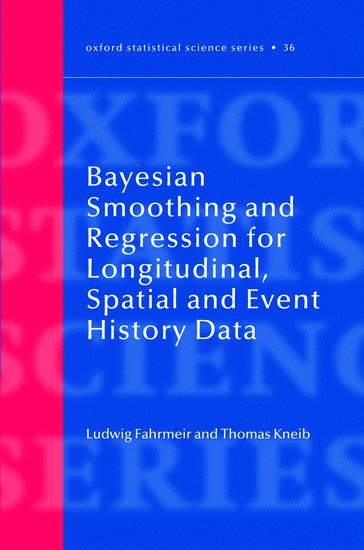
Several recent advances in smoothing and semiparametric regression are presented in this book from a unifying, Bayesian perspective. Simulation-based full Bayesian Markov chain Monte Carlo (MCMC) inference, as well as empirical Bayes procedures closely related to penalized likelihood estimation and mixed models, are considered here. Throughout, the focus is on semiparametric regression and smoothing based on basis expansions of unknown functions and effects in combination with smoothness priors for the basis coefficients.Beginning with a review of basic methods for smoothing and mixed models, longitudinal data, spatial data and event history data are treated in separate chapters. Worked examples from various fields such as forestry, development economics, medicine and marketing are used to illustrate the statistical methods covered in this book. Most of these examples have been analysed using implementations in the Bayesian software, BayesX, and some with R Codes. These, as well as some of the data sets, are made publicly available on the website accompanying this book.
2 642 kr
Skickas inom 10-15 vardagar
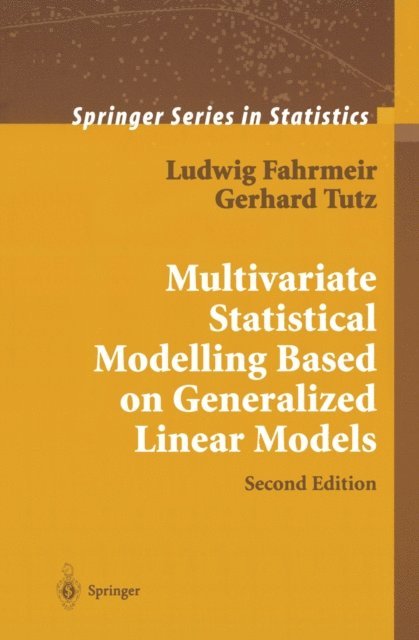
Since our first edition of this book, many developments in statistical mod elling based on generalized linear models have been published, and our primary aim is to bring the book up to date. Naturally, the choice of these recent developments reflects our own teaching and research interests. The new organization parallels that of the first edition. We try to motiv ate and illustrate concepts with examples using real data, and most data sets are available on http:/ fwww. stat. uni-muenchen. de/welcome_e. html, with a link to data archive. We could not treat all recent developments in the main text, and in such cases we point to references at the end of each chapter. Many changes will be found in several sections, especially with those connected to Bayesian concepts. For example, the treatment of marginal models in Chapter 3 is now current and state-of-the-art. The coverage of nonparametric and semiparametric generalized regression in Chapter 5 is completely rewritten with a shift of emphasis to linear bases, as well as new sections on local smoothing approaches and Bayesian inference. Chapter 6 now incorporates developments in parametric modelling of both time series and longitudinal data. Additionally, random effect models in Chapter 7 now cover nonparametric maximum likelihood and a new section on fully Bayesian approaches. The modifications and extensions in Chapter 8 reflect the rapid development in state space and hidden Markov models.
Del 78 - Lecture Notes in Statistics
Advances in GLIM and Statistical Modelling
Proceedings of the GLIM92 Conference and the 7th International Workshop on Statistical Modelling, Munich, 13–17 July 1992
Häftad, Engelska, 1992
1 061 kr
Skickas inom 10-15 vardagar
This volume presents the published Proceedings of the joint meeting of GUM92 and the 7th International Workshop on Statistical Modelling, held in Munich, Germany from 13 to 17 July 1992. The meeting aimed to bring together researchers interested in the development and applications of generalized linear modelling in GUM and those interested in statistical modelling in its widest sense. This joint meeting built upon the success of previous workshops and GUM conferences. Previous GUM conferences were held in London and Lancaster, and a joint GUM Conference/4th Modelling Workshop was held in Trento. (The Proceedings of previous GUM conferences/Statistical Modelling Workshops are available as numbers 14 , 32 and 57 of the Springer Verlag series of Lecture Notes in Statistics). Workshops have been organized in Innsbruck, Perugia, Vienna, Toulouse and Utrecht. (Proceedings of the Toulouse Workshop appear as numbers 3 and 4 of volume 13 of the journal Computational Statistics and Data Analysis). Much statistical modelling is carried out using GUM, as is apparent from many of the papers in these Proceedings. Thus the Programme Committee were also keen on encouraging papers which addressed problems which are not only of practical importance but which are also relevant to GUM or other software development. The Programme Committee requested both theoretical and applied papers. Thus there are papers in a wide range of practical areas, such as ecology, breast cancer remission and diabetes mortality, banking and insurance, quality control, social mobility, organizational behaviour.
2 642 kr
Skickas inom 10-15 vardagar
Since our first edition of this book, many developments in statistical mod elling based on generalized linear models have been published, and our primary aim is to bring the book up to date. Naturally, the choice of these recent developments reflects our own teaching and research interests. The new organization parallels that of the first edition. We try to motiv ate and illustrate concepts with examples using real data, and most data sets are available on http:/ fwww. stat. uni-muenchen. de/welcome_e. html, with a link to data archive. We could not treat all recent developments in the main text, and in such cases we point to references at the end of each chapter. Many changes will be found in several sections, especially with those connected to Bayesian concepts. For example, the treatment of marginal models in Chapter 3 is now current and state-of-the-art. The coverage of nonparametric and semiparametric generalized regression in Chapter 5 is completely rewritten with a shift of emphasis to linear bases, as well as new sections on local smoothing approaches and Bayesian inference. Chapter 6 now incorporates developments in parametric modelling of both time series and longitudinal data. Additionally, random effect models in Chapter 7 now cover nonparametric maximum likelihood and a new section on fully Bayesian approaches. The modifications and extensions in Chapter 8 reflect the rapid development in state space and hidden Markov models.
3 581 kr
Skickas inom 7-10 vardagar
920 kr
Skickas inom 10-15 vardagar
Jeder Kredit birgt für den Kreditgeber ein Risiko, da es unsicher ist, ob der Kreditnehmer seinen Zahlungsverpflichtungen nachkommen wird. Es bietet einen Einstieg in die Kreditrisikomessung und die dafür notwendige Statistik.
401 kr
Skickas inom 10-15 vardagar
Dieses Arbeitsbuch ergänzt perfekt das Lehrbuch Fahrmeir/Künstler/Pigeot/Tutz: Statistik - Der Weg zur Datenanalyse. Es dient damit der Vertiefung und der Einübung des im Lehrbuch vermittelten Stoffes zur Wahrscheinlichkeitsrechnung, deskriptiven und induktiven Statistik.
819 kr
Skickas inom 10-15 vardagar
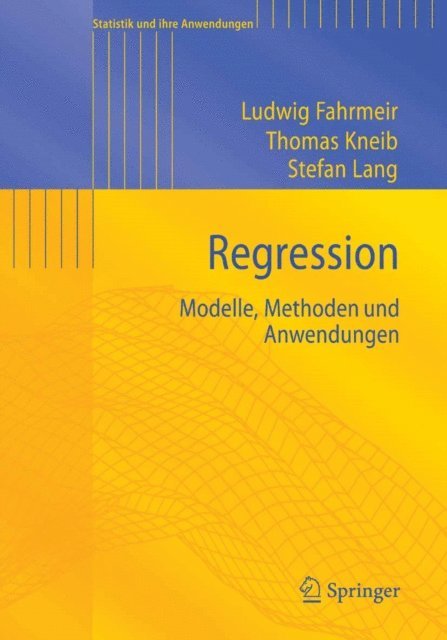
In dieser Einführung werden erstmals klassische Regressionsansätze und moderne nicht- und semiparametrische Methoden in einer integrierten, einheitlichen und anwendungsorientierten Form beschrieben. Die Darstellung wendet sich an Studierende der Statistik in Wahl- und Hauptfach sowie an empirisch-statistisch und interdisziplinär arbeitende Wissenschaftler und Praktiker, zum Beispiel in Wirtschafts- und Sozialwissenschaften, Bioinformatik, Biostatistik, Ökonometrie, Epidemiologie. Die praktische Anwendung der vorgestellten Konzepte und Methoden wird anhand ausführlich vorgestellter Fallstudien demonstriert, um dem Leser die Analyse eigener Fragestellungen zu ermöglichen.
1 770 kr
Skickas inom 5-8 vardagar
Thus, the book primarily targets an audience that includes students, teachers and practitioners in social, economic, and life sciences, as well as students and teachers in statistics programs, and mathematicians and computer scientists with interests in statistical modeling and data analysis.
1 693 kr
Skickas inom 10-15 vardagar
Now in its second edition, this textbook provides an applied and unified introduction to parametric, nonparametric and semiparametric regression that closes the gap between theory and application. The most important models and methods in regression are presented on a solid formal basis, and their appropriate application is shown through numerous examples and case studies. The most important definitions and statements are concisely summarized in boxes, and the underlying data sets and code are available online on the book’s dedicated website. Availability of (user-friendly) software has been a major criterion for the methods selected and presented.The chapters address the classical linear model and its extensions, generalized linear models, categorical regression models, mixed models, nonparametric regression, structured additive regression, quantile regression and distributional regression models. Two appendices describe the required matrix algebra, as well as elements of probability calculus and statistical inference.In this substantially revised and updated new edition the overview on regression models has been extended, and now includes the relation between regression models and machine learning, additional details on statistical inference in structured additive regression models have been added and a completely reworked chapter augments the presentation of quantile regression with a comprehensive introduction to distributional regression models. Regularization approaches are now more extensively discussed in most chapters of the book.The book primarily targets an audience that includes students, teachers and practitioners in social, economic, and life sciences, as well as students and teachers in statistics programs, and mathematicians and computer scientists with interests in statistical modeling and data analysis. It is written at an intermediate mathematical level and assumes only knowledge of basic probability, calculus, matrix algebra and statistics.
1 272 kr
Skickas inom 10-15 vardagar
Now in its second edition, this textbook provides an applied and unified introduction to parametric, nonparametric and semiparametric regression that closes the gap between theory and application. The most important models and methods in regression are presented on a solid formal basis, and their appropriate application is shown through numerous examples and case studies. The most important definitions and statements are concisely summarized in boxes, and the underlying data sets and code are available online on the book’s dedicated website. Availability of (user-friendly) software has been a major criterion for the methods selected and presented.The chapters address the classical linear model and its extensions, generalized linear models, categorical regression models, mixed models, nonparametric regression, structured additive regression, quantile regression and distributional regression models. Two appendices describe the required matrix algebra, as well as elements of probability calculus and statistical inference.In this substantially revised and updated new edition the overview on regression models has been extended, and now includes the relation between regression models and machine learning, additional details on statistical inference in structured additive regression models have been added and a completely reworked chapter augments the presentation of quantile regression with a comprehensive introduction to distributional regression models. Regularization approaches are now more extensively discussed in most chapters of the book.The book primarily targets an audience that includes students, teachers and practitioners in social, economic, and life sciences, as well as students and teachers in statistics programs, and mathematicians and computer scientists with interests in statistical modeling and data analysis. It is written at an intermediate mathematical level and assumes only knowledge of basic probability, calculus, matrix algebra and statistics.
582 kr
Skickas inom 7-10 vardagar
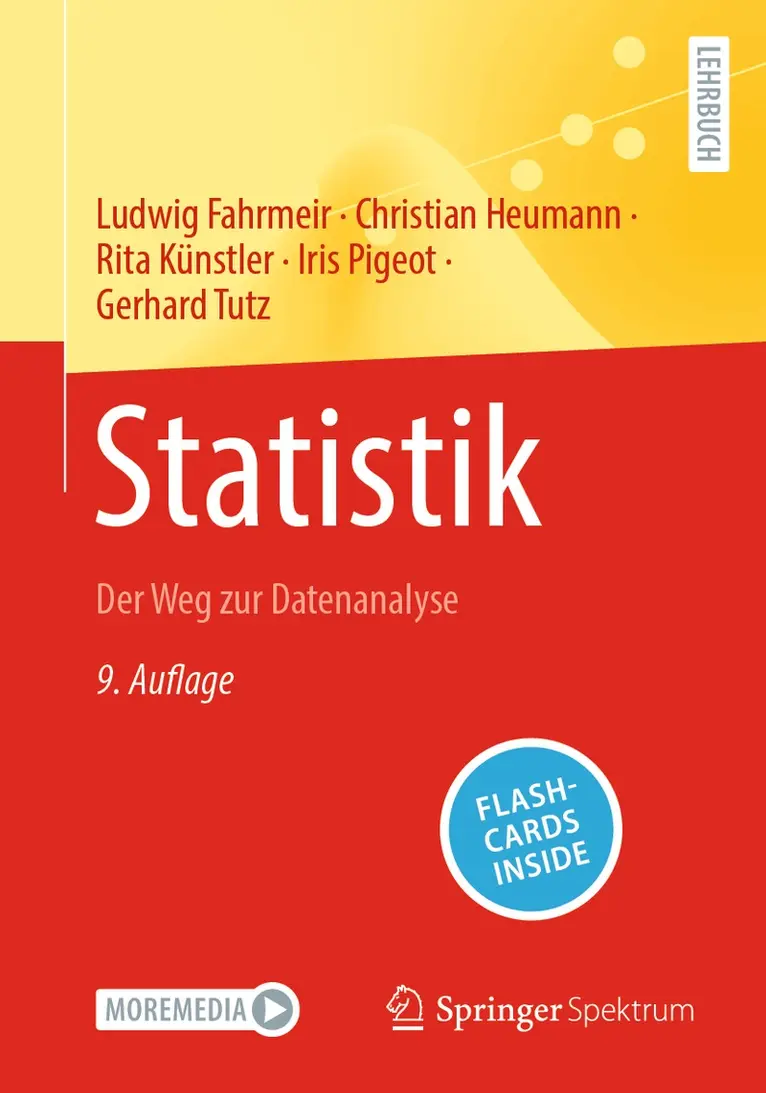
Dieses Lehrbuch liefert eine umfassende Darstellung der deskriptiven und induktiven Statistik sowie moderner Methoden der explorativen Datenanalyse. Dabei stehen inhaltliche Motivation, Interpretation und Verständnis der Methoden im Vordergrund. Unterstützt werden diese durch zahlreiche Grafiken und Anwendungsbeispiele, die auf realen Daten basieren, sowie passende exemplarische R-Codes und Datensätze. Die im Buch beschriebenen Ergebnisse können außerdem anhand der online zur Verfügung stehenden Materialien reproduziert sowie um eigene Analysen ergänzt werden. Eine kurze Einführung in die freie Programmiersprache R ist ebenfalls enthalten. Hervorhebungen erhöhen die Lesbarkeit und Übersichtlichkeit. Das Buch eignet sich als vorlesungsbegleitende Lektüre, aber auch zum Selbststudium.Für die 9. Auflage wurde das Buch inhaltlich überarbeitet und ergänzt. Leserinnen und Leser erhalten nun in der Springer-Nature-Flashcards-App zusätzlich kostenfreien Zugriff auf über 100 exklusive Lernfragen, mit denen sie ihr Wissen überprüfen können.
1 396 kr
Kommande
Dieses Buch schließt die Lücke zwischen statistischer Grundlagenliteratur und mathematisch anspruchsvollen Werken zur Modellierung von Kreditrisiken: Ausgehend von den wichtigsten Begriffen zum Kreditrisiko werden deren statistische Analoga beschrieben. Das Buch stellt die relevanten statistischen Verteilungen dar und gibt eine Einführung in stochastische Prozesse, Portfoliomodelle und Score- bzw. Ratingmodelle. Mit zahlreichen praxisnahen Beispielen ist es der ideale Einstieg in die Kreditrisikomessung für Praktiker und Quereinsteiger.Für die vorliegende zweite Auflage wurden verschiedene Ergänzungen und zahlreiche Aktualisierungen vorgenommen: Ergänzt wurde insbesondere wurde ein Kapitel zur Regulatorik, welches die regulatorischen Entwicklungen durch die Basel-Regelwerke sowie ihre Bedeutung für die Kreditrisikomessung darstellt und einen Ausblick zur weiteren Entwicklung gibt. Durch einen kurzen Überblick zu künstlicher Intelligenz im Kontext der Scoreentwicklung sowie einen Anhang zu neuronalen Netzen werden Entwicklungen im Bereich KI möglichst aktuell und zeitlos aufgegriffen.
607 kr
Kommande
Dieses Arbeitsbuch bietet 227 Aufgaben mit vollständigen Lösungen – ideal zum Üben, Wiederholen und zur Klausurvorbereitung. Viele der Aufgaben sind als Übungen mit dem Statistikprogramm R konzipiert und nutzen digital bereitgestellte Datensätze.Abgedeckte Themen sind insbesondere: Grundlagen der Stochastik, deskriptive und explorative Datenanalyse, induktive Statistik, Regressions- und Varianzanalyse sowie Zeitreihenanalyse.Das Arbeitsbuch ist dabei inhaltlich und strukturell auf das Lehrbuch Statistik – Der Weg zur Datenanalyse von Fahrmeir/Heumann/Künstler/Pigeot/Tutz in der 9. Auflage abgestimmt: Alle 99 Aufgaben aus dem Lehrbuch werden hier ausführlich gelöst und durch Verweise eng mit diesem verknüpft. Beide Bücher sind aber auch unabhängig voneinander nutzbar.Für die vorliegende 6. Auflage des Arbeitsbuchs wurden etliche Aufgaben neu aufgenommen bzw. bisherige Aufgaben durch aktuellere ersetzt.