Max Dresden – författare
Visar alla böcker från författaren Max Dresden. Handla med fri frakt och snabb leverans.
5 produkter
H.A. Kramers Between Tradition and Revolution
Av Max Dresden
Häftad, 2011
1093 kr
Lägg i varukorg
It is now a little more than 11 years since the idea of writing a personal and scientific biography of H. A. Kramers took hold of me. A few days earlier I had been lecturing, in a course on field theory, on the renormalization proce dures of relativistic quantum field theory. Since the students …
Pions to Quarks
Particle Physics in the 1950s
Av Laurie Mark Brown, Max Dresden m. fl.
Häftad, 2009
944 kr
Lägg i varukorg
Editors Laurie Brown, Max Dresden and Lillian Hoddeson have assembled a prestigious group of physicists and historians of science to present a broadly balanced picture of this exciting scientific era that witnessed the coming of age of particle physics and its development into 'big science'. The …
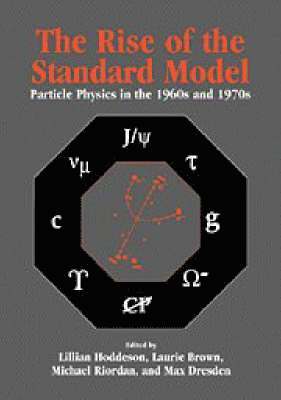
The Rise of the Standard Model
A History of Particle Physics from 1964 to 1979
Av Lillian Hoddeson, Laurie Brown m. fl.
Häftad, 1997
771 kr
Lägg i varukorg
Editors Laurie Brown, Max Dresden, Lillian Hoddeson and Michael Riordan have brought together a distinguished group of elementary particle physicists and historians of science to explore the recent history of particle physics. Based on a conference held at Stanford University, this is the third …
H.A. Kramers Between Tradition and Revolution
Av Max Dresden
E-bok, 2012
1427 kr
Lägg i varukorg
It is now a little more than 11 years since the idea of writing a personal and scientific biography of H. A. Kramers took hold of me. A few days earlier I had been lecturing, in a course on field theory, on the renormalization proce dures of relativistic quantum field theory. Since the students …
Rise of the Standard Model
A History of Particle Physics from 1964 to 1979
Av Lillian Hoddeson, Laurie Brown m. fl.
Inbunden, 1997
1157 kr
Tillfälligt slut
Editors Laurie Brown, Max Dresden, Lillian Hoddeson and Michael Riordan have brought together a distinguished group of elementary particle physicists and historians of science to explore the recent history of particle physics. Based on a conference held at Stanford University, this is the third …