• Fri frakt över 249 kr
  • •
  • Snabba leveranser
  • •
  • Billiga böcker
Kundservice

Du är på sajten för privatpersoner.

Företag, bibliotek eller offentlig verksamhet?

Du handlar på classic.bokus.com, där alla dina funktioner finns intakta.
Till classic.bokus.com
Bokus logotyp. Gå till startsidan.
  • Erbjudanden
  • Nyheter
  • Student
  • Topplistor
  • Barn & ungdom
  • Bokus Play
  • E-böcker
  • Pocketböcker
  • Spel & pussel

10% rabatt på allt med kod: NYSTART10 →

Sidfot

Mina sidor

    Hjälp

    • Kundservice
    • Vanliga frågor och svar
    • Frakt och leverans
    • Retur vid ångerrätt
    • Reklamera vara
    • Betalning
    • Köpvillkor
    • Allmänna villkor
    • Information om webbplatsens tillgänglighet

    Om Bokus

    • Om oss
    • Pressrum
    • För studenter
    • För företag
    • För bibliotek och offentlig verksamhet
    • För leverantörer
    • Hållbarhet

    Populärt

    • Aktuella erbjudanden
    • Presentkort
    • Studentlitteratur
    • Nya böcker
    • Topplistor
    • Signerade böcker
    • Engelska böcker

    Inspiration

    • Boktips
    • BookTok
    • Populära bokserier
    • Barnbokskaraktärer
    • Populära författare
    Logotyp för Bokus
    Följ oss på Facebook (extern länk)Följ oss på Instagram (extern länk)Följ oss på YouTube (extern länk)Följ oss på TikTok (extern länk)
    bokus @ CookiesAnpassa cookiesIntegritetspolicyKöpvillkor
    Till Citymail hemsida (extern länk)Till Budbee hemsida (extern länk)Till Postnord hemsida (extern länk)Till Schenker hemsida (extern länk)Till Early Bird hemsida (extern länk)Till Walleys hemsida (extern länk)
    1. Naturvetenskap och teknik
    2. Matematik och naturvetenskap
    3. Fysik

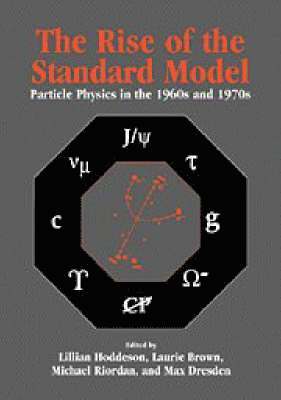
    Rise of the Standard Model

    A History of Particle Physics from 1964 to 1979

    AvLillian Hoddeson,Laurie Brown

    Inbunden, Engelska, 1997

    1 120 kr

    Tillfälligt slut

    Beskrivning

    Editors Laurie Brown, Max Dresden, Lillian Hoddeson and Michael Riordan have brought together a distinguished group of elementary particle physicists and historians of science to explore the recent history of particle physics. Based on a conference held at Stanford University, this is the third volume of a series recounting the history of particle physics and offers the most up-to-date account of the rise of the Standard Model, which explains the microstructure of the world in terms of quarks and leptons and their interactions. Major contributors include Steven Weinberg, Murray Gell-Mann, Michael Redhead, Silvan Schweber, Leon Lederman and John Heilbron. The wide-ranging articles explore the detailed scientific experiments, the institutional settings in which they took place, and the ways in which the many details of the puzzle fit together to account for the Standard Model.

    Produktinformation

    • Utgivningsdatum:1997-11-13
    • Mått:160 x 237 x 45 mm
    • Vikt:1 180 g
    • Format:Inbunden
    • Språk:Engelska
    • Antal sidor:744
    • Förlag:Cambridge University Press
    • ISBN:9780521570824

    Utforska kategorier

    • Fysik inom Naturvetenskap och teknik
    • Naturvetenskapens historia inom Naturvetenskap och teknik

    Recensioner i media

    '… a beautifully produced collection of essays by most of the leading scientists involved - including no fewer than eight Nobel laureates - and several eminent historians … both practitioners and knowledgeable bystanders can draw inspiration from these reflections on what may turn out to have been the golden age of particle physics.' Graham Farmelo, New Scientist

    Innehållsförteckning

    • Contributors; Editors' acknowledgements; Photographs of the symposium; Abbreviations and acronyms; Mathematical notation; Part I. Introduction: 1. The rise of the standard model: 1964–1979 Laurie M. Brown, Michael Riordan, Max Dresden, and Lillian Hoddeson; 2. Changing attitudes and the standard model Steven Weinberg; 3. Two previous standard models J. L. Heilbron; Part II. Quarks and Leptons: 4. From the psi to charmed mesons: three years with the SLAC-LBL detector at SPEAR Gerson Goldhaber; 5. The discovery of the tau lepton Martin Perl; 6. The discovery of the upsilon, bottom quark and B mesons Leon M. Lederman; 7. The discovery of CP violation James Cronin; 8. Flavor mixing and CP violation Makoto Kobayashi; Part III. Toward Gauge Theories: 9. The path to renormalizability Martinus Veltman; 10. Renormalization of gauge theories Gerard 't Hooft; 11. Asymptotic freedom and the emergence of QCD David Gross; 12. Quark confinement Leonard Susskind; 13. A view from the island Alexander Polyakov; 14. On the early days of the renormalization group Dmitrij V. Shirkov; Part IV. Accelerators, Detectors, and Laboratories: 15. The rise of colliding beams Burton Richter; 16. The CERN intersecting storage rings: the leap into the hadron collider era Kjell Johnsen; 17. Development of large detectors for colliding-beam experiments Roy Schwitters; 18. Pure and hybrid detectors: mark I and the psi Peter Galison; 19. Building fermilab: a user's paradise Robert R. Wilson and Adrienne Kolb; 20. Panel session: science policy and the social structure of big laboratories Catherine Westfall; 21. Some sociological consequences of high-energy physicists' development of the standard model Mark Bodnarczuk; 22. Comments on accelerators, detectors, and laboratories John Krige; Part V. Electroweak Unification: 23. The first gauge theory of the weak interactions Sidney Bludman; 24. The early history of high-energy neutrino physics Melvin Schwartz; 25. Gargamelle and the discovery of neutral currents Donald Perkins; 26. What a fourth quark can do John Iliopoulos; 27. Weak-electromagnetic interference in polarized electron-deuteron scattering Charles Prescott; 28. Panel session: spontaneous breaking of symmetry Laurie M. Brown, Robert Brout, Tian Yu Cao, Peter Higgs, and Yoichiro Nambu; Part VI. The Discovery of Quarks and Gluons: 29. Early baryon and meson spectroscopy culminating in the discovery of the omega-minus and charmed baryons Nicholas Samios; 30. Quark models and quark phenomenology Harry Lipkin; 31. From the nonrelativistic quark model to QCD and back Giacomo Morpurgo; 32. Deep-inelastic scattering and the discovery of quarks Jerome Friedman; 33. Deep-inelastic scattering: from current algebra to partons James Bjorken; 34. Hadron jets and the discovery of the gluon Sau Lan Wu; Part VII. Personal Overviews: 35. Quarks, color, and QCD Murray Gell-Mann; 36. The philosopher problem Paul Teller; 37. Should we believe in quarks and QCD? Michael Redhead; 38. A historical perspective on the rise of the standard model Silvan Schweber; Index.