Michael Strevens – författare
Visar alla böcker från författaren Michael Strevens. Handla med fri frakt och snabb leverans.
7 produkter
7 produkter
141 kr
Skickas inom 3-6 vardagar
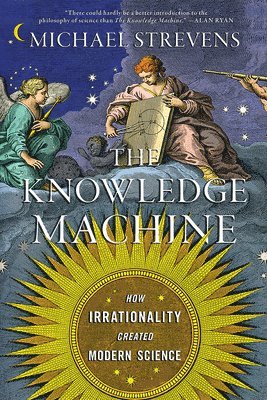
Rich with tales of discovery from Galileo to general relativity, a stimulating and timely analysis of how science works and why we need it.'The best introduction to the scientific enterprise that I know. A wonderful and important book' David Wootton, author of The Invention of ScienceIt is only in the last three centuries that the formidable knowledge-making machine we call modern science has transformed our way of life and our vision of the universe - two thousand years after the invention of law, philosophy, drama and mathematics. Why did we take so long to invent science? And how has it proved to be so powerful?The Knowledge Machine gives a radical answer, exploring how science calls on its practitioners to do something apparently irrational: strip away all previous knowledge - such as theological, metaphysical or political beliefs - and channel unprecedented energy into observation and experiment. In times of climate extremes, novel diseases and rapidly advancing technology, Strevens contends that we need more than ever to grasp the inner workings of our knowledge machine.'A stylish and accessible investigation into the nature of the scientific method' Nigel Warburton, Philosophy Bites'This elegant book takes us to the heart of the scientific enterprise' David Papineau, King's College London, author of Knowing the Score'This book is a delight to read, richly illustrated with wonderfully told incidents from the history of natural science' Nancy Cartwright, University of California San Diego
384 kr
Skickas inom 10-15 vardagar
Many complex systems—from immensely complicated ecosystems to minute assemblages of molecules—surprise us with their simple behavior. Consider, for instance, the snowflake, in which a great number of water molecules arrange themselves in patterns with six-way symmetry. How is it that molecules moving seemingly at random become organized according to the simple, six-fold rule? How do the comings, goings, meetings, and eatings of individual animals add up to the simple dynamics of ecosystem populations? More generally, how does complex and seemingly capricious microbehavior generate stable, predictable macrobehavior?In this book, Michael Strevens aims to explain how simplicity can coexist with, indeed be caused by, the tangled interconnections between a complex system’s many parts. At the center of Strevens’s explanation is the notion of probability and, more particularly, probabilistic independence. By examining the foundations of statistical reasoning about complex systems such as gases, ecosystems, and certain social systems, Strevens provides an understanding of how simplicity emerges from complexity. Along the way, he draws lessons concerning the low-level explanation of high-level phenomena and the basis for introducing probabilistic concepts into physical theory.
316 kr
Skickas inom 7-10 vardagar
What does it mean for scientists to truly understand, rather than to merely describe, how the world works? Michael Strevens proposes a novel theory of scientific explanation and understanding that overhauls and augments the familiar causal approach to explanation. What is replaced is the test for explanatorily relevant causal information: Strevens discards the usual criterion of counterfactual dependence in favor of a criterion that turns on a process of progressive abstraction away from a fully detailed, physical causal story. The augmentations include the introduction of a new, non-causal explanatory relevance relation—entanglement—and an independent theory of the role of black-boxing and functional specification in explanation.The abstraction-centered notion of difference-making leads to a rich causal treatment of many aspects of explanation that have been either ignored or handled inadequately by earlier causal approaches, including the explanation of laws and other regularities, with particular attention to the explanation of physically contingent high-level laws, idealization in explanation, and probabilistic explanation in deterministic systems, as in statistical physics, evolutionary biology, and medicine.The result is an account of explanation that has especially significant consequences for the higher-level sciences: biology, psychology, economics, and other social sciences.
460 kr
Skickas inom 10-15 vardagar
Tychomancy—meaning “the divination of chances”—presents a set of rules for inferring the physical probabilities of outcomes from the causal or dynamic properties of the systems that produce them. Probabilities revealed by the rules are wide-ranging: they include the probability of getting a 5 on a die roll, the probability distributions found in statistical physics, and the probabilities that underlie many prima facie judgments about fitness in evolutionary biology.Michael Strevens makes three claims about the rules. First, they are reliable. Second, they are known, though not fully consciously, to all human beings: they constitute a key part of the physical intuition that allows us to navigate around the world safely in the absence of formal scientific knowledge. Third, they have played a crucial but unrecognized role in several major scientific innovations.A large part of Tychomancy is devoted to this historical role for probability inference rules. Strevens first analyzes James Clerk Maxwell’s extraordinary, apparently a priori, deduction of the molecular velocity distribution in gases, which launched statistical physics. Maxwell did not derive his distribution from logic alone, Strevens proposes, but rather from probabilistic knowledge common to all human beings, even infants as young as six months old. Strevens then turns to Darwin’s theory of natural selection, the statistics of measurement, and the creation of models of complex systems, contending in each case that these elements of science could not have emerged when or how they did without the ability to “eyeball” the values of physical probabilities.
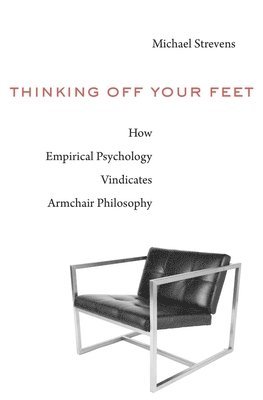
Thinking Off Your Feet
How Empirical Psychology Vindicates Armchair Philosophy
Inbunden, Engelska, 2019
406 kr
Skickas inom 10-15 vardagar
Many philosophers believe they can gain knowledge about the world from the comfort of their armchairs, simply by reflecting on the nature of things. But how can the mind arrive at substantive knowledge of the world without seeking its input? Michael Strevens proposes an original defense of the armchair pursuit of philosophical knowledge, focusing on “the method of cases,” in which judgments about category membership—Does this count as causation? Does that count as the right action to take?—are used to test philosophical hypotheses about such matters as causality, moral responsibility, and beauty.Strevens argues that the method of cases is capable of producing reliable, substantial knowledge. His strategy is to compare concepts of philosophical things to concepts of natural kinds, such as water. Philosophical concepts, like natural kind concepts, do not contain the answers to philosophers’ questions; armchair philosophy therefore cannot be conceptual analysis. But just as natural kind concepts provide a viable starting point for exploring the nature of the material world, so philosophical concepts are capable of launching and sustaining fruitful inquiry into philosophical matters, using the method of cases. Agonizing about unusual “edge cases,” Strevens shows, can play a leading role in such discoveries.Thinking Off Your Feet seeks to reshape current debates about the nature of philosophical thinking and the methodological implications of experimental philosophy, to make significant contributions to the cognitive science of concepts, and to restore philosophy to its traditional position as an essential part of the human quest for knowledge.
173 kr
Skickas inom 7-10 vardagar
Michael Strevens’s “provocative and fascinating” (Jennifer Szalai, New York Times) investigation of science asks two fundamental questions: Why is science so powerful? And why did it take so long for the human race to start using science to learn the secrets of nature? The Knowledge Machine’s radical answer is that science, by nature, calls on its practitioners to do the irrational. By willfully ignoring religion, theoretical beauty, and especially philosophy, scientists embrace an unnaturally narrow method of inquiry, channeling unprecedented energy into observation and experimentation. Rich with vivid historical examples and widely acclaimed, Knowledge Machine overturns many of our most basic assumptions about scientific discovery.
269 kr
Skickas inom 7-10 vardagar
• Why is science so powerful?• Why did it take so long—two thousand years after the invention of philosophy and mathematics—for the human race to start using science to learn the secrets of the universe?In a groundbreaking work that blends science, philosophy, and history, leading philosopher of science Michael Strevens answers these challenging questions, showing how science came about only once thinkers stumbled upon the astonishing idea that scientific breakthroughs could be accomplished by breaking the rules of logical argument.Like such classic works as Karl Popper’s The Logic of Scientific Discovery and Thomas Kuhn’s The Structure of Scientific Revolutions, The Knowledge Machine grapples with the meaning and origins of science, using a plethora of vivid historical examples to demonstrate that scientists willfully ignore religion, theoretical beauty, and even philosophy to embrace a constricted code of argument whose very narrowness channels unprecedented energy into empirical observation and experimentation. Strevens calls this scientific code the iron rule of explanation, and reveals the way in which the rule, precisely because it is unreasonably close-minded, overcomes individual prejudices to lead humanity inexorably toward the secrets of nature.“With a mixture of philosophical and historical argument, and written in an engrossing style” (Alan Ryan), The Knowledge Machine provides captivating portraits of some of the greatest luminaries in science’s history, including Isaac Newton, the chief architect of modern science and its foundational theories of motion and gravitation; William Whewell, perhaps the greatest philosopher-scientist of the early nineteenth century; and Murray Gell-Mann, discoverer of the quark. Today, Strevens argues, in the face of threats from a changing climate and global pandemics, the idiosyncratic but highly effective scientific knowledge machine must be protected from politicians, commercial interests, and even scientists themselves who seek to open it up, to make it less narrow and more rational—and thus to undermine its devotedly empirical search for truth.Rich with illuminating and often delightfully quirky illustrations, The Knowledge Machine, written in a winningly accessible style that belies the import of its revisionist and groundbreaking concepts, radically reframes much of what we thought we knew about the origins of the modern world.