Pablo T. Spiller - Böcker
Visar alla böcker från författaren Pablo T. Spiller. Handla med fri frakt och snabb leverans.
5 produkter
5 produkter
The Institutional Foundations of Public Policy in Argentina
A Transactions Cost Approach
Häftad, Engelska, 2009
428 kr
Skickas inom 7-10 vardagar
This book develops a general model of public policymaking, focusing on the difficulties of securing intertemporal exchanges among politicians. By using this model the authors are able to derive a series of empirical propositions about the conditions under which policies are likely to be volatile, rigid, or high quality. In addition, the authors combine the tools of game theory with Williamson's transaction cost theory, North's institutional arguments, and contract theory, to provide a general theory of public policymaking in a comparative political economy setting. They also undertake a detailed study of Argentina, using statistical analyses on newly developed data to complement their nuanced account of institutions, rules, incentives and outcomes. Drawing on this research the book explores the reasons for Argentina's seeming inability to design and implement high quality public policies over a sustained period of time.
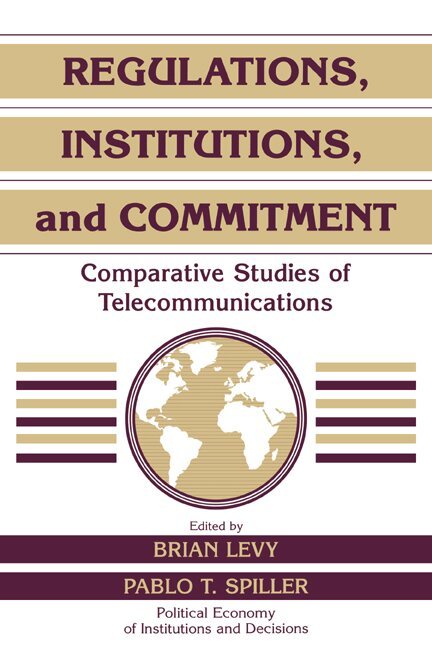
Regulations, Institutions, and Commitment
Comparative Studies of Telecommunications
Inbunden, Engelska, 1996
604 kr
Skickas inom 7-10 vardagar
The book assesses the impact of core political and social institutions on regulatory structures and performance in the telecommunications industry in Jamaica, the United Kingdom, Chile, Argentina, and the Philippines. These core institutions are shown to influence strongly the credibility and effectiveness of regulation, and thus its ability to encourage private investment and support efficiency. Currently, privatization and regulatory reform are often viewed as the solution to the problem of poor performance by telecommunications and other public utilities. This volume argues that these high expectations may not always be met because of the way a country's political and social institutions - its executive, legislative and judicial systems, its informal norms of public behaviour - interact with regulatory processes and economic conditions. In some environments, regulatory solutions run counter to the prevailing wisdom: achieving credible commitment may require an inflexible regulatory regime, and sometimes public ownership of utilities may be the only feasible alternative.
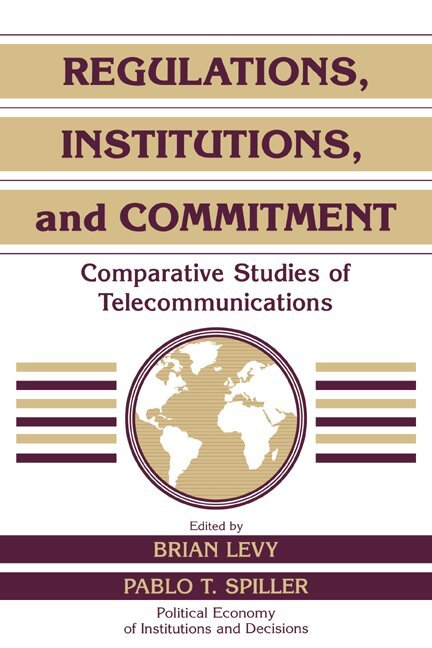
Regulations, Institutions, and Commitment
Comparative Studies of Telecommunications
Häftad, Engelska, 1996
409 kr
Skickas inom 7-10 vardagar
The book assesses the impact of core political and social institutions on regulatory structures and performance in the telecommunications industry in Jamaica, the United Kingdom, Chile, Argentina, and the Philippines. These core institutions are shown to influence strongly the credibility and effectiveness of regulation, and thus its ability to encourage private investment and support efficiency. Currently, privatization and regulatory reform are often viewed as the solution to the problem of poor performance by telecommunications and other public utilities. This volume argues that these high expectations may not always be met because of the way a country's political and social institutions - its executive, legislative and judicial systems, its informal norms of public behaviour - interact with regulatory processes and economic conditions. In some environments, regulatory solutions run counter to the prevailing wisdom: achieving credible commitment may require an inflexible regulatory regime, and sometimes public ownership of utilities may be the only feasible alternative.
The Institutional Foundations of Public Policy in Argentina
A Transactions Cost Approach
Inbunden, Engelska, 2007
1 245 kr
Skickas inom 7-10 vardagar
This book develops a general model of public policymaking, focusing on the difficulties of securing intertemporal exchanges among politicians. By using this model the authors are able to derive a series of empirical propositions about the conditions under which policies are likely to be volatile, rigid, or high quality. In addition, the authors combine the tools of game theory with Williamson's transaction cost theory, North's institutional arguments, and contract theory, to provide a general theory of public policymaking in a comparative political economy setting. They also undertake a detailed study of Argentina, using statistical analyses on newly developed data to complement their nuanced account of institutions, rules, incentives and outcomes. Drawing on this research the book explores the reasons for Argentina's seeming inability to design and implement high quality public policies over a sustained period of time.
1 177 kr
Skickas inom 10-15 vardagar
Pepsi-Cola and Coca-Cola are widely recognized as being two of the premier marketing companies in the world. They have introduced a great variety of new products and package types. They have raised celebrity advertising to a new level. Coca-Cola even changed the formula for Coke. These and other developments in the carbonated soft drink industry came about from major strategy changes by Pepsi-Cola and Coca-Cola. Rather than simply reacting to a changing competitive environment, PepsiCo and The Coca-Cola Company have created and implemented strategies that turned the new environment to their advantage. Although Pepsi-Cola attacked Coca-Cola's dominance and achieved near-parity with Coke in bottled soft drinks, both Coke and Pepsi have benefitted from fighting the Cola Wars. The battle between them has stimulated continuing growth in an industry regularly pronounced by the experts for many years to be on the verge of maturity.One widely ignored aspect of the Cola Wars is the ongoing transformation of the soft drink distribution systems of Coca-Cola and Pepsi-Cola from systems of independent bottlers to captive bottling subsidiaries. Chandler advanced the hypothesis that successful firms develop strategies to take advantage of new opportunities, and that those strategies then determine the organizational structure required for effective implementation. We find that changes in the organization of the two leading carbonated soft drink firms' distribution systems provide support for Chandler's hypothesis. The independent bottling systems were a unique and effective organization for many decades. Changes in the external environment, however, raised the costs of transacting between the parent concentrate manufacturers and their independent bottlers. In particular, the new competitive environment required rapidly changing product and marketing strategies, and the implementation of these strategies required the close cooperation of the distribution systems. In effect, Coke and Pepsi needed to change the organization of their distribution systems to implement effectively the strategies that stimulated the new competitive environment, because the relative transaction costs of the independent bottling systems in the new environment were too high. The book presents a strategic analysis of the history of the industry.