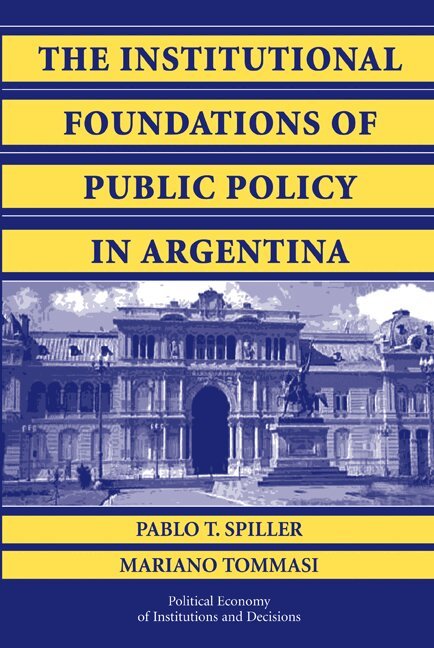
This book develops a general model of public policymaking, focusing on the difficulties of securing intertemporal exchanges among politicians. By using this model the authors are able to derive a series of empirical propositions about the conditions under which policies are likely to be volatile, rigid, or high quality. In addition, the authors combine the tools of game theory with Williamson's transaction cost theory, North's institutional arguments, and contract theory, to provide a general theory of public policymaking in a comparative political economy setting. They also undertake a detailed study of Argentina, using statistical analyses on newly developed data to complement their nuanced account of institutions, rules, incentives and outcomes. Drawing on this research the book explores the reasons for Argentina's seeming inability to design and implement high quality public policies over a sustained period of time.
This 1995 volume views important social and political issues through the eyes of economists. Pioneered by Gary Becker, this approach asserts that all actions, whether working, playing, dating, or mating, have economic motivations and consequences, and can be analysed using economic reasoning. Intended as an introduction to the current state of the field, the essays are informal and non-technical, while still using up-to-date economic reasoning to illuminate such topics as crime, marriage, discrimination, immigration, fads and fashions. The expanding domain of economics is illustrated, as problems from sociology, political science, anthropology, and public policy are all included in this Beckerian view: the world of human interaction, as seen by an economist.
This book develops a general model of public policymaking, focusing on the difficulties of securing intertemporal exchanges among politicians. By using this model the authors are able to derive a series of empirical propositions about the conditions under which policies are likely to be volatile, rigid, or high quality. In addition, the authors combine the tools of game theory with Williamson's transaction cost theory, North's institutional arguments, and contract theory, to provide a general theory of public policymaking in a comparative political economy setting. They also undertake a detailed study of Argentina, using statistical analyses on newly developed data to complement their nuanced account of institutions, rules, incentives and outcomes. Drawing on this research the book explores the reasons for Argentina's seeming inability to design and implement high quality public policies over a sustained period of time.