Paul F. Uhlir - Böcker
Visar alla böcker från författaren Paul F. Uhlir. Handla med fri frakt och snabb leverans.
9 produkter
9 produkter
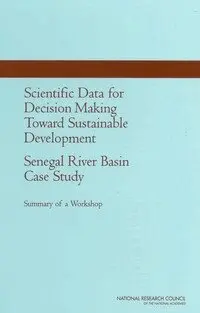
Scientific Data for Decision Making Toward Sustainable Development: Senegal River Basin Case Study
Summary of a Workshop
Häftad, Engelska, 2003
344 kr
Tillfälligt slut
Scientific databases relating to the environment, natural resources, and public health on the African continent are, for various reasons, difficult to create and manage effectively. Yet the creation of these and other types of databases--and their subsequent use to produce new information and knowledge for decision-makers--is essential to advancing scientific and technical progress in that region and to its sustainable development. The U.S. National Committee for CODATA collaborated with the Senegalese National CODATA Committee to convene a "Workshop on Scientific Data for Decision-Making Toward Sustainable Development: Senegal River Basin Case Study," which was held on 11-15 March 2002, in Dakar, Senegal. The workshop examined multidisciplinary data sources and data handling in the West Africa region, using the Senegal River Basin as a case study, to determine how these data are or can be better used in decision making related to sustainable development.
Open Access and the Public Domain in Digital Data and Information for Science
Proceedings of an International Symposium
Häftad, Engelska, 2004
704 kr
Tillfälligt slut
This symposium, which was held on March 10-11, 2003, at UNESCO headquarters in Paris, brought together policy experts and managers from the government and academic sectors in both developed and developing countries to (1) describe the role, value, and limits that the public domain and open access to digital data and information have in the context of international research; (2) identify and analyze the various legal, economic, and technological pressures on the public domain in digital data and information, and their potential effects on international research; and (3) review the existing and proposed approaches for preserving and promoting the public domain and open access to scientific and technical data and information on a global basis, with particular attention to the needs of developing countries.
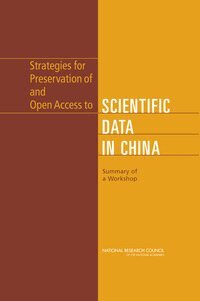
Strategies for Preservation of and Open Access to Scientific Data in China
Summary of a Workshop
Häftad, Engelska, 2006
588 kr
Tillfälligt slut
Preservation of and open access to digital scientific resources are essential to global research, yet the challenges in storing and maintaining access to these collections are substantial. China faces major hurdles in this regard. A workshop held in June 2004 in Beijing convened scientific information managers, digital archiving experts, national science policy and funding officials, and representatives of development organizations to explore the scientific and technical, legal and policy, institutional and economic, and management aspects of creating sustainable and accessible archives of digital health and environmental data in China.
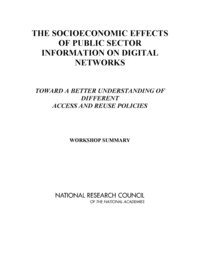
Socioeconomic Effects of Public Sector Information on Digital Networks
Toward a Better Understanding of Different Access and Reuse Policies: Workshop Summary
Häftad, Engelska, 2009
458 kr
Tillfälligt slut
While governments throughout the world have different approaches to how they make their public sector information (PSI) available and the terms under which the information may be reused, there appears to be a broad recognition of the importance of digital networks and PSI to the economy and to society. However, despite the huge investments in PSI and the even larger estimated effects, surprisingly little is known about the costs and benefits of different information policies on the information society and the knowledge economy. By understanding the strengths and weaknesses of the current assessment methods and their underlying criteria, it should be possible to improve and apply such tools to help rationalize the policies and to clarify the role of the internet in disseminating PSI. This in turn can help promote the efficiency and effectiveness of PSI investments and management, and to improve their downstream economic and social results. The workshop that is summarized in this volume was intended to review the state of the art in assessment methods and to improve the understanding of what is known and what needs to be known about the effects of PSI activities.
Designing the Microbial Research Commons
Proceedings of an International Symposium
Häftad, Engelska, 2010
646 kr
Tillfälligt slut
Recent decades have witnessed an ever-increasing range and volume of digital data. All elements of the pillars of science--whether observation, experiment, or theory and modeling--are being transformed by the continuous cycle of generation, dissemination, and use of factual information. This is even more so in terms of the re-using and re-purposing of digital scientific data beyond the original intent of the data collectors, often with dramatic results. We all know about the potential benefits and impacts of digital data, but we are also aware of the barriers, the challenges in maximizing the access, and use of such data. There is thus a need to think about how a data infrastructure can enhance capabilities for finding, using, and integrating information to accelerate discovery and innovation. How can we best implement an accessible, interoperable digital environment so that the data can be repeatedly used by a wide variety of users in different settings and with different applications?With this objective: to use the microbial communities and microbial data, literature, and the research materials themselves as a test case, the Board on Research Data and Information held an International Symposium on Designing the Microbial Research Commons at the National Academy of Sciences in Washington, DC on 8-9 October 2009. The symposium addressed topics such as models to lower the transaction costs and support access to and use of microbiological materials and digital resources from the perspective of publicly funded research, public-private interactions, and developing country concerns. The overall goal of the symposium was to stimulate more research and implementation of improved legal and institutional models for publicly funded research in microbiology.
Future of Scientific Knowledge Discovery in Open Networked Environments
Summary of a Workshop
Häftad, Engelska, 2012
565 kr
Tillfälligt slut
Digital technologies and networks are now part of everyday work in the sciences, and have enhanced access to and use of scientific data, information, and literature significantly. They offer the promise of accelerating the discovery and communication of knowledge, both within the scientific community and in the broader society, as scientific data and information are made openly available online. The focus of this project was on computer-mediated or computational scientific knowledge discovery, taken broadly as any research processes enabled by digital computing technologies. Such technologies may include data mining, information retrieval and extraction, artificial intelligence, distributed grid computing, and others. These technological capabilities support computer-mediated knowledge discovery, which some believe is a new paradigm in the conduct of research. The emphasis was primarily on digitally networked data, rather than on the scientific, technical, and medical literature. The meeting also focused mostly on the advantages of knowledge discovery in open networked environments, although some of the disadvantages were raised as well.The workshop brought together a set of stakeholders in this area for intensive and structured discussions. The purpose was not to make a final declaration about the directions that should be taken, but to further the examination of trends in computational knowledge discovery in the open networked environments, based on the following questions and tasks: 1. Opportunities and Benefits: What are the opportunities over the next 5 to 10 years associated with the use of computer-mediated scientific knowledge discovery across disciplines in the open online environment? What are the potential benefits to science and society of such techniques? 2. Techniques and Methods for Development and Study of Computer-mediated Scientific Knowledge Discovery: What are the techniques and methods used in government, academia, and industry to study and understand these processes, the validity and reliability of their results, and their impact inside and outside science? 3. Barriers: What are the major scientific, technological, institutional, sociological, and policy barriers to computer-mediated scientific knowledge discovery in the open online environment within the scientific community?What needs to be known and studied about each of these barriers to help achieve the opportunities for interdisciplinary science and complex problem solving? 4. Range of Options: Based on the results obtained in response to items 1-3, define a range of options that can be used by the sponsors of the project, as well as other similar organizations, to obtain and promote a better understanding of the computer-mediated scientific knowledge discovery processes and mechanisms for openly available data and information online across the scientific domains. The objective of defining these options is to improve the activities of the sponsors (and other similar organizations) and the activities of researchers that they fund externally in this emerging research area. The Future of Scientific Knowledge Discovery in Open Networked Environments: Summary of a Workshop summarizes the responses to these questions and tasks at hand.
Case for International Sharing of Scientific Data
A Focus on Developing Countries: Proceedings of a Symposium
Häftad, Engelska, 2012
530 kr
Tillfälligt slut
The theme of this international symposium is the promotion of greater sharing of scientific data for the benefit of research and broader development, particularly in the developing world. This is an extraordinarily important topic. Indeed, I have devoted much of my own career to matters related to the concept of openness. I had the opportunity to promote and help build the open courseware program at the Massachusetts Institute of Technology (MIT). This program has made the teaching materials for all 2,000 subjects taught at MIT available on the Web for anyone, anywhere, to use anytime at no cost. In countries where basic broadband was not available, we shipped it in on hard drives and compact disks. Its impact has been worldwide, but it has surely had the greatest impact on the developing world. I am also a trustee of a nonprofit organization named Ithaca that operates Journal Storage (JSTOR) and other entities that make scholarly information available at very low cost. The culture of science has been international and open for centuries.Indeed, the scientific enterprise can only work when all information is open and accessible, because science works through critical analysis and replication of results. In recent years, as some scientific data, and especially technological data, have increased in economic value frequently has caused us to be far less open with information than business and free enterprise require us to be. Indeed, the worldwide shift to what is known as open innovation is strengthening every day. Finally, since the end of World War II, the realities of modern military conflict and now terrorism have led governments to restrict information through classification. This is important, but I believe that we classify far too much information. The last thing we need today, at the beginning of the twenty-first century, is further arbitrary limitations on the free flow of scientific information, whether by policies established by governments and businesses, or by lack of information infrastructure. For all these reasons, the international sharing of scientific data is one of the topics of great interest here at the National Academies and has been the subject of many of our past reports.This is the primary reason why this symposium has been co-organized by the NRC's Policy and Global Affairs Division-the Board on International Scientific Organizations (BISO) and the Board on Research Data and Information (BRDI). The Case for International Sharing of Scientific Data: A Focus on Developing Countries: Proceedings of a Symposium summarizes the symposium.
Governing Digitally Integrated Genetic Resources, Data, and Literature
Global Intellectual Property Strategies for a Redesigned Microbial Research Commons
Inbunden, Engelska, 2016
1 702 kr
Skickas inom 7-10 vardagar
The free exchange of microbial genetic information is an established public good, facilitating research on medicines, agriculture, and climate change. However, over the past quarter-century, access to genetic resources has been hindered by intellectual property claims from developed countries under the World Trade Organization's TRIPS Agreement (1994) and by claims of sovereign rights from developing countries under the Convention on Biological Diversity (CBD) (1992). In this volume, the authors examine the scientific community's responses to these obstacles and advise policymakers on how to harness provisions of the Nagoya Protocol (2010) that allow multilateral measures to support research. By pooling microbial materials, data, and literature in a carefully designed transnational e-infrastructure, the scientific community can facilitate access to essential research assets while simultaneously reinforcing the open access movement. The original empirical surveys of responses to the CBD included here provide a valuable addition to the literature on governing scientific knowledge commons.
Governing Digitally Integrated Genetic Resources, Data, and Literature
Global Intellectual Property Strategies for a Redesigned Microbial Research Commons
Häftad, Engelska, 2017
600 kr
Skickas inom 7-10 vardagar
The free exchange of microbial genetic information is an established public good, facilitating research on medicines, agriculture, and climate change. However, over the past quarter-century, access to genetic resources has been hindered by intellectual property claims from developed countries under the World Trade Organization's TRIPS Agreement (1994) and by claims of sovereign rights from developing countries under the Convention on Biological Diversity (CBD) (1992). In this volume, the authors examine the scientific community's responses to these obstacles and advise policymakers on how to harness provisions of the Nagoya Protocol (2010) that allow multilateral measures to support research. By pooling microbial materials, data, and literature in a carefully designed transnational e-infrastructure, the scientific community can facilitate access to essential research assets while simultaneously reinforcing the open access movement. The original empirical surveys of responses to the CBD included here provide a valuable addition to the literature on governing scientific knowledge commons.