Paul H. Rubin - Böcker
Visar alla böcker från författaren Paul H. Rubin. Handla med fri frakt och snabb leverans.
10 produkter
10 produkter
242 kr
Skickas inom 5-8 vardagar
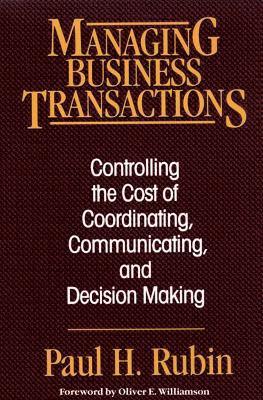
Managing Business Transactions is the first book on the principles of a new managerial economics, based on transaction cost economics.The transaction, the basic unit of business has been studied by theoretical economists for decades. Rubin has translated their research into basic principles for managers at all levels to structure transactions to best achieve both individual and company goals. Rubin analyzes and offers strategies for transactions of all kinds.
615 kr
Skickas inom 10-15 vardagar
This is the first book to examine individual rights from an economic perspective, collecting together leading articles in this emerging area of interest and showing the vibrant and expanding scholarship that relates them. Areas covered include The implications of constitutional protections of individual rights and freedoms, including freedom of speech and of the press, The right to bear arms, The right against unreasonable searches, The right against self-incrimination, The right to trial by jury, The right against cruel and unusual punishment, including capital punishment.The focus of these papers is both theoretical and empirical, examining how economics can illuminate the entire sequence of crime and punishment, from the decision to commit a crime, to police methods for apprehending and arresting criminals, to the rules used in trials to the scope of punishment for the convicted.
3 035 kr
Skickas inom 7-10 vardagar
This is the first book to examine individual rights from an economic perspective, collecting together leading articles in this emerging area of interest and showing the vibrant and expanding scholarship that relates them. Areas covered include The implications of constitutional protections of individual rights and freedoms, including freedom of speech and of the press, The right to bear arms, The right against unreasonable searches, The right against self-incrimination, The right to trial by jury, The right against cruel and unusual punishment, including capital punishment.The focus of these papers is both theoretical and empirical, examining how economics can illuminate the entire sequence of crime and punishment, from the decision to commit a crime, to police methods for apprehending and arresting criminals, to the rules used in trials to the scope of punishment for the convicted.
2 361 kr
Skickas inom 7-10 vardagar
In 1984, the Department of Justice settled its antitrust caseagainst AT&T. The agreement, embedded in the Modification ofFinal Judgment, led to a divestiture of the local telephoneexchanges from AT&T to the Regional Bell Operating Companies(known as the Baby Bells ). This agreement gave unprecedented powerover a major US industry to one man, Judge Harold Greene of the USDistrict Court of the District of Columbia. The Baby Bells couldnot enter any line of business without approval from Judge Greene.With technological change it became increasingly desirable for theBaby Bells to enter different lines of business, but each attemptwas subject to legal challenge and lengthy, costly litigation. In1994, the Baby Bells mounted a major legal challenge to theModification of Final Judgement (MFJ). As part of their strategy,they asked leading scholars in the field to examine the costs andbenefits of the MFJ and provide evidence in the form of affidavitsregarding its effect. Using a cost-benefit framework, theconclusion of the analysis is that the MFJ should be vacated andcompetition should be allowed in the industry. DeregulatingTelecommunications draws together a group of leading practitionersand academics in the fields of regulation, industrial organisationand antitrust to explore: A cost-benefit analysis of the 1984 AT&T antitrust settlementTheoretical and empirical studies that analyse the results of thesettlement from its inception in 1984 to 1994An explanation for the recent policy decisions to reduce theamount of regulation in telecommunicationsAnalysis vital to predicting the results of any deregulation intelecommunications in the futureThis book will prove invaluable to economists interested intelecommunications, as well as those interested in antitrust and in regulation.
1 092 kr
Skickas inom 10-15 vardagar
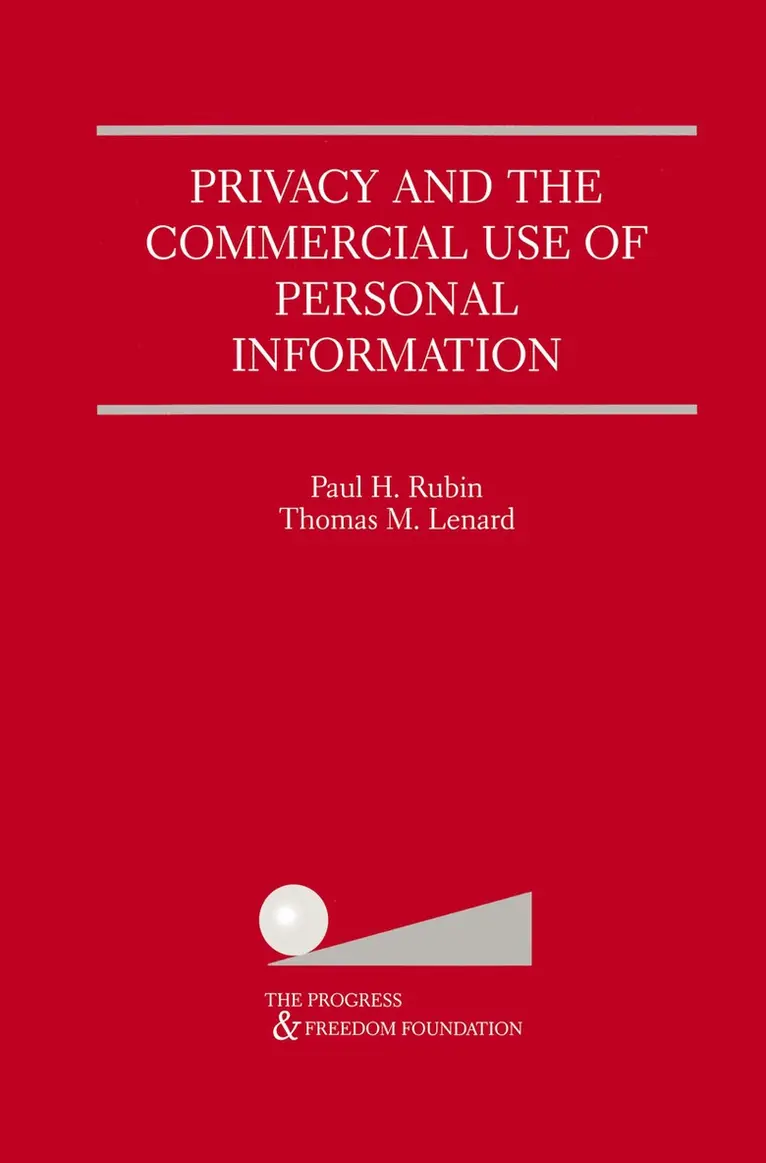
The debate over privacy presents some complex policy-making challenges. While data on consumers has long been used for marketing purposes, the Internet has substantially increased the flow of personal information. This has produced great benefits, but it also has raised concerns on the part of individuals about what information is being collected, how it is being used and who has access to it. These concerns, in turn, have led to calls for new government regulation. This study focuses on the market for personal information used for advertising and marketing purposes, which is the market affected by most of the regulatory and legislative proposals under consideration. It addresses the following basic questions: are there "failures" in the market for personal information?; if market failures exist, how do they adversely affect consumers?; can such failures be remedied by government regulation?; and would the benefits of government regulation exceed the costs? The authors find that the commercial market for information appears to be working well and is responding to consumers' privacy concerns.They conclude that regulation imposed on a medium like the Internet that is changing so rapidly would have unpredictable and costly consequences. This study is a product of The Progress & Freedom Foundation's project on Regulating Personal Information: Balancing Benefits and Costs. The Progress & Freedom Foundation studies the impact of the digital revolution and its implications for public policy. It conducts research in fields such as electronic commerce, telecommunications and the impact of the Internet on government, society and economic growth. It also studies issues such as the need to reform government regulation, especially in technology-intensive fields such as medical innovation, energy and environmental regulation.
375 kr
Skickas inom 5-8 vardagar
Darwinian Politics is the first book to examine political behavior from a modern evolutionary perspective. Here, Paul H. Rubin discusses group or social behavior, including ethnic and racial conflict; altruism and cooperation; envy; political power; and the role of religion in politics ¾ issues that have formed the hallmark of human social behavior.Adopting a Darwinian perspective, Rubin demonstrates why certain political-moral philosophies succeed or fail in modern Western culture. He begins by showing relationships between biology and natural selection and the history of political philosophy and explains why desirable policies must treat each person as an individual. He considers the notion of group identity and conflict, observing a human propensity to form in-groups, a behavior that does not necessitate but often leads to deviancies such as racism. In discussing altruism, Rubin shows that people are willing to aid the poor if they are convinced that the recipients are not shirkers or free loaders. This explains why recent welfare reforms are widely viewed as successful. Envy, a trait that is often counterproductive in today’s world, is also addressed. In comparing major moral philosophical systems, Rubin contends that utilitarianism is broadly consistent with our evolved preferences. He illustrates evolutionary premises for religious belief and for desires to regulate the behavior of others, and how in today’s world such regulation may not serve any useful purpose.Ultimately, Rubin argues that humans naturally seek political freedom, and modern Western society provides more freedom than any previous one. In light of his analysis, the author extrapolates that, while there are still areas for improvements, humans have done a remarkably good job of satisfying their evolved political preferences.
191 kr
Skickas inom 3-6 vardagar
976 kr
Skickas inom 10-15 vardagar
Hon. Orrin G. Hatch United States Senate Electronic commerce will be pivotal to the United States economy in the 21 SI Century. With the advent ofelectronic commerce, some consumers have become concerned about the disclosure, transfer, and sale of information which businesses have collected about them. These concerns purportedly are slowing the rate ofexpansion ofelectronic commerce, thereby putting at risk the future growth of the New Economy. To reduce this risk, a variety of schemes have been proposed under which the government would regulate online privacy. Congress currently is in the midst ofa vigorous debate as to whether the government should regulate on-line privacy standards, and, ifso, what form such regulation should take. This succinct yet powerful book by Paul Rubin and Thomas Lenard goes to the heart of these issues. It explains that there is no evidence of actual consumer harm or market failure that could justify burdensome government regulation of online privacy. It describes the tremendous advantages consumers currently receive from the free flow of information collected on line, advantages which could be eliminated if the government unnecessarily regulates and stops this flow of information. It argues that the free market provides businesses with compelling incentives to adopt their own measures - such as seal programs and novel technologies - to assuage consumer privacy concerns. This book presents compelling evidence to support these and many other points central to the continuing debate in the halls of Congress and elsewhere concerningonline privacy.
4 974 kr
Skickas inom 7-10 vardagar
This volume contains a selection of the most important articles on the issue of the evolution of the common law. The notion that evolutionary forces would lead to common law efficiency has been very influential in the study of the economics of law. Even those scholars who do not believe that the law is efficient will find it useful to consider the evolutionary forces identified in this volume.In an even-handed approach, Professor Rubin has selected not only articles which advance the hypothesis of efficient evolution, but also those which claim that the evolutionary process is not efficient. Further articles show that the process is indeed sometimes efficient and sometimes not, and identify those conditions which bring about more of less efficiency in the evolution of law. This authoritative collection will be useful to anyone who is concerned with the sources of efficiency and inefficiency in the law, as well as to scholars pursuing research in this area.
Del 11 - The Shaftesbury Papers series
Promises, Promises
Contracts in Russia and other Post-Communist Economies
Häftad, Engelska, 1998
260 kr
Skickas inom 7-10 vardagar
Promises, Promises examines from a libertarian perspective, the differing methods and levels of success of adapting contract law in the Czech Republic, Hungary, Poland and especially Russia in the wake of political change. The author analyses the roles of government power and policy, opportunism and private regulatory mechanisms within the pattern of change.