Thomas M. Lenard - Böcker
Visar alla böcker från författaren Thomas M. Lenard. Handla med fri frakt och snabb leverans.
5 produkter
5 produkter
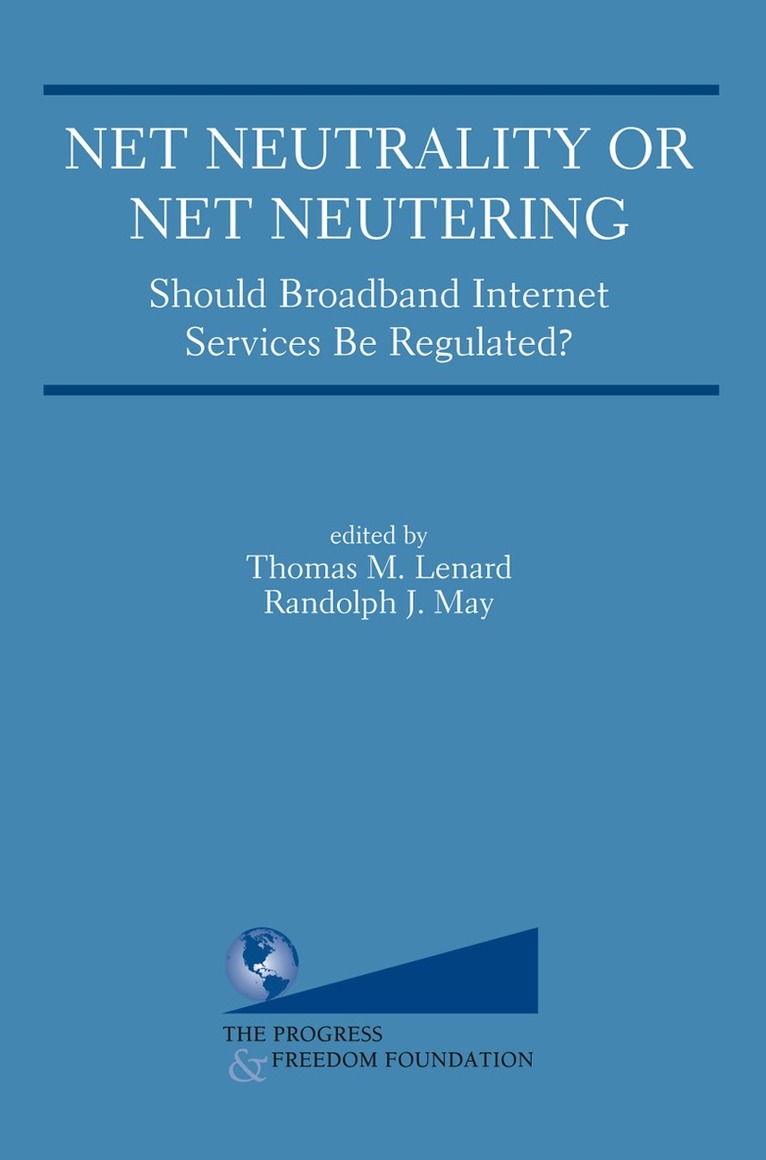
Net Neutrality or Net Neutering: Should Broadband Internet Services Be Regulated
Inbunden, Engelska, 2006
1 635 kr
Skickas inom 10-15 vardagar
Randolph J. May and Thomas M. Lenard The Progress & Freedom Foundation Most of the papers in this book were originally presented at a June 2003 Progress & Freedom Foundation conference entitled, "Net Neutrality or Net Neutering: Should Broadband Internet Services Be Regulated. " As we now publish the suitably updated collection of papers, along with two others, the title remains entirely appropriate. For while calls to mandate rights of access to the broadband networks of cable operators, telephone companies, and other facilities-based broadband providers might ebb and flow, as we write this, the tide is running high. So persistent are calls for mandatory network access rights in the communications world that a book that explores the vari ous facets of Net Neutrality is not likely to be soon outdated. The Policy Statement released by the Federal Communications Commis sion in September 2005 in its long-running proceedings to establish an ap propriate regulatory framework for cable operator and telephone compa- provided broadband services describes the bundle of "rights" commonly un derstood to be encompassed under the rubric of Net Neutrality: (1) consum ers are entitled to access the lawful Internet content of their choice; (2) con sumers are entitled to run applications and services of their choice; (3) consumers are entitled to connect their choice of legal devices that do not harm the network; and (4) consumers are entitled to competition among net work providers, application and services providers, and content providers.
1 092 kr
Skickas inom 10-15 vardagar
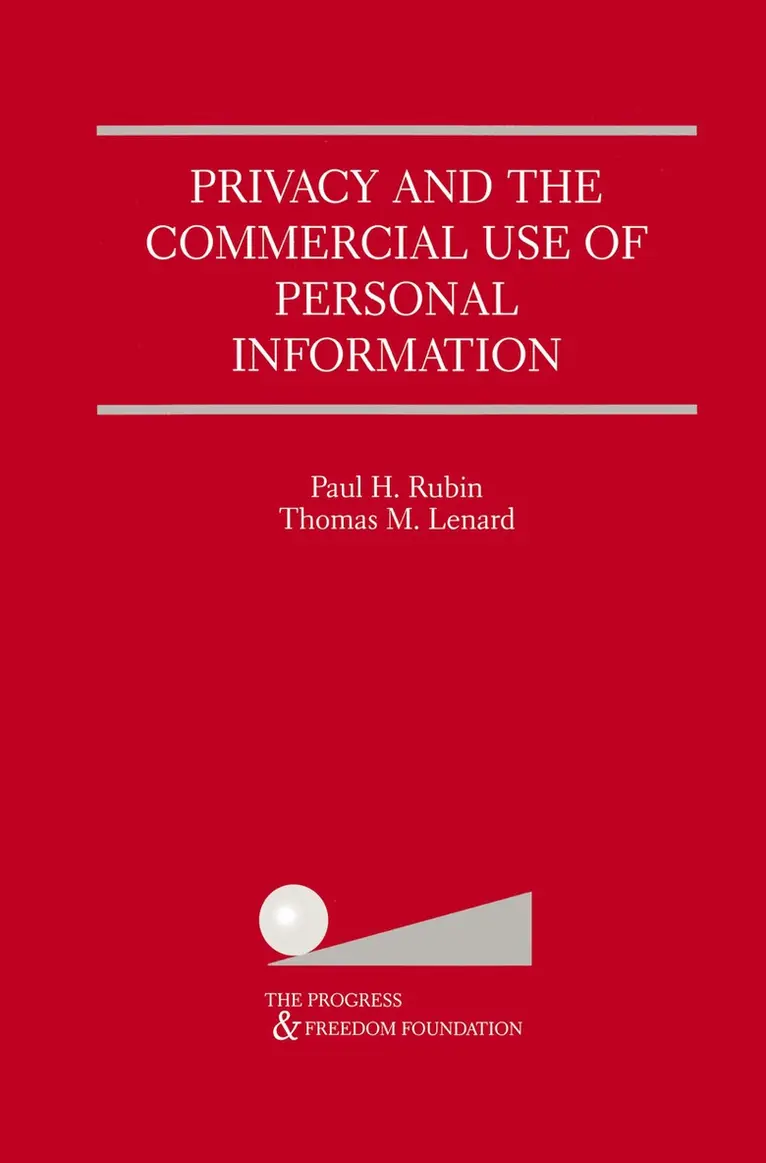
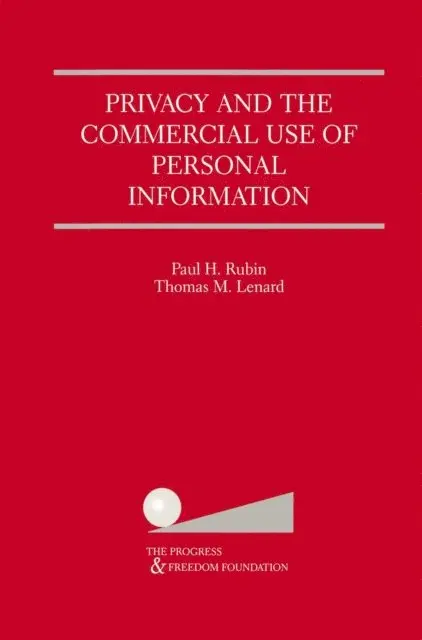
The debate over privacy presents some complex policy-making challenges. While data on consumers has long been used for marketing purposes, the Internet has substantially increased the flow of personal information. This has produced great benefits, but it also has raised concerns on the part of individuals about what information is being collected, how it is being used and who has access to it. These concerns, in turn, have led to calls for new government regulation. This study focuses on the market for personal information used for advertising and marketing purposes, which is the market affected by most of the regulatory and legislative proposals under consideration. It addresses the following basic questions: are there "failures" in the market for personal information?; if market failures exist, how do they adversely affect consumers?; can such failures be remedied by government regulation?; and would the benefits of government regulation exceed the costs? The authors find that the commercial market for information appears to be working well and is responding to consumers' privacy concerns.They conclude that regulation imposed on a medium like the Internet that is changing so rapidly would have unpredictable and costly consequences. This study is a product of The Progress & Freedom Foundation's project on Regulating Personal Information: Balancing Benefits and Costs. The Progress & Freedom Foundation studies the impact of the digital revolution and its implications for public policy. It conducts research in fields such as electronic commerce, telecommunications and the impact of the Internet on government, society and economic growth. It also studies issues such as the need to reform government regulation, especially in technology-intensive fields such as medical innovation, energy and environmental regulation.
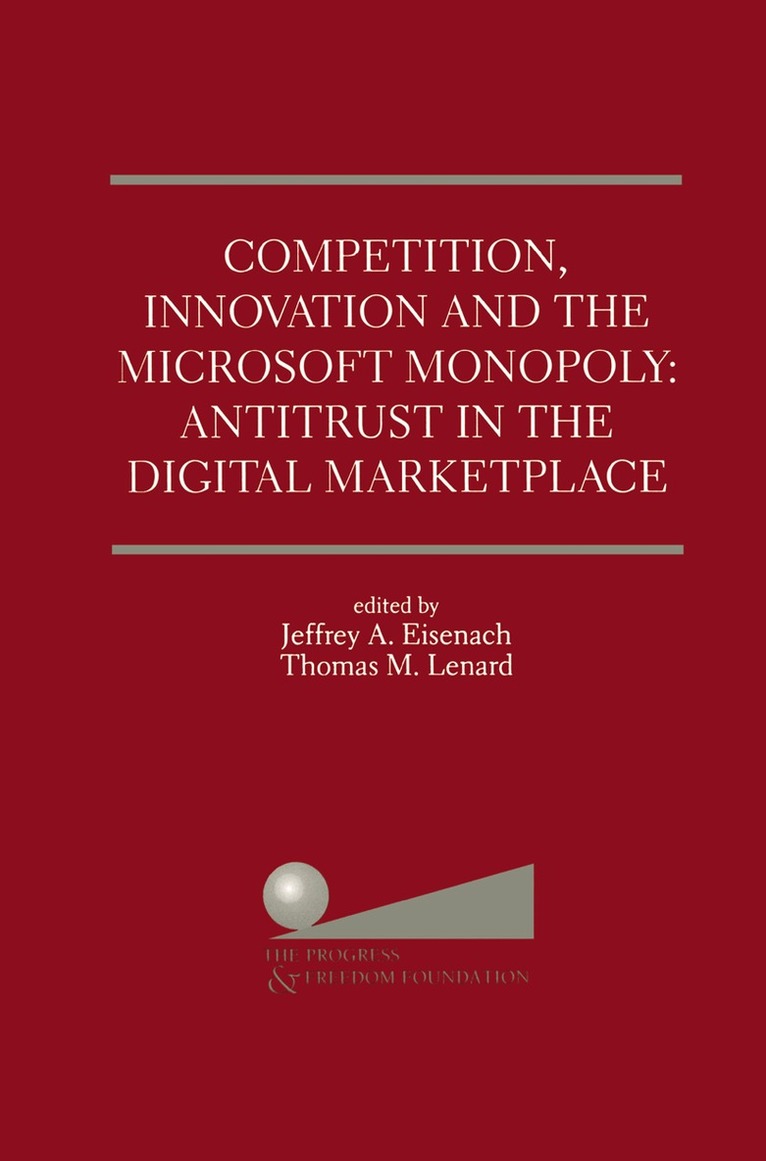
Competition, Innovation and the Microsoft Monopoly: Antitrust in the Digital Marketplace
Proceedings of a conference held by The Progress & Freedom Foundation in Washington, DC February 5, 1998
Inbunden, Engelska, 1999
1 458 kr
Skickas inom 10-15 vardagar
America's antitrust laws were born out of the Industrial Revolution. Opponents of the antitrust laws argue that whatever merit the antitrust laws may have had in the past they have no place in a digital economy. Rapid innovation makes the accumulation of market power practically impossible. Markets change too quickly for antitrust actions to keep up. And antitrust remedies are inevitably regulatory and hence threaten to "regulate business". A different view - and, generally, the view presented in this volume - is that antitrust law can and does have an important and constructive role to play in the digital economy. The software business is new, it is complex, and it is rapidly moving. Analysis of market definition, contestibility and potential competition, the role of innovation, network externalities, cost structures and marketing channels presents challenges for academics, policymakers and judges alike. Evaluating consumer harm is problematic. Distinguishing between illegal conduct and brutal - but legitimate - competition is often difficult. Is antitrust analysis up to the challenge? This volume suggests that antitrust analysis still works.In contrast to the political rhetoric that has surrounded much of the debate over the Microsoft case, the articles presented here suggest neither that Microsoft is inherently bad, nor that it deserves a de facto exemption from the antitrust laws. Instead, they offer insights for policymakers, courts, practitioners, professors and students of antitrust policy everywhere - on how antitrust analysis can be applied to the business of making and marketing computer software.
974 kr
Skickas inom 10-15 vardagar
Hon. Orrin G. Hatch United States Senate Electronic commerce will be pivotal to the United States economy in the 21 SI Century. With the advent ofelectronic commerce, some consumers have become concerned about the disclosure, transfer, and sale of information which businesses have collected about them. These concerns purportedly are slowing the rate ofexpansion ofelectronic commerce, thereby putting at risk the future growth of the New Economy. To reduce this risk, a variety of schemes have been proposed under which the government would regulate online privacy. Congress currently is in the midst ofa vigorous debate as to whether the government should regulate on-line privacy standards, and, ifso, what form such regulation should take. This succinct yet powerful book by Paul Rubin and Thomas Lenard goes to the heart of these issues. It explains that there is no evidence of actual consumer harm or market failure that could justify burdensome government regulation of online privacy. It describes the tremendous advantages consumers currently receive from the free flow of information collected on line, advantages which could be eliminated if the government unnecessarily regulates and stops this flow of information. It argues that the free market provides businesses with compelling incentives to adopt their own measures - such as seal programs and novel technologies - to assuage consumer privacy concerns. This book presents compelling evidence to support these and many other points central to the continuing debate in the halls of Congress and elsewhere concerningonline privacy.
Competition, Innovation and the Microsoft Monopoly: Antitrust in the Digital Marketplace
Proceedings of a conference held by The Progress & Freedom Foundation in Washington, DC February 5, 1998
Häftad, Engelska, 2012
1 635 kr
Skickas inom 10-15 vardagar
Do the antitrust laws have a place in the digital economy or are they obsolete? That is the question raised by the government's legal action against Microsoft, and it is the question this volume is designed to answer. America's antitrust laws were born out of the Industrial Revolution. Opponents of the antitrust laws argue that whatever merit the antitrust laws may have had in the past they have no place in a digital economy. Rapid innovation makes the accumulation of market power practically impossible. Markets change too quickly for antitrust actions to keep up. And antitrust remedies are inevitably regulatory and hence threaten to `regulate business'. A different view - and, generally, the view presented in this volume - is that antitrust law can and does have an important and constructive role to play in the digital economy. The software business is new, it is complex, and it is rapidly moving. Analysis of market definition, contestibility and potential competition, the role of innovation, network externalities, cost structures and marketing channels present challenges for academics, policymakers and judges alike. Evaluating consumer harm is problematic. Distinguishing between illegal conduct and brutal - but legitimate - competition is often difficult. Is antitrust analysis up to the challenge? This volume suggests that antitrust analysis `still works'. In stark contrast to the political rhetoric that has surrounded much of the debate over the Microsoft case, the articles presented here suggest neither that Microsoft is inherently bad, nor that it deserves a de facto exemption from the antitrust laws. Instead, they offer insights - for policymakers, courts, practitioners, professors and students of antitrust policy everywhere - on how antitrust analysis can be applied to the business of making and marketing computer software.