Philip G. Pardey - Böcker
Visar alla böcker från författaren Philip G. Pardey. Handla med fri frakt och snabb leverans.
5 produkter
5 produkter
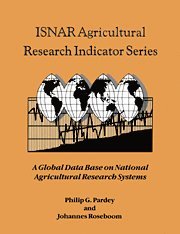
ISNAR Agricultural Research Indicator Series
A Global Data Base on National Agricultural Research Systems
Häftad, Engelska, 2004
718 kr
Skickas inom 7-10 vardagar
The Indicator Series contains fully-sourced and extensively documented country-specific files on the basic resources committed to national agricultural research systems (NARS). It includes, where possible, annual observations from 1960 to 1986 on a variety of agricultural research expenditure and research personnel series at the system or national level for 154 developing and developed countries. This volume contains the most comprehensive time series possible which is consistent in reporting data within countries, across countries, and between the personnel and expenditure series. Notes to the data tables often include supplementary tables which give a breakdown of the aggregate figures to an institutional level. The structure of the Indicator Series facilitates its use at three levels: (1) the data series themselves; (2) the data series plus personnel and expenditure comments; (3) the data, comments and citations (both sources and additional references) - for use in more targeted analysis at the country and/or issue-orientated level.
Science Under Scarcity
Principles and Practice for Agricultural Research and Priority Setting
Häftad, Engelska, 1998
1 125 kr
Skickas inom 7-10 vardagar
Resources for agricultural science are scarce across the world. Yet even as resources are shrinking, agricultural science has expanded its inquiry into many new areas - such as environmental preservation, food quality, and rural development - without forsaking its more traditional concerns. In a time of tight government budgets, research administrators are faced with the need to provide strong evidence that costs are justified by benefits. Science under Scarcity is an invaluable guide to the theory and methods necessary for evaluating research in agriculture and for setting priorities for resource allocation. Although economists have made significant progress in developing more sophisticated methods for research evaluation and priority setting, many research analysts and administrators do not have a working knowledge of those practices. Without the assistance of formal economic analysis it is particularly difficult to assess the social value of new technologies or to make informed judgements about the trade-offs that are involved in allocation decisions. Addressing that knowledge gap, this book reviews, synthesizes, and extends such methods as economic surplus analysis, econometric techniques, mathematical programming procedures, and scoring models. It discusses these practices in the context of scientific policy, describes their conceptual foundations, and explains how to do them. Originally published in 1995 in hardcover by Cornell University Press, it is now reissued in paperback by CAB INTERNATIONAL.
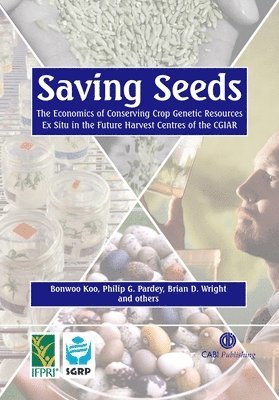
Saving Seeds
The Economics of Conserving Crop Genetic Resources Ex Situ in the Future Harvest Centres of CGIAR
Inbunden, Engelska, 2004
1 319 kr
Skickas inom 7-10 vardagar
The conservation of genetic resources is vital to the maintenance of biodiversity and to the world’s ability to feed its growing population. There are now more than a thousand genebanks worldwide involved in the ex situ (meaning “away from the source”) storage of particular classes of crops. Since the 1970s, the eleven genebanks maintained by the centres of the Consultative Group on International Agricultural Research (CGIAR) have become pivotal to the global conservation effort. However, key policy and management issues – usually with economic dimensions – have largely been overlooked.This provided the impetus for a series of detailed economic studies, led by IFPRI, in collaboration with five CGIAR centres: CIAT (based in Colombia), CIMMYT (Mexico), ICARDA (Syria), ICRISAT (India) and IRRI (Philippines). This book reports these studies and discusses their wider implications.
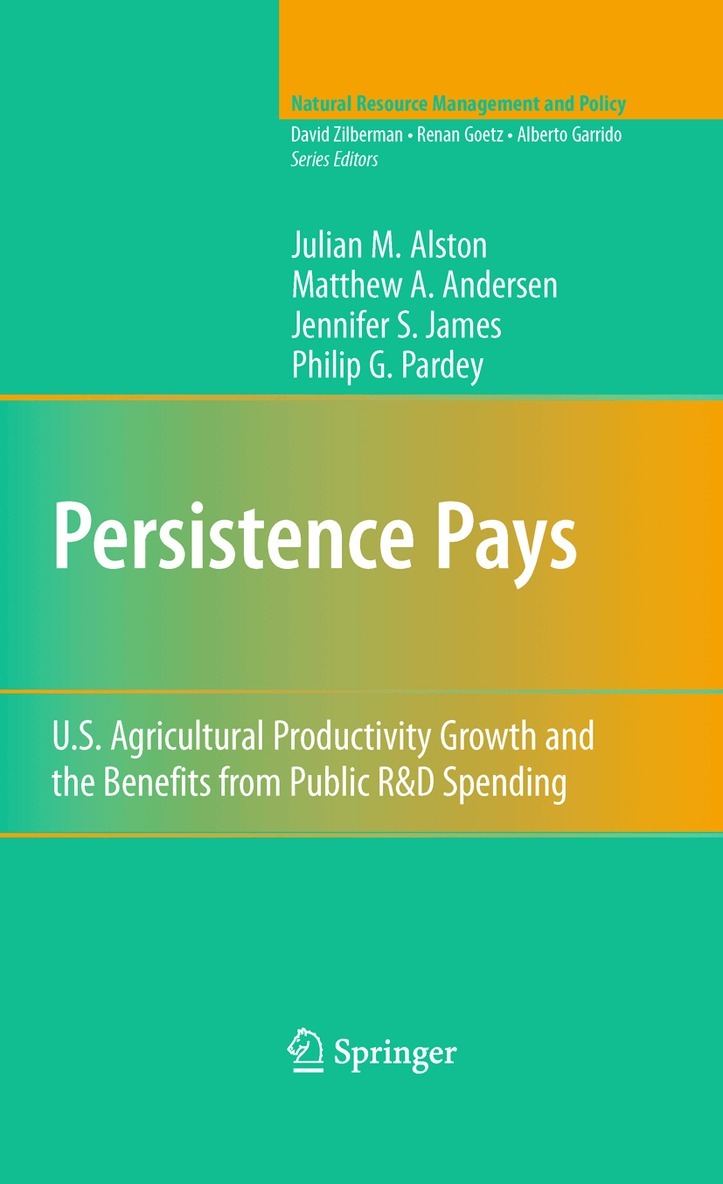
Persistence Pays
U.S. Agricultural Productivity Growth and the Benefits from Public R&D Spending
Inbunden, Engelska, 2009
2 101 kr
Skickas inom 10-15 vardagar
gricultural science policy in the United States has profoundly affected the growth and development of agriculture worldwide, not just in the A United States. Over the past 150 years, and especially over the second th half of the 20 Century, public investments in agricultural R&D in the United States grew faster than the value of agricultural production. Public spending on agricultural science grew similarly in other more-developed countries, and c- lectively these efforts, along with private spending, spurred agricultural prod- tivity growth in rich and poor nations alike. The value of this investment is seldom fully appreciated. The resulting p- ductivity improvements have released labor and other resources for alternative uses—in 1900, 29. 2 million Americans (39 percent of the population) were - rectly engaged in farming compared with just 2. 9 million (1. 1 percent) today— while making food and fiber more abundant and cheaper. The benefits are not confined to Americans. U. S. agricultural science has contributed with others to growth in agricultural productivity in many other countries as well as the Un- ed States. The world’s population more than doubled from around 3 billion in 1961 to 6. 54 billion in 2006 (U. S. Census Bureau 2009). Over the same period, production of important grain crops (including maize, wheat and rice) almost trebled, such that global per capita grain production was 18 percent higher in 2006.
Del 34 - Natural Resource Management and Policy
Persistence Pays
U.S. Agricultural Productivity Growth and the Benefits from Public R&D Spending
Häftad, Engelska, 2012
2 101 kr
Skickas inom 10-15 vardagar
gricultural science policy in the United States has profoundly affected the growth and development of agriculture worldwide, not just in the A United States. Over the past 150 years, and especially over the second th half of the 20 Century, public investments in agricultural R&D in the United States grew faster than the value of agricultural production. Public spending on agricultural science grew similarly in other more-developed countries, and c- lectively these efforts, along with private spending, spurred agricultural prod- tivity growth in rich and poor nations alike. The value of this investment is seldom fully appreciated. The resulting p- ductivity improvements have released labor and other resources for alternative uses—in 1900, 29. 2 million Americans (39 percent of the population) were - rectly engaged in farming compared with just 2. 9 million (1. 1 percent) today— while making food and fiber more abundant and cheaper. The benefits are not confined to Americans. U. S. agricultural science has contributed with others to growth in agricultural productivity in many other countries as well as the Un- ed States. The world’s population more than doubled from around 3 billion in 1961 to 6. 54 billion in 2006 (U. S. Census Bureau 2009). Over the same period, production of important grain crops (including maize, wheat and rice) almost trebled, such that global per capita grain production was 18 percent higher in 2006.