Ramón Reichert - Böcker
Visar alla böcker från författaren Ramón Reichert. Handla med fri frakt och snabb leverans.
10 produkter
10 produkter
Del 663 - Europaeische Hochschulschriften / European University Studie
Die Konstitution Der Sozialen Welt
Zur Erkenntniskritik Der Sozial- Und Kulturwissenschaften
Häftad, Tyska, 2003
418 kr
Tillfälligt slut
435 kr
Skickas inom 11-20 vardagar
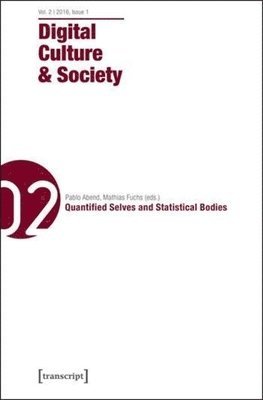
Digital Culture & Society is a refereed, international journal, fostering discussion about the ways in which digital technologies, platforms and applications reconfigure daily lives and practices. It offers a forum for critical analysis and inquiries into digital media theory and provides a publication environment for interdisciplinary research approaches, contemporary theory developments and methodological innovation.The second issue »Quantified Selves | Statistical Bodies« provides methodological and theoretical reflections on technologically generated knowledge about the body and socio-cultural practices that are subsumed, discussed, and criticized using the key concept »Quantified Self«.
435 kr
Skickas inom 11-20 vardagar
»Digital Culture & Society« is a refereed, international journal, fostering discussion about the ways in which digital technologies, platforms and applications reconfigure daily lives and practices. It offers a forum for critical analysis and inquiries into digital media theory and provides a publication environment for interdisciplinary research approaches, contemporary theory developments and methodological innovation.The third issue »Politics of Big Data« edited by Mark Coté, Paolo Gerbaudo, and Jennifer Pybus, critically examines the political and economic dimensions of Big Data and thus details its contestation. The contributions focus on the materialities and processes which manifest Big Data and explore forms of value beyond the state and capital. These range from open data initiatives, social media metrics, machine learning algorithms, data visualisation to data dashboards, critical data analysis, and new modes of data action research and practice.
435 kr
Skickas inom 11-20 vardagar
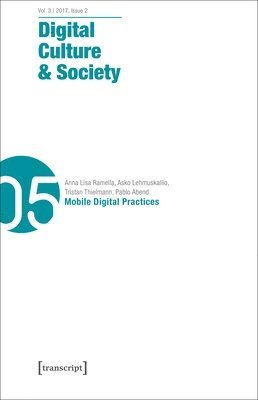
»Digital Culture & Society« is a refereed, international journal, fostering discussion about the ways in which digital technologies, platforms and applications reconfigure daily lives and practices. It offers a forum for critical analysis and inquiries into digital media theory and provides a publication environment for interdisciplinary research approaches, contemporary theory developments and methodological innovation.This issue, edited by Anna Lisa Ramella, Asko Lehmuskallio, Tristan Thielmann and Pablo Abend, discusses the mobility of people, data and devices from the perspective of digital mobile practices. As the authors of various empirical case studies show, these need to be studied both situationally, and on the move.With contributions by Marion Schulze, Jamie Coates, Geoffrey Hobbis, Samuel Gerald Collins, among others, and an interview with Heather Horst, David Morley, and Noel B. Salazar.
435 kr
Skickas inom 11-20 vardagar
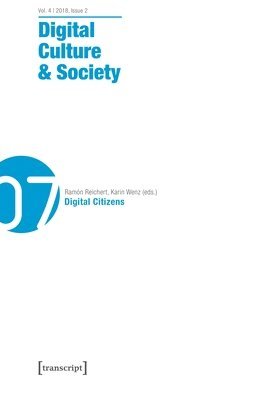
»Digital Culture & Society« is a refereed, international journal, fostering discussion about the ways in which digital technologies, platforms and applications reconfigure daily lives and practices. It offers a forum for critical analysis and inquiries into digital media theory and provides a publication environment for interdisciplinary research approaches, contemporary theory developments and methodological innovation.This special issue discusses theoretical and artistic investigations on citizen engagement, digital citizenship and grassroots information politics. The articles reflect on the role of the digital citizen from the perspectives of (digital) sociology, science, technology and society (STS), (digital) media studies, cultural studies, political sciences, and philosophy.
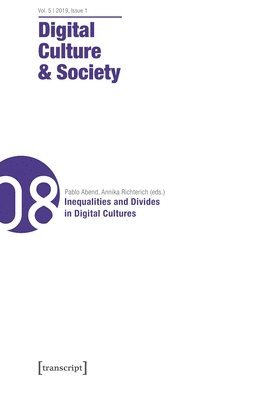
Digital Culture & Society (DCS) Vol. 5, Issue 1/ – Inequalities and Divides in Digital Cultures
Häftad, Engelska, 2021
592 kr
Skickas inom 3-6 vardagar
Digital Culture & Society is a refereed, international journal, fostering discussion about the ways in which digital technologies, platforms and applications reconfigure daily lives and practices. It offers a forum for inquiries into digital media theory, methodologies, and socio-technological developments.This issue presents empirical studies as well as theoretical and methodological reflections on inequalities and divides in digital cultures. From various (inter-)disciplinary perspectives, the authors examine three main themes – inequality of access, inequality by design and discursive divides, and inequality by algorithms – while suggesting ways for research to move beyond these.
Digital Culture & Society (DCS)
Vol. 7, Issue 2/2021 Networked Images in Surveillance Capitalism
Häftad, Engelska, 2022
435 kr
Skickas
Capturing personal data in exchange for free services is now ubiquitous in networked media and recently led to diagnoses of surveillance and platform capitalism. In social media discourse, dataveillance and data mining have been criticized as new forms of capitalist exploitation for some time. From social photos, selfies and image communities on the internet to connected viewing and streaming, and video conferencing during the Corona pandemic – the digital image is not only predominantly networked but also accessed through platforms and structured by their economic imperatives, data acquisition techniques and algorithmic processing. In this issue, the contributors show how participation and commodification are closely linked to the production, circulation, consumption and operativity of images and visual communication, raising the question of the role networked images play for and within the proliferating surveillance capitalism.
Digital Culture & Society (DCS)
Vol 8, Issue 1/2022 - Coding Covid-19: The Rise of the App-Society
Häftad, Engelska, 2023
435 kr
Skickas
Code is intended both as a computer-based language to program software and as a functional and visual language for organizing administrative processes, visualizing information, performing behaviour control, and reinforcing shared imaginaries based on surveillance and dread. This special issue of Digital Culture & Society deals with the concept of code in relation to the Covid-19 crisis. The contributions depart from the idea that both forms of coding have become dramatically intertwined during the pandemic and are structuring a new way of being in and seeing reality. They explore the new forms of data-driven surveillance and representation of the pandemic evolution at the level of real-time epidemiology, sensor technologies, science policies, push media, and the heterogeneous counter-discourses that try to subvert them.
Digital Culture & Society (DCS)
Vol. 10, Issue 1/2024 - Digital War: Media Strategies and Visual Politics during the Full-Scale Attack of Russia on Ukraine
Häftad, Engelska, 2025
435 kr
Skickas
Since the full-scale Russian attack on Ukraine on February 24, 2022, warfare on social media and online platforms has introduced a new way of mediatizing war. A constant war-related newsfeed on social media and online platforms has emerged. Against this background the war in Ukraine represents a »fractal war – where you choose to subscribe to your own tailored version of warfare in your feed. This makes it the most personalized war in history« (Andrew Hoskins). This special issue investigates smartphone use, online media, platform politics, and the impact of the crowdsourced war. New forms of digital participation, collective witnessing and web archiving by media users and media providers are linked with new methodological and empirical challenges for source analysis of digital forensics, jurisdiction, and collective memory. The contributors analyze digital society and its relationship to war, violence, genocide, witnessing practices, and cultural appropriation in a critical and reflective manner.
Del 22 - Digital Culture & Society
Digital Culture & Society
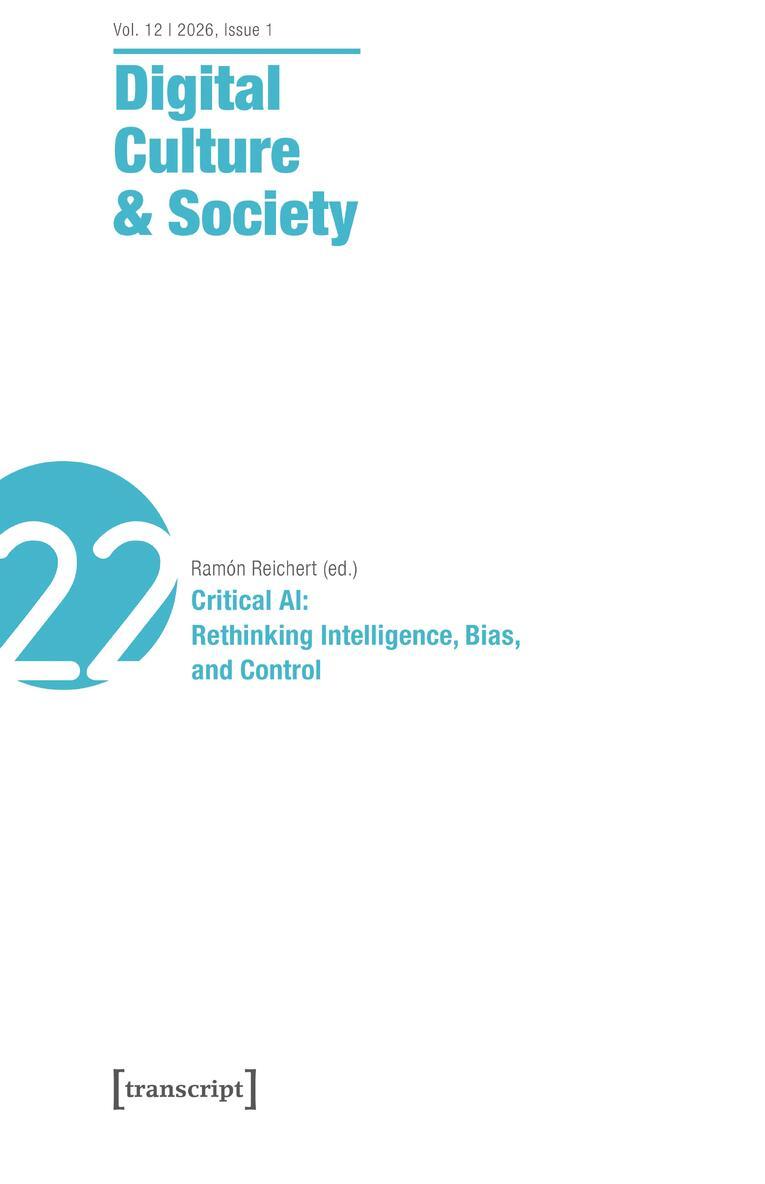
Vol. 12, Issue 1/2026 - Critical AI: Rethinking Intelligence, Bias, and Control
Häftad, Engelska, 2026
435 kr
Kommande
Artificial Intelligence is not only a technological innovation, but a cultural practice shaped by social, historical, and political contexts. AI systems reflect human values and power relations, reinforcing cultural norms and ideologies. Through algorithmic monitoring and automated decision-making, they operate as mechanisms of social control – embedding bias, sustaining dominance, and creating new visibilities. This issue examines how AI-mediated surveillance reshapes knowledge, accountability, and marginalization within digital societies, focusing on platform capitalism, the economic precarity and exploitation of clickworkers in the Global South, biometric control, and the commodification of social behavior.