Raul Sanchez Urribarri - Böcker
Visar alla böcker från författaren Raul Sanchez Urribarri. Handla med fri frakt och snabb leverans.
4 produkter
4 produkter
575 kr
Skickas inom 10-15 vardagar
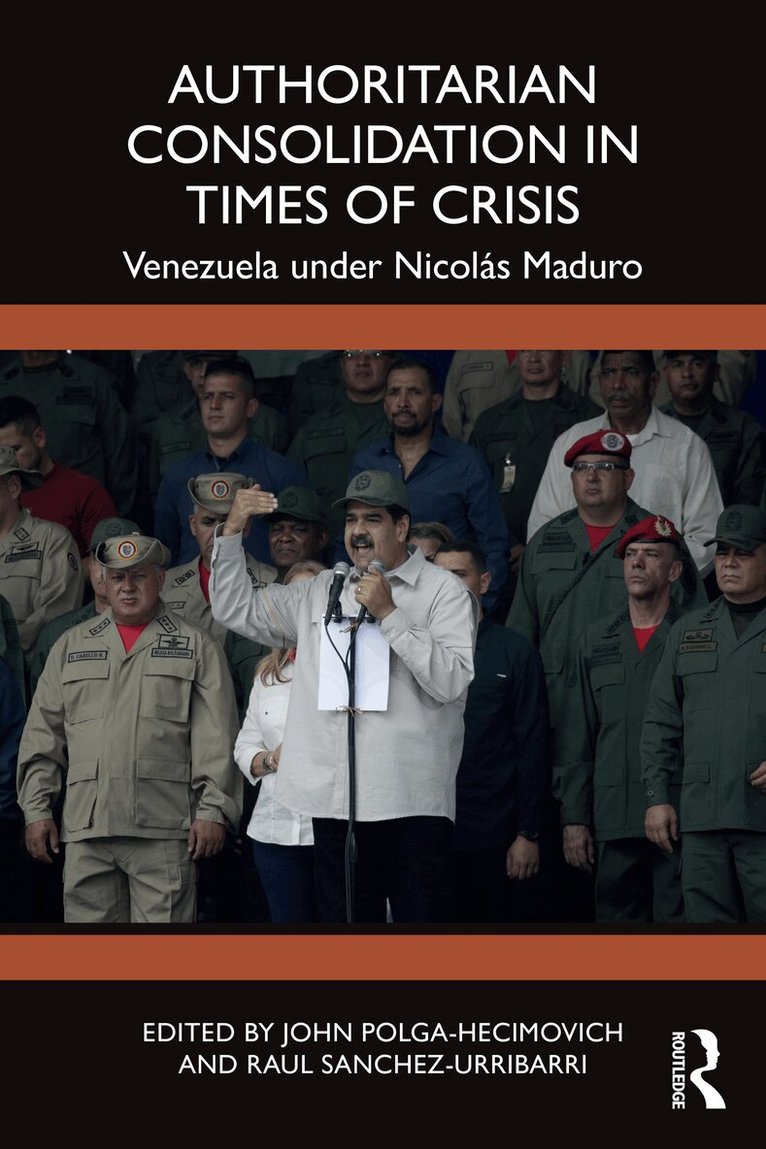
Bringing together experts from across the social sciences, this volume examines the consolidation of authoritarianism in Venezuela under the government of Nicolás Maduro. Taking a comparative perspective, it explains how authoritarians can remain ensconced in power amidst profound economic crisis, widespread social discontent, low approval ratings, and international policies aimed at their removal. Moreover, it seeks to understand the mechanisms and dynamics with which Maduro has consolidated an authoritarian regime in Venezuela. To this end, the editors differentiate the concept of authoritarian consolidation from the more studied processes of democratic erosion and democratic backsliding.The book’s contributors explore in detail the country’s process of autocratization under Maduro at the national and international levels, identifying and explaining the role of diverse actors and institutions in Venezuela’s political regime, and their respective contributions to safeguarding and stabilizing the Maduro administration. By offering a systematic examination of the mechanisms by which regime change was fostered under Maduro’s rule, this volume directly engages with scholarly research on regime transitions and democratic collapse; democratic breakdown and the consolidation of authoritarian rule; and comparative institutional work on Venezuelan politics. The book is relevant to scholars and students of Venezuela, as well as anyone interested in the pressing question of regime crisis survival and authoritarian consolidation.
Authoritarian Consolidation in Times of Crisis
Venezuela under Nicolás Maduro
Inbunden, Engelska, 2025
2 103 kr
Skickas inom 10-15 vardagar
Bringing together experts from across the social sciences, this volume examines the consolidation of authoritarianism in Venezuela under the government of Nicolás Maduro. Taking a comparative perspective, it explains how authoritarians can remain ensconced in power amidst profound economic crisis, widespread social discontent, low approval ratings, and international policies aimed at their removal. Moreover, it seeks to understand the mechanisms and dynamics with which Maduro has consolidated an authoritarian regime in Venezuela. To this end, the editors differentiate the concept of authoritarian consolidation from the more studied processes of democratic erosion and democratic backsliding.The book’s contributors explore in detail the country’s process of autocratization under Maduro at the national and international levels, identifying and explaining the role of diverse actors and institutions in Venezuela’s political regime, and their respective contributions to safeguarding and stabilizing the Maduro administration. By offering a systematic examination of the mechanisms by which regime change was fostered under Maduro’s rule, this volume directly engages with scholarly research on regime transitions and democratic collapse; democratic breakdown and the consolidation of authoritarian rule; and comparative institutional work on Venezuelan politics. The book is relevant to scholars and students of Venezuela, as well as anyone interested in the pressing question of regime crisis survival and authoritarian consolidation.
1 182 kr
Skickas
This volume explores an understudied aspect of courts: The extent to which informal institutions and relational networks (e.g., professional, clientelist, family etc.) relations affect how courts are organised and operate. For instance, to what extent can 'good personal relations' outweigh professional merits in judicial appointment processes? Or in what ways do international or domestic judicial networks help protect courts against other branches of power? Our relational-institutional perspective allows us to better understand a variety of important processes for the comparative study of courts including judicial appointments, judicial decision-making, judicial administration, institutional development, inter-branch relations, corruption, and court reform, among others. More importantly, an emphasis on informality sheds new light on the accountability role of courts in democratic regimes, at a time when democracy worldwide is at risk and authoritarian regimes are on the rise. Bringing together the thoughts of scholars with different levels of seniority and disciplinary expertise, this volume offers cross-national engagement with theory, providing systematic analyses of the configuration, operation, and roles of informal institutions and relations, and their importance in different socio-political contexts and legal systems.
327 kr
Kommande
This volume explores an understudied aspect of courts: The extent to which informal institutions and relational networks (e.g., professional, clientelist, family etc.) relations affect how courts are organised and operate. For instance, to what extent can ‘good personal relations’ outweigh professional merits in judicial appointment processes? Or in what ways do international or domestic judicial networks help protect courts against other branches of power? Our relational-institutional perspective allows us to better understand a variety of important processes for the comparative study of courts – including judicial appointments, judicial decision-making, judicial administration, institutional development, inter-branch relations, corruption, and court reform, among others. More importantly, an emphasis on informality sheds new light on the accountability role of courts in democratic regimes, at a time when democracy worldwide is at risk and authoritarian regimes are on the rise. Bringing together the thoughts of scholars with different levels of seniority and disciplinary expertise, this volume offers cross-national engagement with theory, providing systematic analyses of the configuration, operation, and roles of informal institutions and relations, and their importance in different socio-political contexts and legal systems.