Reinie Erne - Böcker
Visar alla böcker från författaren Reinie Erne. Handla med fri frakt och snabb leverans.
3 produkter
3 produkter
Del 6 - Oxford Graduate Texts in Mathematics (0-19-961947-6)
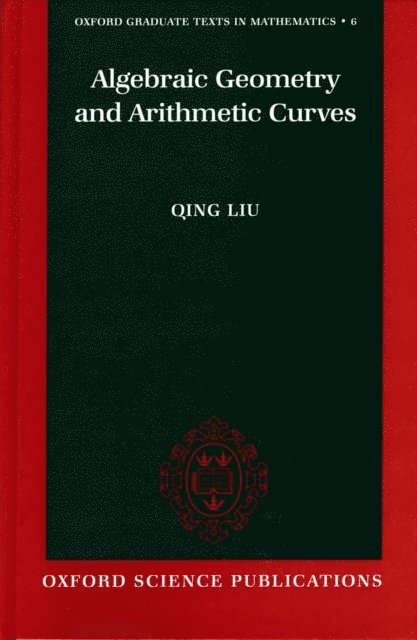
Algebraic Geometry and Arithmetic Curves
Inbunden, Engelska, 2002
1 932 kr
Skickas inom 5-8 vardagar
This book is a general introduction to the theory of schemes, followed by applications to arithmetic surfaces and to the theory of reduction of algebraic curves. The first part introduces basic objects such as schemes, morphisms, base change, local properties (normality, regularity, Zariski's Main Theorem). This is followed by the more global aspect: coherent sheaves and a finiteness theorem for their cohomology groups. Then follows a chapter on sheaves of differentials, dualizing sheaves, and Grothendieck's duality theory. The first part ends with the theorem of Riemann-Roch and its application to the study of smooth projective curves over a field. Singular curves are treated through a detailed study of the Picard group.The second part starts with blowing-ups and desingularisation (embedded or not) of fibered surfaces over a Dedekind ring that leads on to intersection theory on arithmetic surfaces. Castelnuovo's criterion is proved and also the existence of the minimal regular model. This leads to the study of reduction of algebraic curves. The case of elliptic curves is studied in detail. The book concludes with the funadmental theorem of stable reduction of Deligne-Mumford.The book is essentially self-contained, including the necessary material on commutative algebra. The prerequisites are therefore few, and the book should suit a graduate student. It contains many examples and nearly 600 exercises.
536 kr
Skickas inom 10-15 vardagar
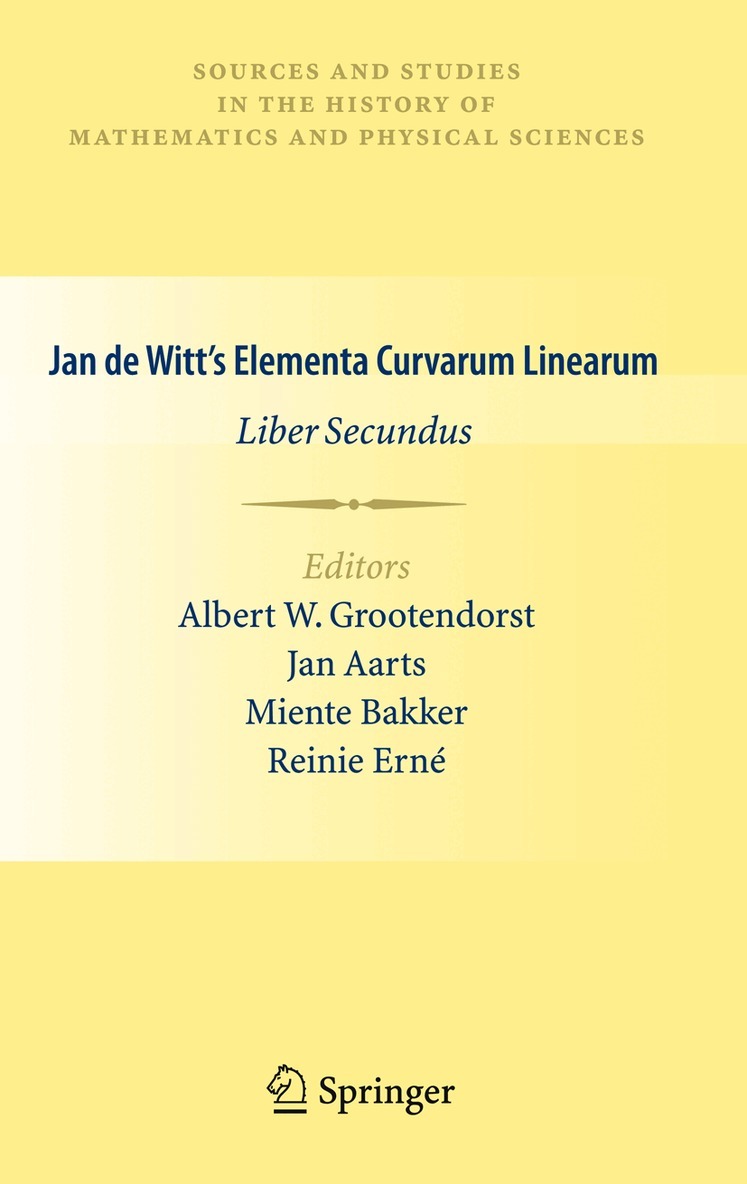
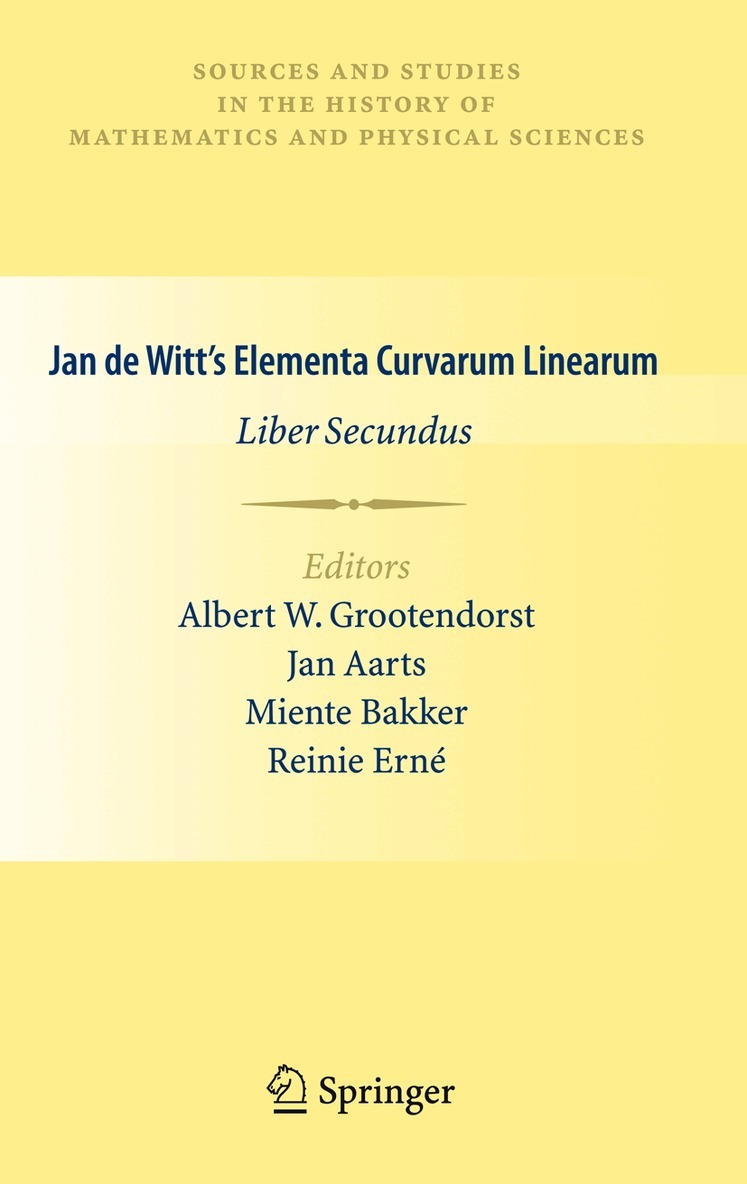
- Following on from the 2000 edition of Jan De Witt’s Elementa Curvarum Linearum, Liber Primus, this book provides the accompanying translation of the second volume of Elementa Curvarum Linearum (Foundations of Curved Lines). One of the first books to be published on Analytic Geometry, it was originally written in Latin by the Dutch statesman and mathematician Jan de Witt, soon after Descartes’ invention of the subject. - Born in 1625, Jan de Witt served with distinction as Grand Pensionary of Holland for much of his adult life. In mathematics, he is best known for his work in actuarial mathematics as well as extensive contributions to analytic geometry.- Elementa Curvarum Linearum, Liber Secondus moves forward from the construction of the familiar conic sections covered in the Liber Primus, with a discussion of problems connected with their classification; given an equation, it covers how one can recover the standard form, and additionally how one can find the equation's geometric properties. - This volume, begun by Albert Grootendorst (1924-2004) and completed after his death by Jan Aarts, Reinie Erné and Miente Bakker, is supplemented by:- annotation explaining finer points of the translation;- extensive commentary on the mathematicsThese features make the work of Jan de Witt broadly accessible to today’s mathematicians.
536 kr
Skickas inom 10-15 vardagar
- Following on from the 2000 edition of Jan De Witt’s Elementa Curvarum Linearum, Liber Primus, this book provides the accompanying translation of the second volume of Elementa Curvarum Linearum (Foundations of Curved Lines). One of the first books to be published on Analytic Geometry, it was originally written in Latin by the Dutch statesman and mathematician Jan de Witt, soon after Descartes’ invention of the subject. - Born in 1625, Jan de Witt served with distinction as Grand Pensionary of Holland for much of his adult life. In mathematics, he is best known for his work in actuarial mathematics as well as extensive contributions to analytic geometry.- Elementa Curvarum Linearum, Liber Secondus moves forward from the construction of the familiar conic sections covered in the Liber Primus, with a discussion of problems connected with their classification; given an equation, it covers how one can recover the standard form, and additionally how one can find the equation's geometric properties. - This volume, begun by Albert Grootendorst (1924-2004) and completed after his death by Jan Aarts, Reinie Erné and Miente Bakker, is supplemented by:- annotation explaining finer points of the translation;- extensive commentary on the mathematicsThese features make the work of Jan de Witt broadly accessible to today’s mathematicians.