Richard E. Clark - Böcker
Visar alla böcker från författaren Richard E. Clark. Handla med fri frakt och snabb leverans.
6 produkter
6 produkter
1 674 kr
Skickas inom 5-8 vardagar
What do we mean when we say that "learning environments are increasingly complex"? What do we know about the cognitive processing that occurs during complex learning? How can we provide effective instructional support for students who must learn and apply complex knowledge? These questions, and related issues, have fascinated educators and educational researchers for many years and are they are the focus of this book. As a tribute to Joost Lowyck, professor educational technology at the K.U. Leuven, eminent scholars from around the globe have contributed to a far reaching analysis of complexity in learning environments from a cognitive perspective. The chapter authors summarize what we know now about complexity and make specific suggestions for educational practice and for future research on complexity. The different contributions in the several chapters discuss theoretical accounts and empirical findings about learning, the learner, and learning environments. Wide-ranging topics include current descriptions of our cognitive architecture, new contributions to cognitive load theory, research and evaluation design considerations, motivation to learn, the influence of prior knowledge, the use of simulations and multimedia, alternative instructional methods and interventions, studies of the classroom context for complex learning and mental model-building. This book is a tribute to Joose Lowyck, professor educational technology at the KU Leuven. International scholars provide far reaching analysis of complexity in learning environments from a cognitive perspective. It makes specific suggestions for educational practice and for future research.
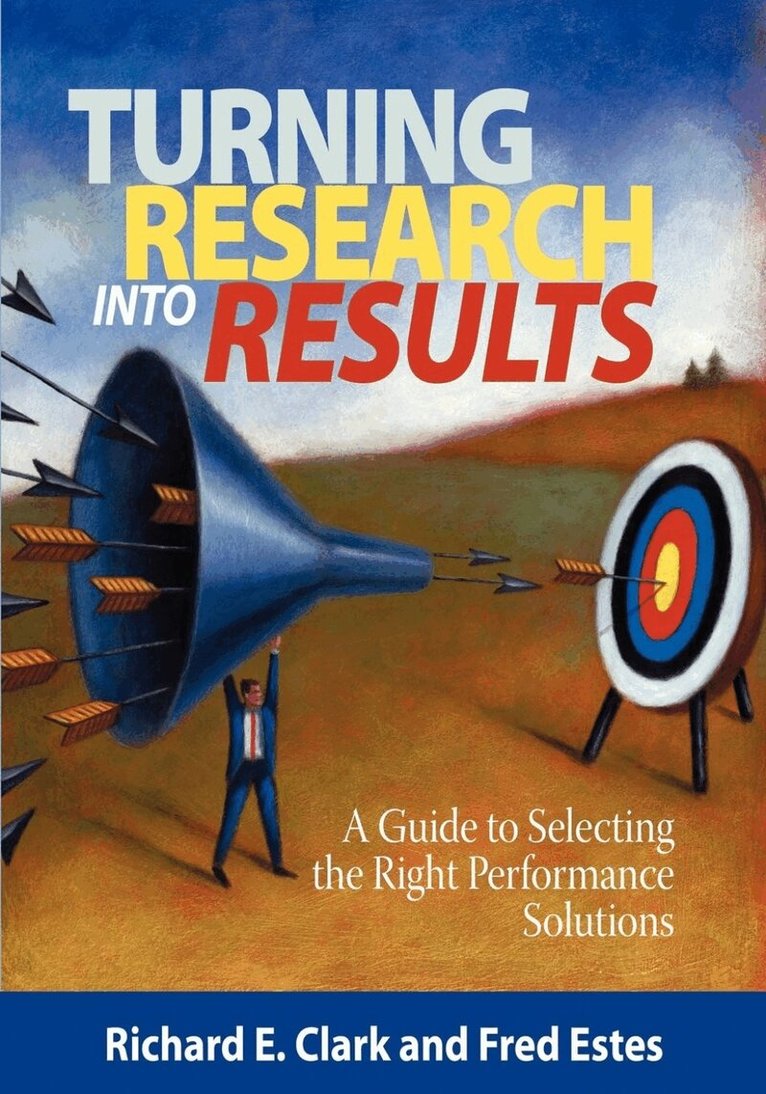
Turning Research Into Results
A Guide to Selecting the Right Performance Solutions
Häftad, Engelska, 2008
518 kr
Skickas inom 7-10 vardagar
This book presents solid, current research that forms the basis for ways to "engineer" maximum performance and ways to select products that reflect the best research and evaluation. The authors have drawn on "what is known" from only the most important research findings and solid evaluation studies. This research lays the foundation on which to build a solid framework for improving performance and organizational effectiveness and forms the basis for recommendations. A reference section provides the sources for those wishing to dig deeper into the research. A secondary aim of the book is to describe, "what is known to be unknown" about ways to enhance peoples work performance. This area marks the frontier of knowledge,a land of both risk and opportunity. There is risk because our knowledge in this area is incomplete or inadequately tested. Yet there is opportunity here to learn more and contribute to knowledge. As in the Old West of the American frontier, where the pioneers precede the mapmakers and engineers, practitioners in organizations must work daily with problems where the state of knowledge is incomplete. The book attempts to post signs at these performance improvement frontiers.
582 kr
Skickas inom 7-10 vardagar
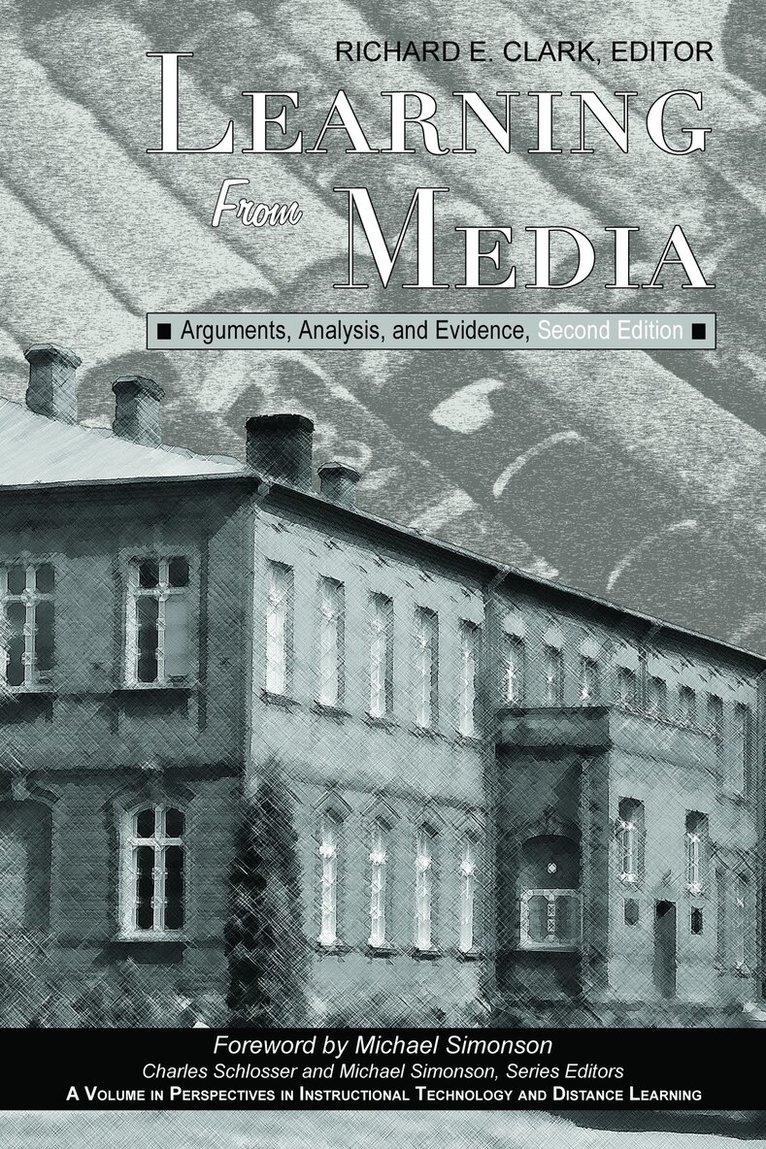
Richard Clark’s observation that “…media are mere vehicles that deliver instruction but do not influence student achievement any more than the truck that delivers our groceries causes changes in our nutrition” is as misunderstood today as it was when first published in the Review of Educational Research in 1983. The convincing if little read scientific evidence presented by Clark has divided the field and caused considerable concern, especially among the providers of newer media for learning.A collection of writings about the “media effects debate,” as it has come to be called, was published in 2001. Edited by Clark, Learning From Media was the first volume in the series “Perspectives in Instructional Technology and Distance Education.” The series editors are convinced that the writings of Clark and those who take issue with his position are of critical importance to the field of instructional technology, Thus, a revised, second edition of Learning From Media is now being offered.The debate about the impact of media on learning remains a fundamental issue as new mediated approaches to teaching and learning are developed, and Clark’s work should be at the center of the discussion. The critical articles on both sides of this debate are contained in Learning From Media, 2nd Edition.
1 029 kr
Skickas inom 7-10 vardagar
Richard Clark’s observation that “…media are mere vehicles that deliver instruction but do not influence student achievement any more than the truck that delivers our groceries causes changes in our nutrition” is as misunderstood today as it was when first published in the Review of Educational Research in 1983. The convincing if little read scientific evidence presented by Clark has divided the field and caused considerable concern, especially among the providers of newer media for learning.A collection of writings about the “media effects debate,” as it has come to be called, was published in 2001. Edited by Clark, Learning From Media was the first volume in the series “Perspectives in Instructional Technology and Distance Education.” The series editors are convinced that the writings of Clark and those who take issue with his position are of critical importance to the field of instructional technology, Thus, a revised, second edition of Learning From Media is now being offered.The debate about the impact of media on learning remains a fundamental issue as new mediated approaches to teaching and learning are developed, and Clark’s work should be at the center of the discussion. The critical articles on both sides of this debate are contained in Learning From Media, 2nd Edition.
582 kr
Skickas inom 7-10 vardagar
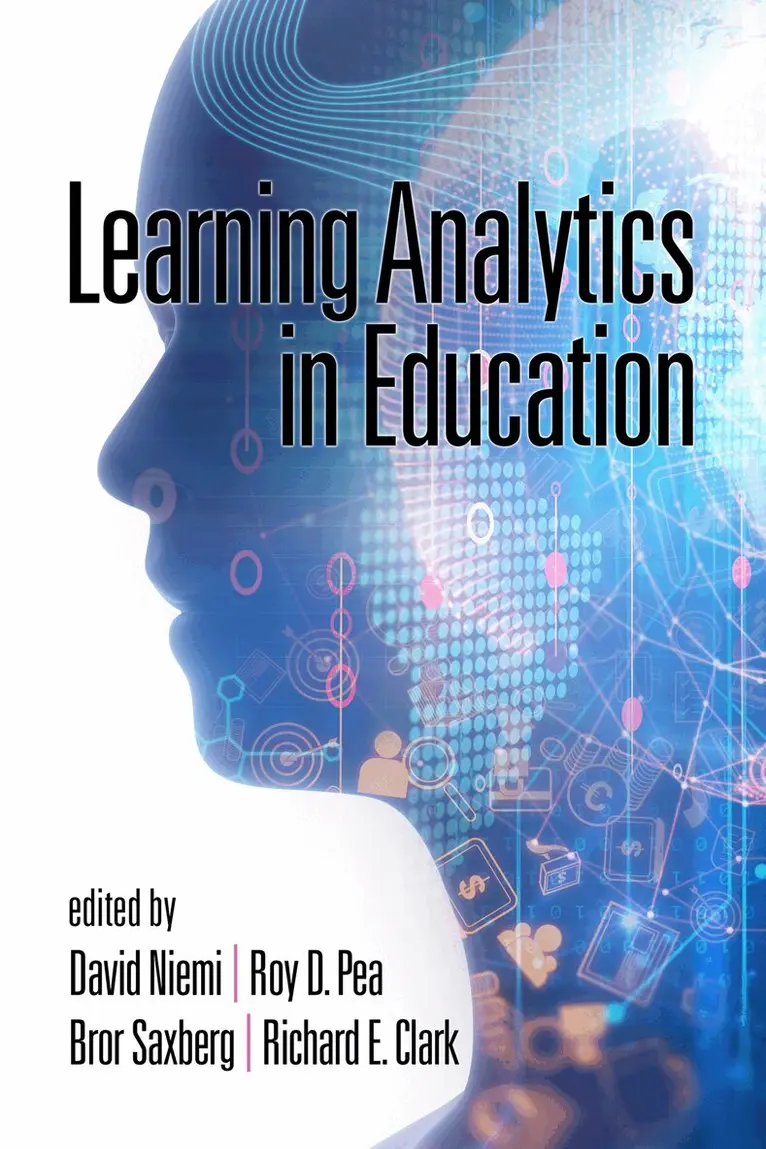
This book provides a comprehensive introduction by an extraordinary range of experts to the recent and rapidly developing field of learning analytics. Some of the finest current thinkers about ways to interpret and benefit from the increasing amount of evidence from learners’ experiences have taken time to explain their methods, describe examples, and point out new underpinnings for the field. Together, they show how this new field has the potential to dramatically increase learner success through deeper understanding of the academic, social-emotional, motivational, identity and meta-cognitive context each learner uniquely brings. Learning analytics is much more than “analyzing learning data”—it is about deeply understanding what learning activities work well, for whom, and when.Learning Analytics in Education provides an essential framework, as well as guidance and examples, for a wide range of professionals interested in the future of learning. If you are already involved in learning analytics, or otherwise trying to use an increasing density of evidence to understand learners’ progress, these leading thinkers in the field may give you new insights. If you are engaged in teaching at any level, or training future teachers/faculty for this new, increasingly technology-enhanced learning world, and want some sense of the potential opportunities (and pitfalls) of what technology can bring to your teaching and students, these forward-thinking leaders can spark your imagination. If you are involved in research around uses of technology, improving learning measurements, better ways to use evidence to improve learning, or in more deeply understanding human learning itself, you will find additional ideas and insights from some of the best thinkers in the field here. If you are involved in making administrative or policy decisions about learning, you will find new ideas (and dilemmas) coming your way from inevitable changes in how we design and deliver instruction, how we measure the outcomes, and how we provide feedback to students, teachers, developers, administrators, and policy-makers. For all these players, the trick will be to get the most out of all the new developments to efficiently and effectively improve learning performance, without getting distracted by “shiny” technologies that are disconnected from how human learning and development actually work.
1 029 kr
Skickas inom 7-10 vardagar
This book provides a comprehensive introduction by an extraordinary range of experts to the recent and rapidly developing field of learning analytics. Some of the finest current thinkers about ways to interpret and benefit from the increasing amount of evidence from learners’ experiences have taken time to explain their methods, describe examples, and point out new underpinnings for the field. Together, they show how this new field has the potential to dramatically increase learner success through deeper understanding of the academic, social-emotional, motivational, identity and meta-cognitive context each learner uniquely brings. Learning analytics is much more than “analyzing learning data”—it is about deeply understanding what learning activities work well, for whom, and when.Learning Analytics in Education provides an essential framework, as well as guidance and examples, for a wide range of professionals interested in the future of learning. If you are already involved in learning analytics, or otherwise trying to use an increasing density of evidence to understand learners’ progress, these leading thinkers in the field may give you new insights. If you are engaged in teaching at any level, or training future teachers/faculty for this new, increasingly technology-enhanced learning world, and want some sense of the potential opportunities (and pitfalls) of what technology can bring to your teaching and students, these forward-thinking leaders can spark your imagination. If you are involved in research around uses of technology, improving learning measurements, better ways to use evidence to improve learning, or in more deeply understanding human learning itself, you will find additional ideas and insights from some of the best thinkers in the field here. If you are involved in making administrative or policy decisions about learning, you will find new ideas (and dilemmas) coming your way from inevitable changes in how we design and deliver instruction, how we measure the outcomes, and how we provide feedback to students, teachers, developers, administrators, and policy-makers. For all these players, the trick will be to get the most out of all the new developments to efficiently and effectively improve learning performance, without getting distracted by “shiny” technologies that are disconnected from how human learning and development actually work.