Jan Elen - Böcker
Visar alla böcker från författaren Jan Elen. Handla med fri frakt och snabb leverans.
9 produkter
9 produkter
1 674 kr
Skickas inom 5-8 vardagar
What do we mean when we say that "learning environments are increasingly complex"? What do we know about the cognitive processing that occurs during complex learning? How can we provide effective instructional support for students who must learn and apply complex knowledge? These questions, and related issues, have fascinated educators and educational researchers for many years and are they are the focus of this book. As a tribute to Joost Lowyck, professor educational technology at the K.U. Leuven, eminent scholars from around the globe have contributed to a far reaching analysis of complexity in learning environments from a cognitive perspective. The chapter authors summarize what we know now about complexity and make specific suggestions for educational practice and for future research on complexity. The different contributions in the several chapters discuss theoretical accounts and empirical findings about learning, the learner, and learning environments. Wide-ranging topics include current descriptions of our cognitive architecture, new contributions to cognitive load theory, research and evaluation design considerations, motivation to learn, the influence of prior knowledge, the use of simulations and multimedia, alternative instructional methods and interventions, studies of the classroom context for complex learning and mental model-building. This book is a tribute to Joose Lowyck, professor educational technology at the KU Leuven. International scholars provide far reaching analysis of complexity in learning environments from a cognitive perspective. It makes specific suggestions for educational practice and for future research.
Use of Representations in Reasoning and Problem Solving
Analysis and Improvement
Inbunden, Engelska, 2010
2 224 kr
Skickas inom 10-15 vardagar
Within an increasingly multimedia focused society, the use of external representations in learning, teaching and communication has increased dramatically. Whether in the classroom, university or workplace, there is a growing requirement to use and interpret a large variety of external representational forms and tools for knowledge acquisition, problem solving, and to communicate with others.Use of Representations in Reasoning and Problem Solving brings together contributions from some of the world’s leading researchers in educational and instructional psychology, instructional design, and mathematics and science education to document the role which external representations play in our understanding, learning and communication. Traditional research has focused on the distinction between verbal and non-verbal representations, and the way they are processed, encoded and stored by different cognitive systems. The contributions here challenge these research findings and address the ambiguity about how these two cognitive systems interact, arguing that the classical distinction between textual and pictorial representations has become less prominent. The contributions in this book explore:how we can theorise the relationship between processing internal and external representationswhat perceptual and cognitive restraints can affect the use of external representationshow individual differences affect the use of external representationshow we can combine external representations to maximise their impacthow we can adapt representational tools for individual differences.Using empirical research findings to take a fresh look at the processes which take place when learning via external representations, this book is essential reading for all those undertaking postgraduate study and research in the fields of educational and instructional psychology, instructional design and mathematics and science education.
Use of Representations in Reasoning and Problem Solving
Analysis and Improvement
Häftad, Engelska, 2010
823 kr
Skickas inom 10-15 vardagar
Within an increasingly multimedia focused society, the use of external representations in learning, teaching and communication has increased dramatically. Whether in the classroom, university or workplace, there is a growing requirement to use and interpret a large variety of external representational forms and tools for knowledge acquisition, problem solving, and to communicate with others.Use of Representations in Reasoning and Problem Solving brings together contributions from some of the world’s leading researchers in educational and instructional psychology, instructional design, and mathematics and science education to document the role which external representations play in our understanding, learning and communication. Traditional research has focused on the distinction between verbal and non-verbal representations, and the way they are processed, encoded and stored by different cognitive systems. The contributions here challenge these research findings and address the ambiguity about how these two cognitive systems interact, arguing that the classical distinction between textual and pictorial representations has become less prominent. The contributions in this book explore:how we can theorise the relationship between processing internal and external representationswhat perceptual and cognitive restraints can affect the use of external representationshow individual differences affect the use of external representationshow we can combine external representations to maximise their impacthow we can adapt representational tools for individual differences.Using empirical research findings to take a fresh look at the processes which take place when learning via external representations, this book is essential reading for all those undertaking postgraduate study and research in the fields of educational and instructional psychology, instructional design and mathematics and science education.
Handbook of Research in Educational Communications and Technology
Learning Design
Inbunden, Engelska, 2020
3 060 kr
Skickas inom 10-15 vardagar
The 5th edition of the prestigious AECT Handbook continues previous efforts to reach outside the traditional instructional design and technology community to the learning sciences and computer information systems communities toward developing a conceptualization of the field. However, given the pervasive and increasingly complex role technology now plays in education since the 1st edition of the Handbook in 1996, the editors have reorganized the research chapters in this edition to focus on the learning problems we are trying to solve with educational technologies, rather than to focus on the things we are using to solve those problems. Additionally, for the first time this edition of the Handbook reflects our field’s growing understanding of the importance of design scholarship to inform practice by including design case chapters. These changes for this edition of the Handbook are intended to bring educational technology research into the broader framework of educational research by elaborating on the role instructional design and technology plays as a scholarly discipline in addressing education’s increasingly complex issues.Provides comprehensive reviews of new developments in educational technology research and design practice.Includes concrete examples to guide future research and practice in the ways emerging technologies can be used to solve educational problems.Contains extensive references furnished to guide readers to the most recent research and design practice in the field of instructional design and technology.
Handbook of Research in Educational Communications and Technology
Learning Design
Häftad, Engelska, 2021
3 060 kr
Skickas inom 10-15 vardagar
The 5th edition of the prestigious AECT Handbook continues previous efforts to reach outside the traditional instructional design and technology community to the learning sciences and computer information systems communities toward developing a conceptualization of the field. However, given the pervasive and increasingly complex role technology now plays in education since the 1st edition of the Handbook in 1996, the editors have reorganized the research chapters in this edition to focus on the learning problems we are trying to solve with educational technologies, rather than to focus on the things we are using to solve those problems. Additionally, for the first time this edition of the Handbook reflects our field’s growing understanding of the importance of design scholarship to inform practice by including design case chapters. These changes for this edition of the Handbook are intended to bring educational technology research into the broader framework of educational research by elaborating on the role instructional design and technology plays as a scholarly discipline in addressing education’s increasingly complex issues.Provides comprehensive reviews of new developments in educational technology research and design practice.Includes concrete examples to guide future research and practice in the ways emerging technologies can be used to solve educational problems.Contains extensive references furnished to guide readers to the most recent research and design practice in the field of instructional design and technology.
521 kr
Skickas inom 10-15 vardagar
This book describes research outcomes on domain-specific serious games. The first part of the book focuses on the design and major characteristics of actual (mainly math-related) serious games. The second part of the book presents recent empirical studies on these games, exploring topics such as the effectiveness of serious games for learning and increasing motivation and the influence of learners’ domain-specific and game competencies. The integration of serious games into the curriculum and subsequent performance and motivation outcomes are also presented.
Del 1 - Zeitschrift für Hochschulentwicklung Jg. 16
Effectiveness of instructional interventions in higher education
Häftad, Engelska, 2021
385 kr
Skickas inom 3-6 vardagar
1 064 kr
Skickas inom 10-15 vardagar
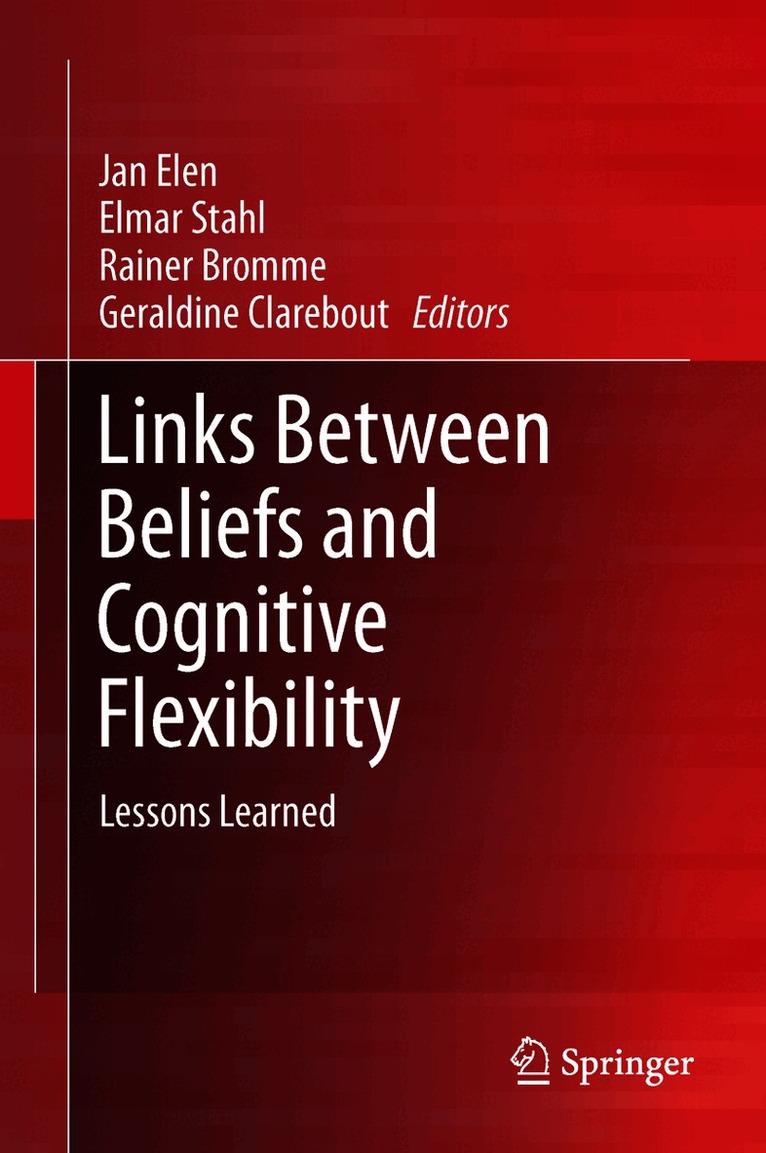
With the world and its structures becoming ever more complex, and the nature of future employment becoming ever more unpredictable, the notion of ‘cognitive flexibility’ has a high profile in educational and psychological debate. The contributions in this volume analyze the nature of cognitive flexibility, as well as the impact of different types of beliefs on cognitive flexibility. Making adequate decisions requires considering input from a variety of continuously evolving sources rather than adhering to predetermined procedures. Adopting a position in a debate necessitates the critical evaluation of different alternatives, while solving a problem entails selecting appropriate problem-solving strategies. Meanwhile, studying requires students to integrate a range of interventions, and treating a patient involves making a differential diagnosis. The common factor, cognitive flexibility, lies at the core of effective functioning in complex, domain-specific environments. Cognitive flexibility can be described as the disposition to consider diverse information elements while deciding on how to solve a problem or to execute a learning-related task in a variety of domains. The concept of ‘disposition’ implies that individuals will not always demonstrate cognitive flexibility even if they are in principle able to act in a cognitively flexible way. The notion does not require that alternatives are always deliberately considered, which is why this volume’s tandem discussion of beliefs is key element of the discussion. Beliefs play a central role in cognitive flexibility and relate to what individuals consider to be important, valid and/or true. Of specific interest is the relationship between epistemological beliefs and cognitive flexibility, especially as a particular subset of epistemological beliefs seems to be a prerequisite to a cognitively flexible disposition.
1 064 kr
Skickas inom 10-15 vardagar
The common factor, cognitive flexibility, lies at the core of effective functioning in complex, domain-specific environments. Cognitive flexibility can be described as the disposition to consider diverse information elements while deciding on how to solve a problem or to execute a learning-related task in a variety of domains.