Erik de Corte – författare
Visar alla böcker från författaren Erik de Corte. Handla med fri frakt och snabb leverans.
13 produkter
Use of Representations in Reasoning and Problem Solving
Analysis and Improvement
Av Lieven Verschaffel, Erik de Corte m. fl.
Inbunden, 2010
2661 kr
Lägg i varukorg
Within an increasingly multimedia focused society, the use of external representations in learning, teaching and communication has increased dramatically. Whether in the classroom, university or workplace, there is a growing requirement to use and interpret a large variety of external …
Use of Representations in Reasoning and Problem Solving
Analysis and Improvement
Av Lieven Verschaffel, Erik de Corte m. fl.
Häftad, 2010
925 kr
Lägg i varukorg
Within an increasingly multimedia focused society, the use of external representations in learning, teaching and communication has increased dramatically. Whether in the classroom, university or workplace, there is a growing requirement to use and interpret a large variety of external …
International Perspectives on the Design of Technology-supported Learning Environments
Av Stella Vosniadou, Erik De Corte m. fl.
Häftad, 1996
234 kr
Lägg i varukorg
In recent years, the use of technology for the purposes of improving and enriching traditional instructional practices has received a great deal of attention. However, few works have explicitly examined cognitive, psychological, and educational principles on which technology-supported learning …
International Perspectives on the Design of Technology-supported Learning Environments
Av Stella Vosniadou, Erik De Corte m. fl.
Inbunden, 1996
744 kr
Lägg i varukorg
In recent years, the use of technology for the purposes of improving and enriching traditional instructional practices has received a great deal of attention. However, few works have explicitly examined cognitive, psychological, and educational principles on which technology-supported learning …
International Perspectives on the Design of Technology-supported Learning Environments
Av Heinz Mandl, Robert Glaser m. fl.
E-bok, 2012
270 kr
Lägg i varukorg
In recent years, the use of technology for the purposes of improving and enriching traditional instructional practices has received a great deal of attention. However, few works have explicitly examined cognitive, psychological, and educational principles on which technology-supported learning …
International Perspectives on the Design of Technology-supported Learning Environments
Av Heinz Mandl, Robert Glaser m. fl.
E-bok, 2012
270 kr
Lägg i varukorg
In recent years, the use of technology for the purposes of improving and enriching traditional instructional practices has received a great deal of attention. However, few works have explicitly examined cognitive, psychological, and educational principles on which technology-supported learning …
Use of Representations in Reasoning and Problem Solving
Analysis and Improvement
Av Jan Elen, Ton de Jong m. fl.
E-bok, 2010
1094 kr
Lägg i varukorg
Within an increasingly multimedia focused society, the use of external representations in learning, teaching and communication has increased dramatically. Whether in the classroom, university or workplace, there is a growing requirement to use and interpret a large variety of external …
Use of Representations in Reasoning and Problem Solving
Analysis and Improvement
Av Jan Elen, Ton de Jong m. fl.
E-bok, 2010
1094 kr
Lägg i varukorg
Within an increasingly multimedia focused society, the use of external representations in learning, teaching and communication has increased dramatically. Whether in the classroom, university or workplace, there is a growing requirement to use and interpret a large variety of external …
Computer-Based Learning Environments and Problem Solving
Av Lieven Verschaffel, Heinz Mandl m. fl.
E-bok, 2013
1459 kr
Lägg i varukorg
Most would agree that the acquisition of problem-solvingability is a primary goal of education. The emergence of thenew information technologiesin the last ten years hasraised high expectations with respect to the possibilitiesof the computer as an instructional tool for enhancingstudents'' …
Computer-Based Learning Environments and Problem Solving
Av Erik De Corte, Marcia C. Linn m. fl.
Häftad, 2011
1093 kr
Lägg i varukorg
Most would agree that the acquisition of problem-solvingability is a primary goal of education. The emergence of thenew information technologiesin the last ten years hasraised high expectations with respect to the possibilitiesof the computer as an instructional tool for enhancingstudents' …
Technology-Based Learning Environments
Psychological and Educational Foundations
Av Heinz Mandl, Erik de Corte m. fl.
E-bok, 2012
1418 kr
Lägg i varukorg
The present volume contains a large number of the papers contributed to the Advanced Study Institute on the Psychological and Educational Foundations of Technology-Based Learning Environments, which took place in Crete in the summer of 1992. The purpose of the Advanced Study Institute was to bring …
Technology-Based Learning Environments
Psychological and Educational Foundations
Av Stella Vosniadou, Erik de Corte m. fl.
Häftad, 2011
1062 kr
Lägg i varukorg
The present volume contains a large number of the papers contributed to the Advanced Study Institute on the Psychological and Educational Foundations of Technology-Based Learning Environments, which took place in Crete in the summer of 1992. The purpose of the Advanced Study Institute was to bring …
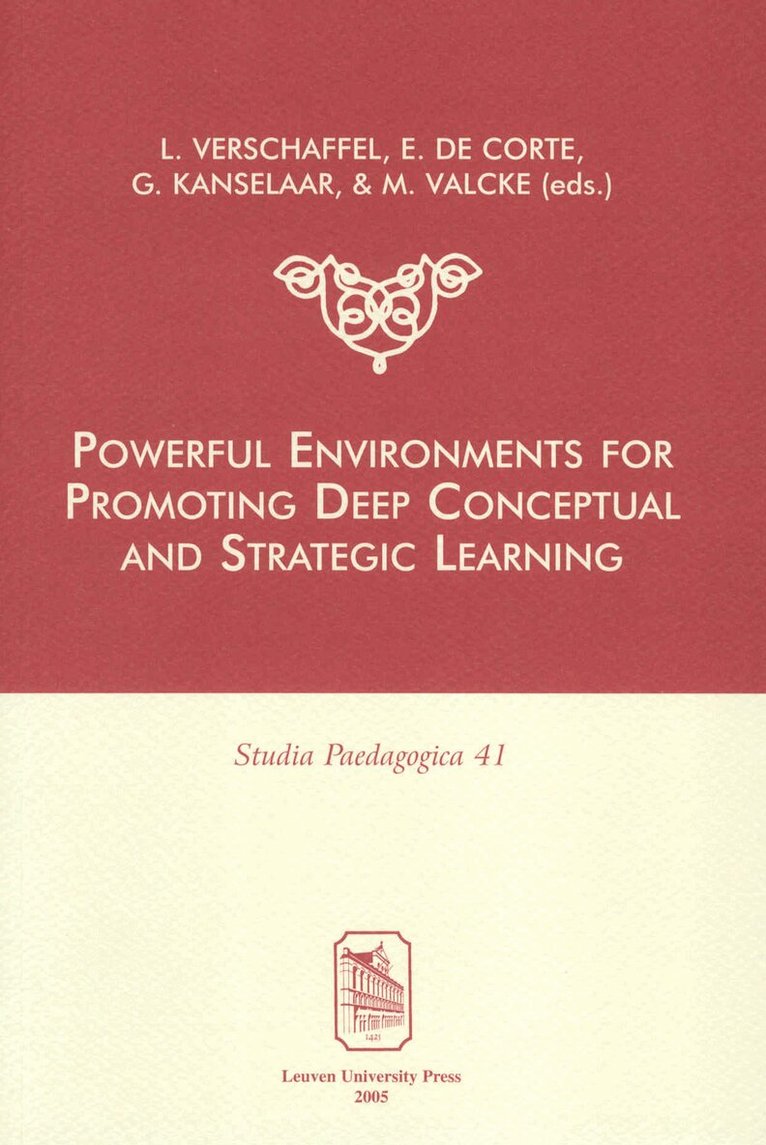
Powerful Environments for Promoting Deep Conceptual and Strategic Learning
Av Lieven Verschaffel, Erik de Corte m. fl.
Häftad, 2005
434 kr
Lägg i varukorg
Over the past years a substantial amount of research has been undertaken relating to the development of powerful learning environments for the acquisition in students of worthwhile educational objectives focussing on conceptual understanding, higher-order cognitive and metacognitive skills, and …