Lieven Verschaffel - Böcker
Visar alla böcker från författaren Lieven Verschaffel. Handla med fri frakt och snabb leverans.
11 produkter
11 produkter
1 657 kr
Skickas inom 5-8 vardagar
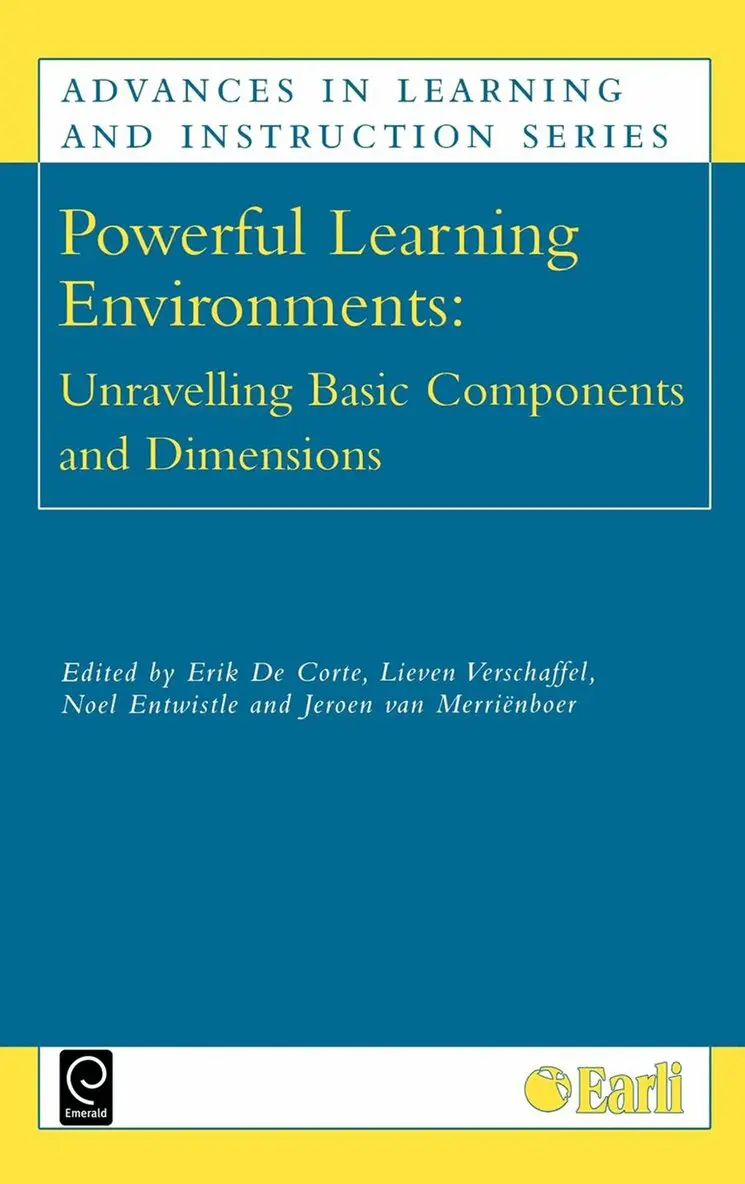
Over the past ten to fifteen years the international scene of research on learning and instruction has witnessed the emergence of important and promising developments. New theoretical frameworks, design principles, and research methodologies focusing on the construction, implementation, and evaluation of powerful learning environments have been put forward, coming from three intersecting subdomains within the broader field of research on learning and instruction - namely instructional psychology, instructional technology, and instructional design. Although it is obvious that the developments in those three subdomains are characterized by similarities and convergencies, there are still important differences. Therefore, there is a great need for scientific debate and attempts to integrate, or justify, the contrasting theoretical frameworks, methodological approaches, and empirical outcomes. A European research network, coordinated by the Center for Instructional Psychology and Technology of the University of Leuven, has been set up to work towards this end. The present volume is the first collective output of this European research network, and focuses on unravelling and identifying basic component and dimensions of powerful learning environments. It is based on the presentations and discussions that constituted the "piece de resistance" of a first meeting of the research network.
Instructional Psychology
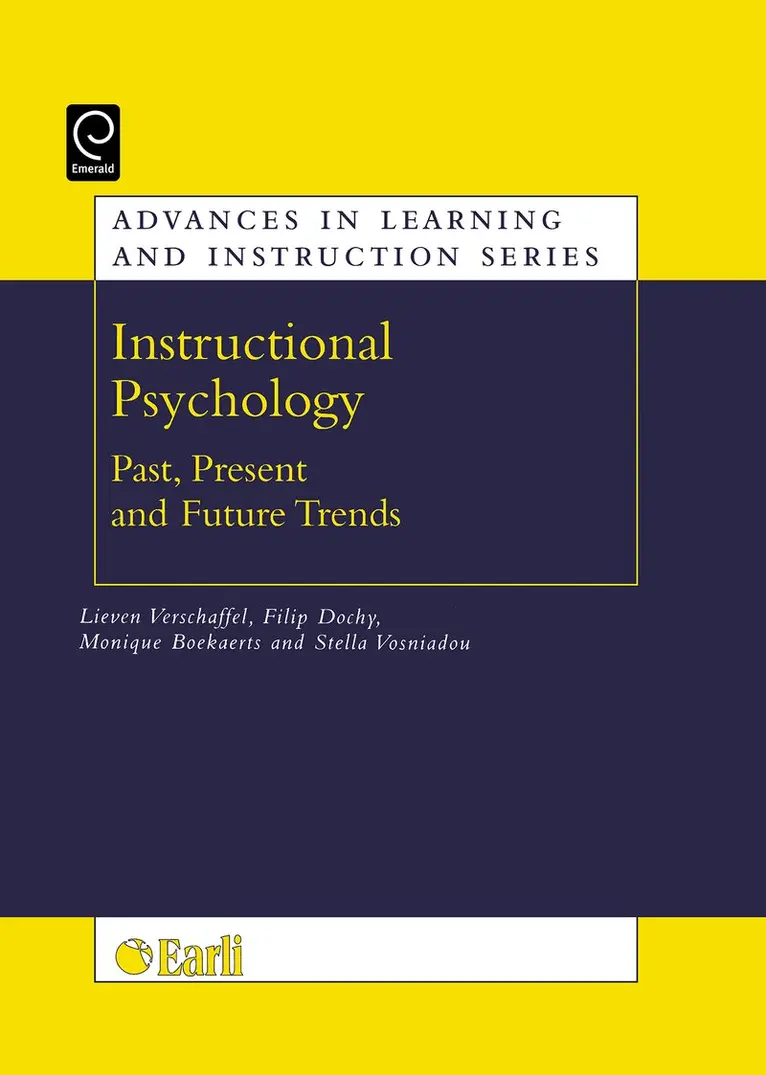
Past, Present, and Future Trends - Sixteen Essays in Honour of Erik De Corte
Inbunden, Engelska, 2006
1 349 kr
Skickas inom 7-10 vardagar
To celebrate Erik De Cortes scientific career in the international scientific field of instructional psychology, high profile researchers and scholars were invited by the editors to write an essay on the past, present, and future of the subdomain of instructional psychology of their personal interest and expertise. This book addresses the core topics of the learning sciences from a diversity of perspectives. The sixteen chapters are grouped into the following six sections: Learning and Development; Learning, Reasoning, and Problem Solving; Motivational and Emotional Aspects of Learning; Learning and Assessment; Learning and Technology, and Instructional and Organizational Designs for Learning. These chapters provide overviews of and commentaries on the past decades of research on learning and teaching. Furthermore, the authors look also at the future of research on learning and instruction and its changing role in our fast developing knowledge society. 16 chapters are written by high profile researchers and scholars. Content provides both a review of existing literature and a discussion of the future of the discipline
1 064 kr
Skickas inom 10-15 vardagar
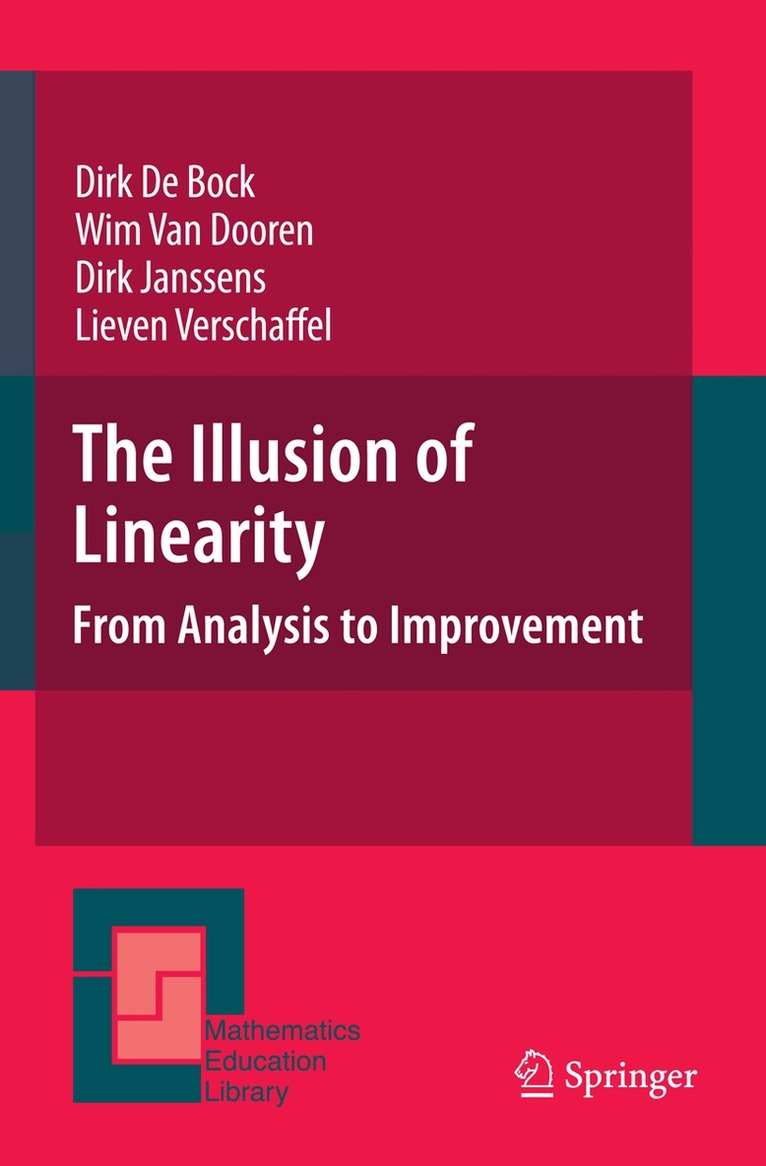
Linear or proportional relationships are a major topic in mathematics education. However, recent research has shown that secondary school students strongly tend to apply the linear model also in situations wherein it is not applicable. This overgeneralization of linearity is sometimes referred to as the "illusion of linearity" and has a strong negative impact on students’ reasoning and problem solving skills."The Illusion of Linearity: From Analysis to Improvement" presents the reader with a comprehensive overview of the major findings of the recent research on the illusion of linearity. Although the empirical study of students’ improper linear reasoning clearly constitutes a new line of research, it owes a great deal to prior work in mathematics education research community (such as the work of the scholars of the Freudenthal Institute on realistic mathematics education). Based on both quantitative and qualitative research, "The Illusion of Linearity: From Analysis to Improvement" discusses the following issues: (1) how the illusion of linearity appears in diverse domains of mathematics and science and how it is conceptually related to other more general misconceptions identified in the research literature, (2) what are the crucial psychological, mathematical, and educational factors being responsible for the occurrence and persistence of the phenomenon, and (3) how the illusion of linearity can be remedied by appropriate instruction."The Illusion of Linearity: From Analysis to Improvement" is essential to those working in mathematics education, particularly teacher educators and curriculum research and development.
Use of Representations in Reasoning and Problem Solving
Analysis and Improvement
Inbunden, Engelska, 2010
2 225 kr
Skickas inom 10-15 vardagar
Within an increasingly multimedia focused society, the use of external representations in learning, teaching and communication has increased dramatically. Whether in the classroom, university or workplace, there is a growing requirement to use and interpret a large variety of external representational forms and tools for knowledge acquisition, problem solving, and to communicate with others.Use of Representations in Reasoning and Problem Solving brings together contributions from some of the world’s leading researchers in educational and instructional psychology, instructional design, and mathematics and science education to document the role which external representations play in our understanding, learning and communication. Traditional research has focused on the distinction between verbal and non-verbal representations, and the way they are processed, encoded and stored by different cognitive systems. The contributions here challenge these research findings and address the ambiguity about how these two cognitive systems interact, arguing that the classical distinction between textual and pictorial representations has become less prominent. The contributions in this book explore:how we can theorise the relationship between processing internal and external representationswhat perceptual and cognitive restraints can affect the use of external representationshow individual differences affect the use of external representationshow we can combine external representations to maximise their impacthow we can adapt representational tools for individual differences.Using empirical research findings to take a fresh look at the processes which take place when learning via external representations, this book is essential reading for all those undertaking postgraduate study and research in the fields of educational and instructional psychology, instructional design and mathematics and science education.
Use of Representations in Reasoning and Problem Solving
Analysis and Improvement
Häftad, Engelska, 2010
824 kr
Skickas inom 10-15 vardagar
Within an increasingly multimedia focused society, the use of external representations in learning, teaching and communication has increased dramatically. Whether in the classroom, university or workplace, there is a growing requirement to use and interpret a large variety of external representational forms and tools for knowledge acquisition, problem solving, and to communicate with others.Use of Representations in Reasoning and Problem Solving brings together contributions from some of the world’s leading researchers in educational and instructional psychology, instructional design, and mathematics and science education to document the role which external representations play in our understanding, learning and communication. Traditional research has focused on the distinction between verbal and non-verbal representations, and the way they are processed, encoded and stored by different cognitive systems. The contributions here challenge these research findings and address the ambiguity about how these two cognitive systems interact, arguing that the classical distinction between textual and pictorial representations has become less prominent. The contributions in this book explore:how we can theorise the relationship between processing internal and external representationswhat perceptual and cognitive restraints can affect the use of external representationshow individual differences affect the use of external representationshow we can combine external representations to maximise their impacthow we can adapt representational tools for individual differences.Using empirical research findings to take a fresh look at the processes which take place when learning via external representations, this book is essential reading for all those undertaking postgraduate study and research in the fields of educational and instructional psychology, instructional design and mathematics and science education.
1 577 kr
Skickas inom 10-15 vardagar
The almost universal rejection of the notion of symbols as "carriers of meaning" has created the need to find an alternative for the use of models as embodiments of mathematical concepts. By taking its point of departure as a concern for the way students actually use tools and symbols, and for what these signify for them, this book explores the option of building on symbolizing, modelling and tool use as personally meaningful activities. This theme is approached from different angles and different perspectives. One dimension is that of setting, varying from the study of informal, spontaneous activity of students, to an explicit focus on instructional design, and goals and effects of instruction. Another dimension is the theoretical framework of the researcher, varying from constructivism, to activity theory, cognitive-psychology and instructional-design theory.
1 064 kr
Skickas inom 10-15 vardagar
Linear or proportional relationships are a major topic in mathematics education. However, recent research has shown that secondary school students strongly tend to apply the linear model also in situations wherein it is not applicable. This overgeneralization of linearity is sometimes referred to as the "illusion of linearity" and has a strong negative impact on students’ reasoning and problem solving skills."The Illusion of Linearity: From Analysis to Improvement" presents the reader with a comprehensive overview of the major findings of the recent research on the illusion of linearity. Although the empirical study of students’ improper linear reasoning clearly constitutes a new line of research, it owes a great deal to prior work in mathematics education research community (such as the work of the scholars of the Freudenthal Institute on realistic mathematics education). Based on both quantitative and qualitative research, "The Illusion of Linearity: From Analysis to Improvement" discusses the following issues: (1) how the illusion of linearity appears in diverse domains of mathematics and science and how it is conceptually related to other more general misconceptions identified in the research literature, (2) what are the crucial psychological, mathematical, and educational factors being responsible for the occurrence and persistence of the phenomenon, and (3) how the illusion of linearity can be remedied by appropriate instruction."The Illusion of Linearity: From Analysis to Improvement" is essential to those working in mathematics education, particularly teacher educators and curriculum research and development.
106 kr
Skickas inom 10-15 vardagar
This book examines the kinds of transitions that have been studied in mathematics education research. It defines transition as a process of change, and describes learning in an educational context as a transition process. The book focuses on research in the area of mathematics education, and starts out with a literature review, describing the epistemological, cognitive, institutional and sociocultural perspectives on transition. It then looks at the research questions posed in the studies and their link with transition, and examines the theoretical approaches and methods used. It explores whether the research conducted has led to the identification of continuous processes, successive steps, or discontinuities. It answers the question of whether there are difficulties attached to the discontinuities identified, and if so, whether the research proposes means to reduce the gap – to create a transition. The book concludes with directions for future research on transitions in mathematics education.
1 064 kr
Skickas inom 10-15 vardagar
Most would agree that the acquisition of problem-solvingability is a primary goal of education. The emergence of thenew information technologiesin the last ten years hasraised high expectations with respect to the possibilitiesof the computer as an instructional tool for enhancingstudents' problem-solving skills.This volume is the first to assemble, review, and discussthe theoretical, methodological, and developmental knowledgerelating to this topical issue in a multidisciplinaryconfrontation of highly recommended experts in cognitivescience, computer science, educational technology, andinstructional psychology.Contributors describe the most recent results and the mostadvanced methodological approaches relating to theapplication of the computer for encouraging knowledgeconstruction, stimulating higher-order thinking and problemsolving, and creating powerfullearning environments forpursuing those objectives. The computer applications relateto a variety of content domains and age levels.
1 577 kr
Skickas inom 10-15 vardagar
The almost universal rejection of the notion of symbols as `carriers of meaning' has created the need to find an alternative for the use of models as embodiments of mathematical concepts. By taking its point of departure as a concern for the way students actually use tools and symbols, and for what these signify for them, this book explores the option of building on symbolizing, modelling and tool use as personally meaningful activities of students. This theme is approached from different angles and different perspectives. One dimension is that of setting, varying from the study of informal, spontaneous activity of students, to an explicit focus on instructional design, and goals and effects of instruction. Another dimension is the theoretical framework of the researcher, varying from constructivism, to activity theory, cognitive-psychology and instructional-design theory. This book will appeal to a wide audience, varying from researchers, instructional designers, educators, and graduate students.
413 kr
Skickas inom 5-8 vardagar
Over the past years a substantial amount of research has been undertaken relating to the development of powerful learning environments for the acquisition in students of worthwhile educational objectives focussing on conceptual understanding, higher-order cognitive and metacognitive skills, and self-regulated learning. This research has been mainly undertaken from three distinct perspectives in the study of learning and instruction, namely instructional psychology, instructional technology, and instructional design. Against this background a "research community" involving 14 European research teams has been initiated with the aim of interactively contributing to the advancement of theory and methodology relating to the design, implementation, and evaluation of powerful learning environments. This volume constitutes a collective output of this research community, focussing on the identification and analysis of major components and dimensions of powerful learning environments aimed at the promotion of deep conceptual and strategic learning in major domains of school curricula, like mathematics, physics, history, and social sciences. In Part I of the volume three chapters present general perspectives on the central theme of the third workshop. In Part II six studies are reported wherein novel learning environments for elementary and secondary mathematics education have been designed, implemented and evaluated. In Part III of the volume another set of five investigations is presented relating to the design, implementation and evaluation of powerful learning environments in other subject-matter domains and in teacher training.