• Fri frakt över 249 kr
  • •
  • Snabba leveranser
  • •
  • Billiga böcker
Kundservice

Du är på sajten för privatpersoner.

Företag, bibliotek eller offentlig verksamhet?

Du handlar på classic.bokus.com, där alla dina funktioner finns intakta.
Till classic.bokus.com
Bokus logotyp. Gå till startsidan.
  • Erbjudanden
  • Nyheter
  • Student
  • Topplistor
  • Barn & ungdom
  • Bokus Play
  • E-böcker
  • Pocketböcker
  • Spel & pussel

10% rabatt på allt med kod NYSTART10 →

Sidfot

Mina sidor

    Hjälp

    • Kundservice
    • Vanliga frågor och svar
    • Frakt och leverans
    • Retur vid ångerrätt
    • Reklamera vara
    • Betalning
    • Köpvillkor
    • Allmänna villkor
    • Information om webbplatsens tillgänglighet

    Om Bokus

    • Om oss
    • Pressrum
    • För studenter
    • För företag
    • För bibliotek och offentlig verksamhet
    • För leverantörer
    • Hållbarhet

    Populärt

    • Aktuella erbjudanden
    • Presentkort
    • Studentlitteratur
    • Nya böcker
    • Topplistor
    • Signerade böcker
    • Engelska böcker

    Inspiration

    • Boktips
    • BookTok
    • Populära bokserier
    • Barnbokskaraktärer
    • Populära författare
    Logotyp för Bokus
    Följ oss på Facebook (extern länk)Följ oss på Instagram (extern länk)Följ oss på YouTube (extern länk)Följ oss på TikTok (extern länk)
    bokus @ CookiesAnpassa cookiesIntegritetspolicyKöpvillkor
    Till Citymail hemsida (extern länk)Till Budbee hemsida (extern länk)Till Postnord hemsida (extern länk)Till Schenker hemsida (extern länk)Till Early Bird hemsida (extern länk)Till Walleys hemsida (extern länk)
    1. Psykologi och pedagogik
    2. Pedagogik
    3. Pedagogisk psykologi

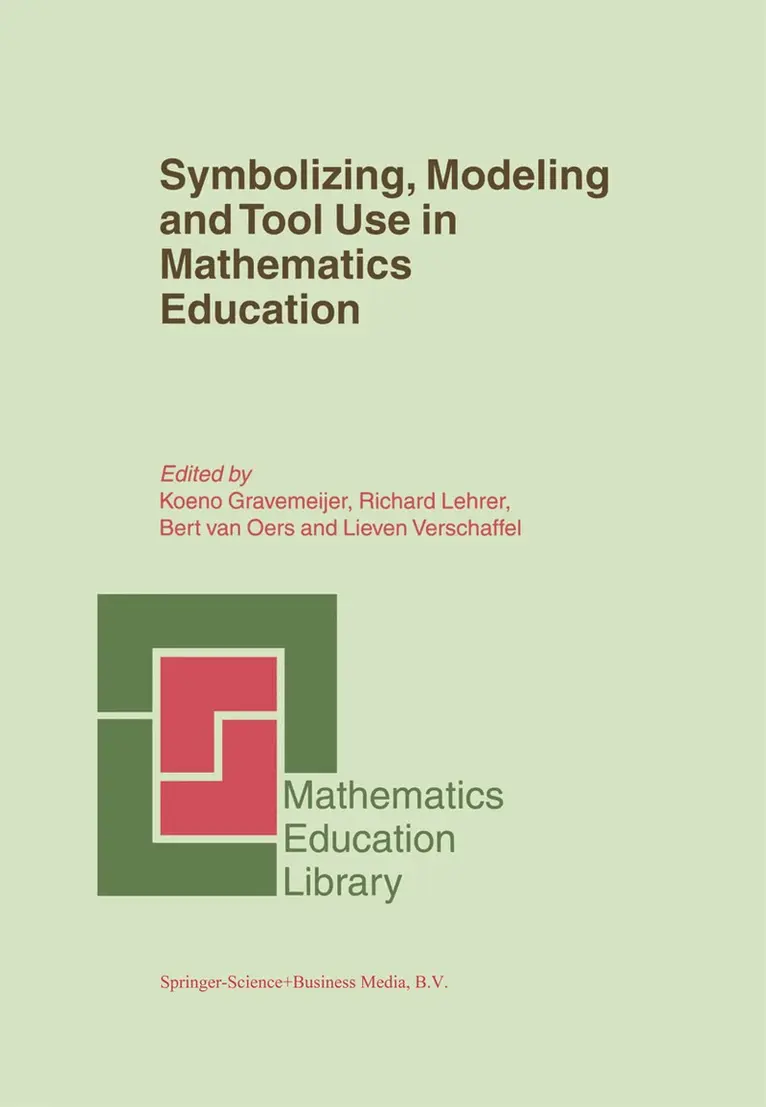
    Symbolizing, Modeling and Tool Use in Mathematics Education

    AvK.P Gravemeijer,R. Lehrer

    Häftad, Engelska, 2010

    Del 30 i serien Mathematics Education Library

    1 625 kr

    Beställningsvara. Skickas inom 10-15 vardagar. Fri frakt över 249 kr.

    Beskrivning

    The almost universal rejection of the notion of symbols as `carriers of meaning' has created the need to find an alternative for the use of models as embodiments of mathematical concepts. By taking its point of departure as a concern for the way students actually use tools and symbols, and for what these signify for them, this book explores the option of building on symbolizing, modelling and tool use as personally meaningful activities of students. This theme is approached from different angles and different perspectives. One dimension is that of setting, varying from the study of informal, spontaneous activity of students, to an explicit focus on instructional design, and goals and effects of instruction. Another dimension is the theoretical framework of the researcher, varying from constructivism, to activity theory, cognitive-psychology and instructional-design theory. This book will appeal to a wide audience, varying from researchers, instructional designers, educators, and graduate students.

    Produktinformation

    • Utgivningsdatum:2010-12-05
    • Mått:210 x 297 x 18 mm
    • Vikt:834 g
    • Format:Häftad
    • Språk:Engelska
    • Serie:Mathematics Education Library
    • Antal sidor:308
    • Förlag:Springer
    • ISBN:9789048161805

    Utforska kategorier

    • Pedagogisk psykologi inom Psykologi och pedagogik
    • Matematik inom Naturvetenskap och teknik
    • Läroplaner och kursplaner inom Psykologi och pedagogik

    Innehållsförteckning

    • and overview.- Preamble: from models to modeling.- Section I: Emergent modeling.- to section I: Informal representations and their improvements.- The mathematization of young children’s language.- Symbolizing space into being.- Mathematical representations as systems of notations-in-use.- Students’ Criteria for Representational Adequacy.- Transitions in emergent modeling.- Section II: The role of Models, Symbols and Tools in instructional design.- to section II: The role of Models, Symbols and Tools in instructional design.- Emergent models as an instructional design heuristic.- Modeling, Symbolizing, and Tool Use in Statistical Data Analysis.- Didactic objects and didactic models in radical constructivism.- Taking into account different views: Three brief comments on papers by Gravemeijer & Stephan, Cobb and Thompson.- Section III: Models, situated practices, and generalization.- to section III: Models, situated practices, and generalization.- On Guessing the Essential Thing.- Everyday knowledge and mathematical modeling of school word problems.- On the development of human representional competence from and evolutionary point of view: From Episodic To Virtual Culture.- Modeling Reasoning.