• Fri frakt över 249 kr
  • •
  • Snabba leveranser
  • •
  • Billiga böcker
Kundservice

Du är på sajten för privatpersoner.

Företag, bibliotek eller offentlig verksamhet?

Du handlar på classic.bokus.com, där alla dina funktioner finns intakta.
Till classic.bokus.com
Bokus logotyp. Gå till startsidan.
  • Erbjudanden
  • Nyheter
  • Student
  • Topplistor
  • Barn & ungdom
  • Bokus Play
  • E-böcker
  • Pocketböcker
  • Spel & pussel

10% rabatt på allt med kod NYSTART10 →

Sidfot

Mina sidor

    Hjälp

    • Kundservice
    • Vanliga frågor och svar
    • Frakt och leverans
    • Retur vid ångerrätt
    • Reklamera vara
    • Betalning
    • Köpvillkor
    • Allmänna villkor
    • Information om webbplatsens tillgänglighet

    Om Bokus

    • Om oss
    • Pressrum
    • För studenter
    • För företag
    • För bibliotek och offentlig verksamhet
    • För leverantörer
    • Hållbarhet

    Populärt

    • Aktuella erbjudanden
    • Presentkort
    • Studentlitteratur
    • Nya böcker
    • Topplistor
    • Signerade böcker
    • Engelska böcker

    Inspiration

    • Boktips
    • BookTok
    • Populära bokserier
    • Barnbokskaraktärer
    • Populära författare
    Logotyp för Bokus
    Följ oss på Facebook (extern länk)Följ oss på Instagram (extern länk)Följ oss på YouTube (extern länk)Följ oss på TikTok (extern länk)
    bokus @ CookiesAnpassa cookiesIntegritetspolicyKöpvillkor
    Till Citymail hemsida (extern länk)Till Budbee hemsida (extern länk)Till Postnord hemsida (extern länk)Till Schenker hemsida (extern länk)Till Early Bird hemsida (extern länk)Till Walleys hemsida (extern länk)
    1. Psykologi och pedagogik
    2. Pedagogik
    3. Pedagogisk psykologi

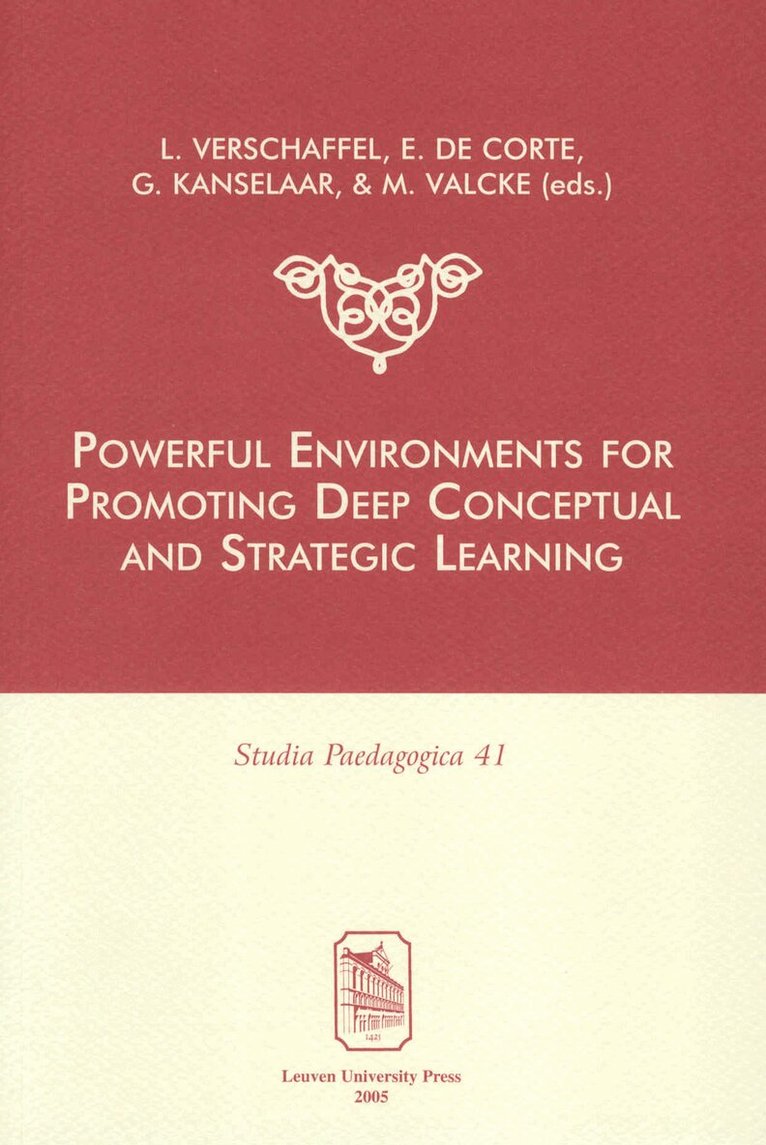
    Powerful Environments for Promoting Deep Conceptual and Strategic Learning

    AvLieven Verschaffel,Erik de Corte

    Häftad, Engelska, 2005

    Del i serien Studia Paedagogica

    421 kr

    Beställningsvara. Skickas inom 5-8 vardagar. Fri frakt över 249 kr.

    Beskrivning

    Over the past years a substantial amount of research has been undertaken relating to the development of powerful learning environments for the acquisition in students of worthwhile educational objectives focussing on conceptual understanding, higher-order cognitive and metacognitive skills, and self-regulated learning. This research has been mainly undertaken from three distinct perspectives in the study of learning and instruction, namely instructional psychology, instructional technology, and instructional design. Against this background a "research community" involving 14 European research teams has been initiated with the aim of interactively contributing to the advancement of theory and methodology relating to the design, implementation, and evaluation of powerful learning environments. This volume constitutes a collective output of this research community, focussing on the identification and analysis of major components and dimensions of powerful learning environments aimed at the promotion of deep conceptual and strategic learning in major domains of school curricula, like mathematics, physics, history, and social sciences. In Part I of the volume three chapters present general perspectives on the central theme of the third workshop. In Part II six studies are reported wherein novel learning environments for elementary and secondary mathematics education have been designed, implemented and evaluated. In Part III of the volume another set of five investigations is presented relating to the design, implementation and evaluation of powerful learning environments in other subject-matter domains and in teacher training.

    Produktinformation

    • Utgivningsdatum:2005-08-22
    • Mått:235 x 155 x 17 mm
    • Vikt:454 g
    • Format:Häftad
    • Språk:Engelska
    • Serie:Studia Paedagogica
    • Antal sidor:258
    • Förlag:Leuven University Press
    • ISBN:9789058674692

    Utforska kategorier

    • Pedagogisk psykologi inom Psykologi och pedagogik

    Innehållsförteckning

    • IntroductionPart I: General perspectives1. The problem of knowledge in the design of learning environmentsS. Vosniadou2. On learning environments that foster subject-matter competenceA.H. Schoenfeld3. Engagement in learning: Designing learning environments that are really usedT. de JongPart II: Promoting deep conceptual and strategic learning in mathematics4. Does social interaction influence 3-year-old children's tendency to focus on numerosity? A quasi-experimental study in day careM.M. Hannula, A. Mattinen, and E. Lehtinen5. Using mathematical symbols at the beginning of the arithmetical and algebraic learningA. Fagnant, J. Vlassis, and M. Crahay6. Collaboration in small group mathematics problem solving: A case studyG.H.J. Seegers and D.J. Hoek7. Remedying secondary school students' illusion of linearity: Developing and evaluating a powerful learning environmentW. Van Dooren, D. De Bock, A. Hessels, D. Janssens and L. Verschaffel8. Improving procedural transfer in mathematics with interactive animationsP. Gerjets, K. Scheiter, and R. Catrambone9. Teaching percentages in the primary school: A four country comparative studyF. Depaepe, E. De Corte, P. Op 't Eynde, and L. VerschaffelPart III: Promoting deep conceptual and strategic learning in other major curricular domains10. Teaching-learning environments and student learning in electronic engeneeringN. Entwistle, J. Nisbet, and A. Bromage11. Learner control over information presentation in powerful electronic learning environments used in physics educationL. Kester, P.A. Kirschner, and G. Corbalán-Pérez12. The impact of external graphical representations in different knowledge domains: Is there a domain specific effect?K. De Westelinck and M. Valcke13. Using representational tools to support historical reasoning in CSCLG. Kanselaar, C. van Boxtel, and J. van DrieList of contributors