• Fri frakt över 249 kr
  • •
  • Snabba leveranser
  • •
  • Billiga böcker
Kundservice

Du är på sajten för privatpersoner.

Företag, bibliotek eller offentlig verksamhet?

Du handlar på classic.bokus.com, där alla dina funktioner finns intakta.
Till classic.bokus.com
Bokus logotyp. Gå till startsidan.
  • Erbjudanden
  • Nyheter
  • Student
  • Topplistor
  • Barn & ungdom
  • Bokus Play
  • E-böcker
  • Pocketböcker
  • Spel & pussel

10% rabatt på allt med kod NYSTART10 →

Sidfot

Mina sidor

    Hjälp

    • Kundservice
    • Vanliga frågor och svar
    • Frakt och leverans
    • Retur vid ångerrätt
    • Reklamera vara
    • Betalning
    • Köpvillkor
    • Allmänna villkor
    • Information om webbplatsens tillgänglighet

    Om Bokus

    • Om oss
    • Pressrum
    • För studenter
    • För företag
    • För bibliotek och offentlig verksamhet
    • För leverantörer
    • Hållbarhet

    Populärt

    • Aktuella erbjudanden
    • Presentkort
    • Studentlitteratur
    • Nya böcker
    • Topplistor
    • Signerade böcker
    • Engelska böcker

    Inspiration

    • Boktips
    • BookTok
    • Populära bokserier
    • Barnbokskaraktärer
    • Populära författare
    Logotyp för Bokus
    Följ oss på Facebook (extern länk)Följ oss på Instagram (extern länk)Följ oss på YouTube (extern länk)Följ oss på TikTok (extern länk)
    bokus @ CookiesAnpassa cookiesIntegritetspolicyKöpvillkor
    Till Citymail hemsida (extern länk)Till Budbee hemsida (extern länk)Till Postnord hemsida (extern länk)Till Schenker hemsida (extern länk)Till Early Bird hemsida (extern länk)Till Walleys hemsida (extern länk)
    1. Psykologi och pedagogik
    2. Pedagogik
    3. Pedagogisk psykologi

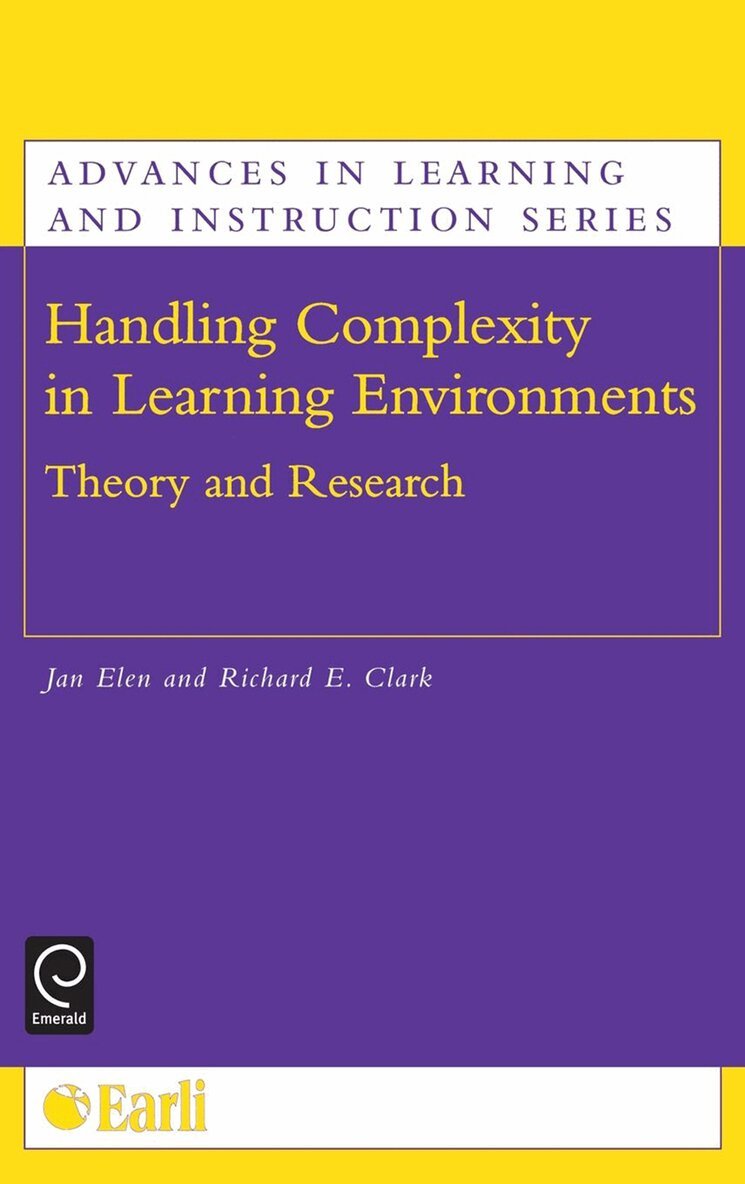
    Handling Complexity in Learning Environments

    Theory and Research

    AvJan Elen,Richard E. Clark

    Inbunden, Engelska, 2006

    Del i serien Advances in Learning and Instruction Series

    1 705 kr

    Beställningsvara. Skickas inom 5-8 vardagar. Fri frakt över 249 kr.

    Beskrivning

    What do we mean when we say that "learning environments are increasingly complex"? What do we know about the cognitive processing that occurs during complex learning? How can we provide effective instructional support for students who must learn and apply complex knowledge? These questions, and related issues, have fascinated educators and educational researchers for many years and are they are the focus of this book. As a tribute to Joost Lowyck, professor educational technology at the K.U. Leuven, eminent scholars from around the globe have contributed to a far reaching analysis of complexity in learning environments from a cognitive perspective. The chapter authors summarize what we know now about complexity and make specific suggestions for educational practice and for future research on complexity. The different contributions in the several chapters discuss theoretical accounts and empirical findings about learning, the learner, and learning environments. Wide-ranging topics include current descriptions of our cognitive architecture, new contributions to cognitive load theory, research and evaluation design considerations, motivation to learn, the influence of prior knowledge, the use of simulations and multimedia, alternative instructional methods and interventions, studies of the classroom context for complex learning and mental model-building. This book is a tribute to Joose Lowyck, professor educational technology at the KU Leuven. International scholars provide far reaching analysis of complexity in learning environments from a cognitive perspective. It makes specific suggestions for educational practice and for future research.

    Produktinformation

    • Utgivningsdatum:2006-06-01
    • Mått:156 x 234 x 19 mm
    • Vikt:637 g
    • Format:Inbunden
    • Språk:Engelska
    • Serie:Advances in Learning and Instruction Series
    • Antal sidor:328
    • Förlag:Emerald Publishing Limited
    • ISBN:9780080449869

    Utforska kategorier

    • Pedagogisk psykologi inom Psykologi och pedagogik

    Mer om författaren

    Currently a professor of Educational Psychology and Technology in the Rossier School of Education at the University of Southern California, where he directs a doctoral program in Human Performance at Work. He was the 2002 recipient of the prestigious Thomas F. Gilbert Professional Achievement Award by the International Society for Performance Improvement. He has served as a performance improvement specialist in a great variety of organizations in North and South America, Europe, Africa, and Asia in the past two decades. For two years he served as Program Board Member and lecturer in Organizational Psychology at Dublin City University in Ireland, and he is Professeur Associe at the Universite de Montreal, Faculte des sciences de l education in Montreal, Quebec. He is president of Atlantic Training Inc., a consulting company with offices in Los Angeles and Dublin. Clarks interest is in the performance of people and technology in culturally diverse, multinational organizations where complex knowledge work is accomplished in a constantly changing environment. He is the author of more than 150 published books, chapters, articles, and monographs, including, most recently, Learning from Media: Arguments, Analysis, and Evidence (Information Age Publishing Inc., 2001), which sold out its first print run in advance of the books release. He is an Educational Psychologist who is an elected Fellow in the American Psychological Association, the American Psychological Society and the American Association of Applied Psychology.

    Innehållsförteckning

    • Contributors. Preface. Introduction. Setting the Scene: Complexity and Learning Environments (J. Elen and R. E. Clark). How the Human Cognitive System Deals With Complexity (J. Sweller). Motivational Challenges Experienced in Highly Complex Learning Environments (R. E. Clark, K. Howard, and S. Early). Mental Models and Complex Problem Solving: Instructional Effects (N. M. Seel). The Social Complexity in Establishing and Sharing Information Resources (U. Cress and F. W. Hesse). The Culture of the Mathematics Classroom: A Complex Determinant of Students Learning (F. Depaepe, E. De Corte, and L. Verschaffel). Scaffolds for Computer Simulation Based Scientific Discovery Learning (T. de Jong). Coping With Complexity in Multimedia Learning (R. E. Mayer). Collaboration Load (P. Dillenbourg and M. Betrancourt). Balancing Support for Student Learning (J. D. Vermunt). The Use of Instructional Interventions: Lean Learning Environments as a Solution for a Design Problem (J. Elen and G. Clarebout). Performance Assessment and Learning Task Selection in Environments for Complex Learning (J. J. G. van Merrienboer, D. Sluijsmans, G. Corbalan et al.). Meeting Challenges to Researching Learning From Instruction by Increasing the Complexity of Research (P. H. Winne). System Theoretic Designs for Researching Complex Events (W. Winn). The Systemic vs. Analytic Study of Complex Learning Environments (G. Salomon). Hypothesized Performance on Complex Tasks as a Function of Scaled Instructional Strategies (M. D. Merrill). Conclusion - When Less Is More: Research and Theory Insights About Instruction for Complex Learning (R. E. Clark and J. Elen). Author Index. Subject Index.