• Fri frakt över 249 kr
  • •
  • Snabba leveranser
  • •
  • Billiga böcker
Kundservice

Du är på sajten för privatpersoner.

Företag, bibliotek eller offentlig verksamhet?

Du handlar på classic.bokus.com, där alla dina funktioner finns intakta.
Till classic.bokus.com
Bokus logotyp. Gå till startsidan.
  • Erbjudanden
  • Nyheter
  • Student
  • Topplistor
  • Barn & ungdom
  • Bokus Play
  • E-böcker
  • Pocketböcker
  • Spel & pussel

10% rabatt på allt med kod NYSTART10 →

Sidfot

Mina sidor

    Hjälp

    • Kundservice
    • Vanliga frågor och svar
    • Frakt och leverans
    • Retur vid ångerrätt
    • Reklamera vara
    • Betalning
    • Köpvillkor
    • Allmänna villkor
    • Information om webbplatsens tillgänglighet

    Om Bokus

    • Om oss
    • Pressrum
    • För studenter
    • För företag
    • För bibliotek och offentlig verksamhet
    • För leverantörer
    • Hållbarhet

    Populärt

    • Aktuella erbjudanden
    • Presentkort
    • Studentlitteratur
    • Nya böcker
    • Topplistor
    • Signerade böcker
    • Engelska böcker

    Inspiration

    • Boktips
    • BookTok
    • Populära bokserier
    • Barnbokskaraktärer
    • Populära författare
    Logotyp för Bokus
    Följ oss på Facebook (extern länk)Följ oss på Instagram (extern länk)Följ oss på YouTube (extern länk)Följ oss på TikTok (extern länk)
    bokus @ CookiesAnpassa cookiesIntegritetspolicyKöpvillkor
    Till Citymail hemsida (extern länk)Till Budbee hemsida (extern länk)Till Postnord hemsida (extern länk)Till Schenker hemsida (extern länk)Till Early Bird hemsida (extern länk)Till Walleys hemsida (extern länk)
    1. Psykologi och pedagogik
    2. Pedagogik
    3. Pedagogisk psykologi

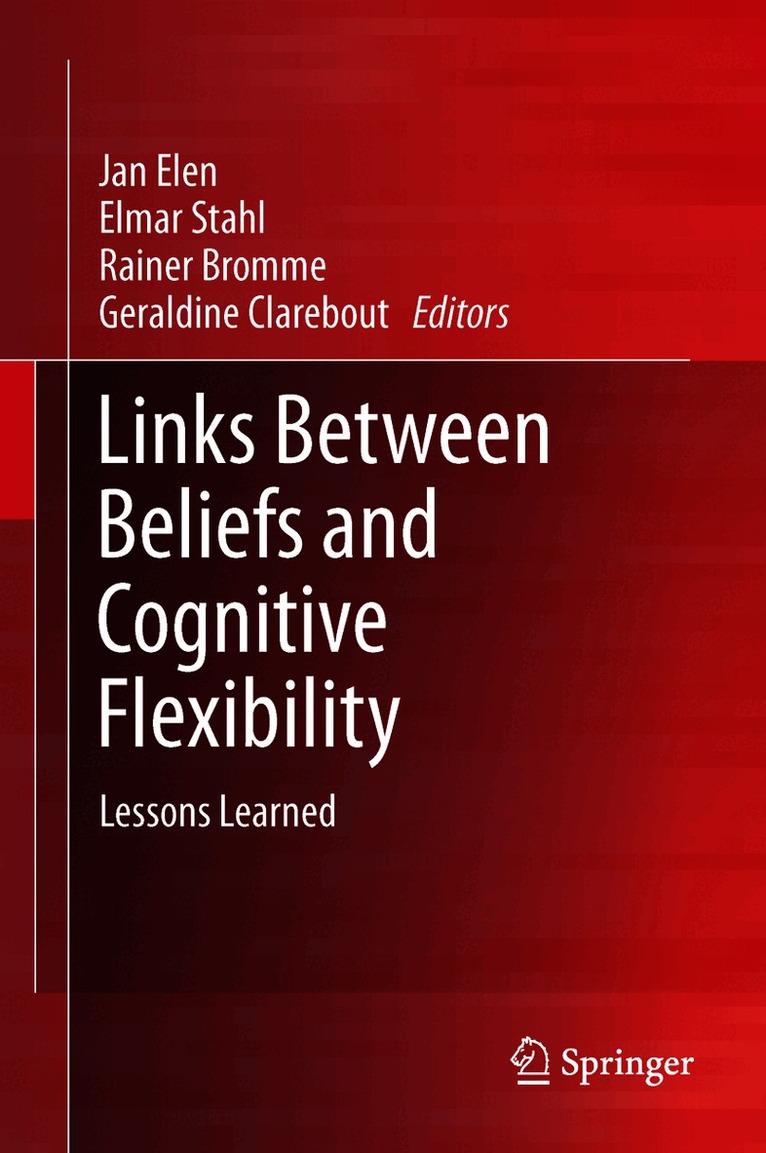
    Links Between Beliefs and Cognitive Flexibility

    Lessons Learned

    AvJan Elen,Elmar Stahl

    Inbunden, Engelska, 2011

    1 086 kr

    Beställningsvara. Skickas inom 10-15 vardagar. Fri frakt över 249 kr.

    Beskrivning

    With the world and its structures becoming ever more complex, and the nature of future employment becoming ever more unpredictable, the notion of ‘cognitive flexibility’ has a high profile in educational and psychological debate. The contributions in this volume analyze the nature of cognitive flexibility, as well as the impact of different types of beliefs on cognitive flexibility. Making adequate decisions requires considering input from a variety of continuously evolving sources rather than adhering to predetermined procedures. Adopting a position in a debate necessitates the critical evaluation of different alternatives, while solving a problem entails selecting appropriate problem-solving strategies. Meanwhile, studying requires students to integrate a range of interventions, and treating a patient involves making a differential diagnosis. The common factor, cognitive flexibility, lies at the core of effective functioning in complex, domain-specific environments. Cognitive flexibility can be described as the disposition to consider diverse information elements while deciding on how to solve a problem or to execute a learning-related task in a variety of domains. The concept of ‘disposition’ implies that individuals will not always demonstrate cognitive flexibility even if they are in principle able to act in a cognitively flexible way. The notion does not require that alternatives are always deliberately considered, which is why this volume’s tandem discussion of beliefs is key element of the discussion. Beliefs play a central role in cognitive flexibility and relate to what individuals consider to be important, valid and/or true. Of specific interest is the relationship between epistemological beliefs and cognitive flexibility, especially as a particular subset of epistemological beliefs seems to be a prerequisite to a cognitively flexible disposition.

    Produktinformation

    • Utgivningsdatum:2011-08-20
    • Mått:155 x 235 x 17 mm
    • Vikt:506 g
    • Format:Inbunden
    • Språk:Engelska
    • Antal sidor:213
    • Upplaga:2011
    • Förlag:Springer
    • ISBN:9789400717923

    Utforska kategorier

    • Pedagogisk psykologi inom Psykologi och pedagogik
    • Filosofiska discipliner inom Filosofi och religion

    Innehållsförteckning

    • Chapter 1   Personal Epistemology: Nomenclature, Conceptualizations, and Measurement, Jeremy Briell, Jan Elen, Lieven Verschaffel, Geraldine Clarebout.- Chapter 2   The Generative Nature of Epistemological Judgments: Focusing on Interactions Instead of Elements to Understand the Relationship between Epistemological Beliefs and Cognitive Flexibility, Elmar Stahl.- Chapter 3     Spontaneous Cognitive Flexibility and an Encompassing System of Epistemological Beliefs, Marlene Schommer-Aikins.- Chapter 4   Personal Epistemology and Philosophical Epistemology The View of a Philosopher, Richard F. Kitchener.- Chapter 5: Beliefs about Abilities and Epistemic Beliefs Aspects of Cognitive Flexibility in Information-Rich Environments, Dorothe Kienhues, Rainer Bromme.- Chapter 6 Cognitive Flexibility and Epistemic Validation in Learning from Multiple Texts, Tobias Richter.- Chapter 7 Development of Cognitive Flexibility and Epistemological Understanding in Argumentation, Beate Sodian, Petra Barchfeld.- Chapter 8 Medical Trainees’ Epistemological Beliefs and Their Cognitive Flexibility, Ann Roex, Jan Degryse, Geraldine Clarebout.- Chapter 9 Analysing and Developing Strategy Flexibility in Mathematics Education, Lieven Verschaffel, Koen Luwel, Joke Torbeyns, Wim Van Dooren.- Chapter 10 Conclusion, Geraldine Clarebout, Rainer Bromme, Elmar Stahl, Jan Elen.