Richard Quinney - Böcker
Visar alla böcker från författaren Richard Quinney. Handla med fri frakt och snabb leverans.
8 produkter
8 produkter
314 kr
Skickas inom 10-15 vardagar
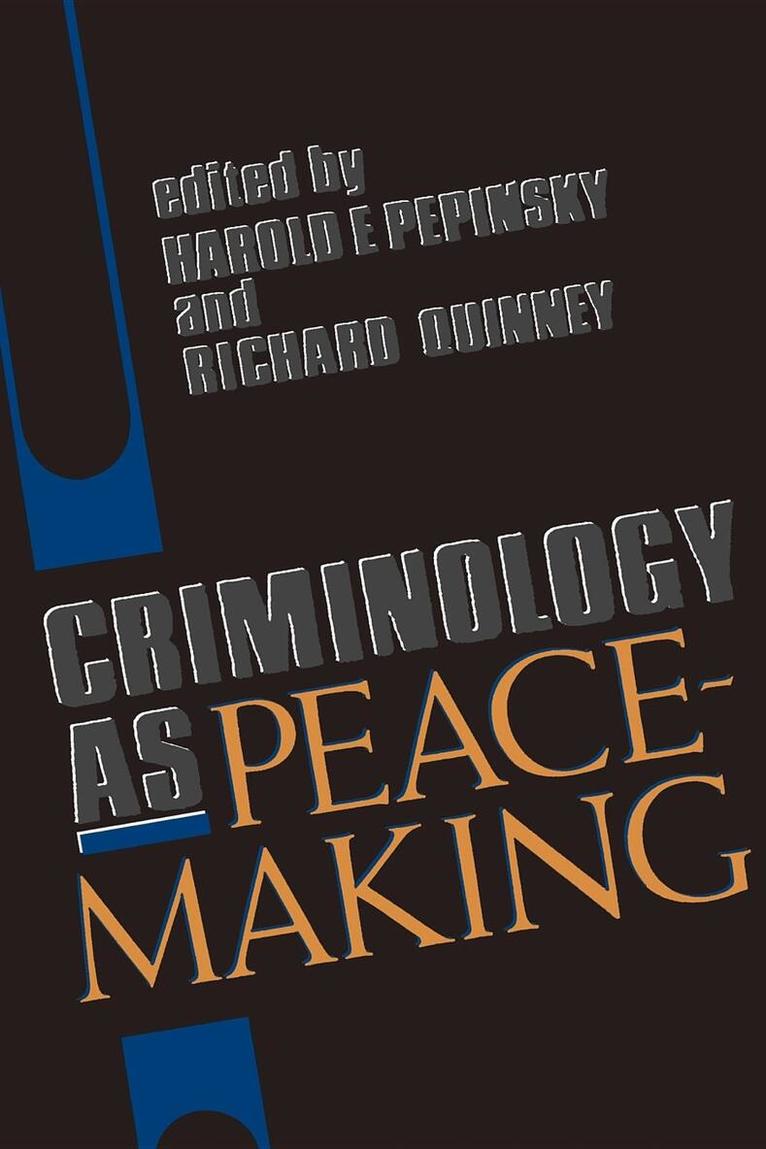
Criminology has traditionally been a military science, a science of war. "The criminal element" is the enemy. Repression and restraint are the primary tools of criminal justice, and criminologists study how to make those tools effective in the "war on crime." We are beginning to realize that this is a war against ourselves and one that we are losing. Our inability to make peace with crime and criminals is reflected in the paucity of our daily personal relations, where we live by domination and discipline, where forgiveness and mercy are seen as naive surrender to victimization. The essays in this volume propose peacemaking as an effective alternative to the "war" on crime. They range from studies of the intellectual roots of the peacemaking tradition to concrete examples of peacemaking in the community, with special attention to feminist peacemmaking traditions and women's experience.
698 kr
Skickas inom 10-15 vardagar
Richard Quinney's The Social Reality of Crime remains an eloquent and important statement on crime, law, and justice. At the time of its appearance in 1970, Quinney's theory not only liberated the field from a recitation of the practices of the police, courts, and corrections, it also represented a marked departure from traditional analysis which viewed criminal behavior as pathological. Quinney not only advanced criminological thought, he inspired scores of students of crime and criminal justice to reorient their perceptions of the justice system.The Social Reality of Crime swept the criminological community and motivated an entire generation of researchers to question definitions of crime and labels of criminality. The book's popularity quickly turned Quinney into a criminologist with an international reputation. Excerpts from the book's first chapter, which is devoted to the theory of the social reality of crime, are now routinely reprinted in anthologies on criminology and deviant behavior. The theory itself is discussed in most criminology textbooks.This new edition of The Social Reality of Crime will renew inspiration for Quinney's unique critical-social constructionist perspective that has been so significant to the development of theoretical work in the fields of criminology, social problems, and the sociology of law.
617 kr
Skickas inom 10-15 vardagar
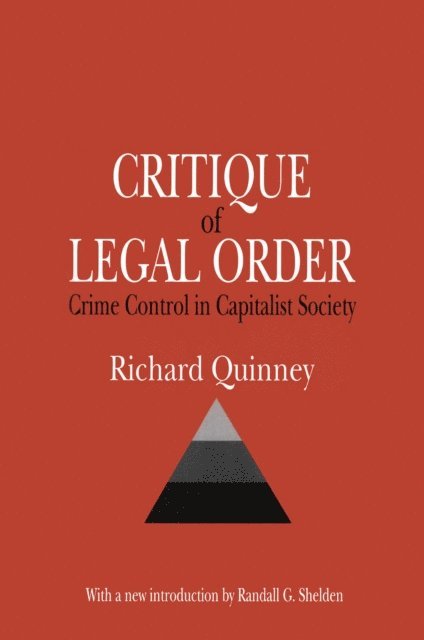
Originally published thirty years ago, Critique of the Legal Order remains highly relevant for the twenty-first century. Here Richard Quinney provides a critical look at the legal order in capitalist society. Using a traditional Marxist perspective, he argues that the legal order is not intended to reduce crime and suffering, but to maintain class differences and a social order that mainly benefits the ruling class. Quinney challenges modern criminologists to examine their own positions. As "ancillary agents of power," criminologists provide information that governing elites use to manipulate and control those who threaten the system. Quinney's original and thorough analysis of "crime control bureaucracies" and the class basis of such bureaucracies anticipates subsequent research and theorizing about the "crime control industry," a system that aims at social control of marginalized populations, rather than elimination of the social conditions that give rise to crime. He forcefully argues that technology applied to a "war against crime," together with academic scholarship, is used to help maintain social order to benefit a ruling class. Quinney also suggests alternatives. Anticipating the work of Noam Chomsky, he suggests we must first overcome a powerful media that provides a "general framework" that serves as the "boundary of expression." Chomsky calls this the manufacture of consent by providing necessary illusions. Quinney calls for a critical philosophy that enables us to transcend the current order and seek an egalitarian socialist order based upon true democratic principles. This core study for criminologists should interest those with a critical perspective on contemporary society.
376 kr
Tillfälligt slut
Through the sharing of one man's life and photographs, this ethnography of human existence covers religion, philosophy, literature, the environment, visual arts, music, drama, literary criticism, sociology, and the psychology of self.This book from start to finish is a study in the passing of time. And it is the passing of the writer in the course of time. We who remain as readers-you and I-imagine another time and another place. We then move on to what is to come next.An artifact of a lived experience, this is a document of a life lived in the course of a decade. The writing-the process of writing-was part of the living. In some cases, the writing was the living, and made the living possible.Throughout the book are lines from W. H. Auden's oratorio poem titled "For the Time Being." As a mantra that runs through the book: The time being is all the time we have. It is the most trying time of all. We seek daily to redeem it from insignificance. Thus the attention given to this everyday life.There is little concern here for the boundaries of disciplines. An ethnography of human existence, an existence itself beyond boundaries, necessarily covers the territory of religion, philosophy, literature, the environment, visual arts, music, drama, literary criticism, sociology, and the psychology of the self. In other words, disciplinary boundaries are broken and transcended. Just as in real life, just as in autobiographical ethnography.Quinney ends this journey with a requiem, a requiem for the living and the dead. The hope is that one has lived a good life. In some ways the requiem is a reprise of what has gone before. It is a mediation of this life, a reflection and a source for the life that remains. Even as we live this moment, a requiem is playing in the background. A music that assures us that we live, and a music that makes us grateful for this life. This everyday wondrous life. For the time being is everything.
1 057 kr
Tillfälligt slut
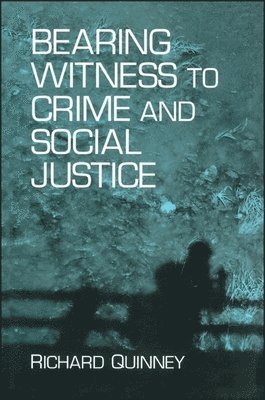
Eminent criminologist Richard Quinney offers his 40-year journey bearing witness to crime and social justice in writings both scholarly and autobiographical.Featuring both scholarly and autobiographical writings, Bearing Witness to Crime and Social Justice follows Richard Quinney's development as a criminologist. Quinney's criminology is a critical criminology which he describes as a journey of witnessing to crime and social justice. Quinney's travels from the 1960s through the 1990s show a progression of ways of thinking and acting: from the social constructionist perspective to phenomenology, from phenomenology to Marxist and critical philosophy, from Marxist and critical philosophy to liberation theology, from liberation theology to Buddhism and existentialism. Along this journey, Quinney adopts a more ethnographic and personal mode of thinking and being. Each new stage of development incorporates what has preceded it; each change has been motivated by the need to understand crime and social justice in another or more complex way, in a way excluded from a former understanding. Each stage has also incorporated changes that were taking place in Quinney's personal life. Ultimately, there is no separation between life and theory, between witnessing and writing.
402 kr
Tillfälligt slut
Eminent criminologist Richard Quinney offers his 40-year journey bearing witness to crime and social justice in writings both scholarly and autobiographical.Featuring both scholarly and autobiographical writings, Bearing Witness to Crime and Social Justice follows Richard Quinney's development as a criminologist. Quinney's criminology is a critical criminology which he describes as a journey of witnessing to crime and social justice. Quinney's travels from the 1960s through the 1990s show a progression of ways of thinking and acting: from the social constructionist perspective to phenomenology, from phenomenology to Marxist and critical philosophy, from Marxist and critical philosophy to liberation theology, from liberation theology to Buddhism and existentialism. Along this journey, Quinney adopts a more ethnographic and personal mode of thinking and being. Each new stage of development incorporates what has preceded it; each change has been motivated by the need to understand crime and social justice in another or more complex way, in a way excluded from a former understanding. Each stage has also incorporated changes that were taking place in Quinney's personal life. Ultimately, there is no separation between life and theory, between witnessing and writing.
1 921 kr
Skickas inom 10-15 vardagar
Originally published thirty years ago, Critique of the Legal Order remains highly relevant for the twenty-first century. Here Richard Quinney provides a critical look at the legal order in capitalist society. Using a traditional Marxist perspective, he argues that the legal order is not intended to reduce crime and suffering, but to maintain class differences and a social order that mainly benefits the ruling class. Quinney challenges modern criminologists to examine their own positions. As "ancillary agents of power," criminologists provide information that governing elites use to manipulate and control those who threaten the system. Quinney's original and thorough analysis of "crime control bureaucracies" and the class basis of such bureaucracies anticipates subsequent research and theorizing about the "crime control industry," a system that aims at social control of marginalized populations, rather than elimination of the social conditions that give rise to crime. He forcefully argues that technology applied to a "war against crime," together with academic scholarship, is used to help maintain social order to benefit a ruling class. Quinney also suggests alternatives. Anticipating the work of Noam Chomsky, he suggests we must first overcome a powerful media that provides a "general framework" that serves as the "boundary of expression." Chomsky calls this the manufacture of consent by providing necessary illusions. Quinney calls for a critical philosophy that enables us to transcend the current order and seek an egalitarian socialist order based upon true democratic principles. This core study for criminologists should interest those with a critical perspective on contemporary society.
2 289 kr
Skickas inom 10-15 vardagar
Richard Quinney's The Social Reality of Crime remains an eloquent and important statement on crime, law, and justice. At the time of its appearance in 1970, Quinney's theory not only liberated the field from a recitation of the practices of the police, courts, and corrections, it also represented a marked departure from traditional analysis which viewed criminal behavior as pathological. Quinney not only advanced criminological thought, he inspired scores of students of crime and criminal justice to reorient their perceptions of the justice system.The Social Reality of Crime swept the criminological community and motivated an entire generation of researchers to question definitions of crime and labels of criminality. The book's popularity quickly turned Quinney into a criminologist with an international reputation. Excerpts from the book's first chapter, which is devoted to the theory of the social reality of crime, are now routinely reprinted in anthologies on criminology and deviant behavior. The theory itself is discussed in most criminology textbooks.This new edition of The Social Reality of Crime will renew inspiration for Quinney's unique critical-social constructionist perspective that has been so significant to the development of theoretical work in the fields of criminology, social problems, and the sociology of law.