Richard W. Yerkes – författare
Visar alla böcker från författaren Richard W. Yerkes. Handla med fri frakt och snabb leverans.
3 produkter
3 produkter
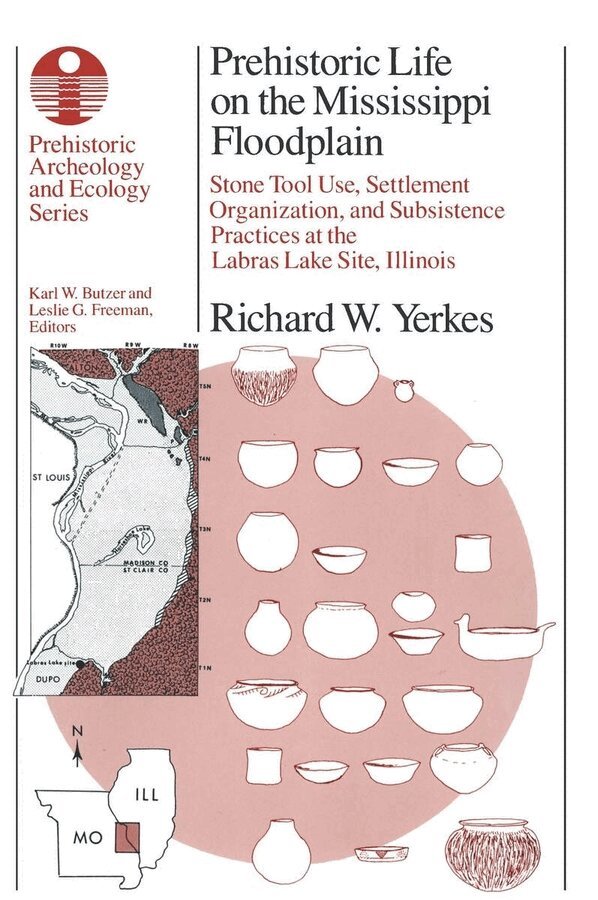
Prehistoric Life on the Mississippi Floodplain
Stone Tool Use, Settlement Organization, and Subsistence Practices at the Labras Lake Site, Illinois
Häftad, Engelska, 1986
333 kr
Skickas inom 7-10 vardagar
At the confluence of the Illinois, the Missouri, and the Mississippi Rivers lies the "American Bottom," a broad floodplain that prehistoric peoples inhabited for millennia. Precisely how did they live? What were their ties to the natural world around them? In this study, based upon some six years of intensive archeological and geological research at Labras Lake in St. Clair County, Illinois, Richard W. Yerkes interprets a wealth of important new data in a stimulating and original fashion. With a fine-tuned control of the data, Yerkes challenges prevailing theories based on simple classifications of stone tools according to shape or on simple models of diffuse and focal economies. He views environment as a dynamic factor in economic and cultural life, rather than as merely a backdrop to it. Using incident light microscopy, he examines wear patterns on stone tools to determine what activities were performed during each period the site was inhabited—the Late Archaic, the Late Woodland, and the Mississippian. As he documents environmental change at Labras Lake, he analyzes plant and animal remains in context to explore diet and seasonal patterns of subsistence and settlement. The result is a more accurate and detailed picture than ever before what prehistoric life on the Mississippi floodplain was like. Yerkes shows how to assess the duration and size of occupations and how to determine where and when true permanent settlements arose. What others call "sedentary encampments" he reveals as sequences of small residental occupations for a narrow range of activities during shorter, seasonal periods. His contribution to the study of the development of sedentism is potentially far-reaching and will interest many North American anthropologists and archeologists.
1 371 kr
Skickas inom 5-8 vardagar
Written in Stone: The Multiple Dimensions of Lithic Analysis demonstrates the vitality of contemporary lithics analysis by examining material from a variety of geographical locations. This edited collection is primarily concerned with the link between craft production and social complexity, the nature of trade, and the delineation of settlement patterns and manipulation of landscape. While deconstructing the present to reconstruct the past, each chapter incorporates a technological dimension shaped by the type of analysis utilized. Methods include microwear analysis, which adds significant understanding of stone tool function, to the identification of obsidian sources, which illustrates the potential of lithic provenance studies for reconstructing trade. This book verifies and expands on the notion that lithics play an integral role in our understanding of past societies at all levels of complexity, from Paleolithic hunter-gatherers to archaic states.
Del 46 - Monumenta Archaeologica
Bikeri
Two Early Copper-Age Villages on the Great Hungarian Plain
Inbunden, Engelska, 2022
1 674 kr
Skickas inom 5-8 vardagar
This edited book describes the multi-disciplinary research conducted by the Körös Regional Archaeological Project in southeastern Hungary from 2000-2007. Centred around two Early Copper Age Tiszapolgár culture villages in the Körös Region of the Great Hungarian Plain, Vészto-Bikeri and Körösladány-Bikeri, the research incorporated excavation, surface collection, geophysical survey and soil chemistry to investigate settlement layout and organization. The transition from the Neolithic period to the Copper Age in the northern Balkans and the Carpathian Basin was marked by significant changes in material culture, settlement layout and organization, and mortuary practices that indicate fundamental social transformations in the middle of the fifth millennium BC. Prior research into the Late Neolithic of the region focused almost exclusively on fortified 'tell' settlements. The Early Copper Age, by contrast, was known primarily from cemeteries such as the type site of Tiszapolgár-Basatanya. The Project’s results yielded the first extensive, systematically collected datasets from Early Copper Age settlements on the Great Hungarian Plain. The two adjacent villages at Bikeri, located only 70 m apart, were similar in size, and both were protected with fortifications. Relative and absolute dates demonstrate that they were occupied sequentially during the Early Copper Age, from ca. 4600-4200 cal B.C. The excavated assemblages from the sites are strikingly similar, suggesting that both were occupied by the same community. This process of settlement relocation after only a few generations breaks from the longer-lasting settlement pattern that are typical of the Late Neolithic.