Roger Tourangeau - Böcker
Visar alla böcker från författaren Roger Tourangeau. Handla med fri frakt och snabb leverans.
9 produkter
9 produkter
1 512 kr
Skickas inom 7-10 vardagar
The development and widespread use of Web surveys have resulted in an outpouring of research on their design. In this volume, Tourangeau, Conrad, and Couper provide a comprehensive summary and synthesis of the literature on this increasingly popular method of data collection. The book includes new integration of the authors' work with other important research on Web surveys, including a meta-analysis of studies that compare reports on sensitive topics in Web surveys with reports collected in other modes of data collection. Adopting the total survey error framework, the book examines sampling and coverage issues, nonresponse, measurement, and the issues involved in combining modes. In addition, the conclusion provides a model for understanding the errors in estimates that combine data collected in more than one mode. Web surveys have several important characteristics that affect their ability to collect accurate survey data. Discussing these in detail, the authors address basic design decisions from input widgets to background colors. They additionally focus on the visual character of Web surveys, on their ability to automatically interact with respondents, and on the Web as a method of self-administration. The Science of Web Surveys is relevant for those with the practical goal of improving their own surveys and those with an interest in understanding an increasingly important method of data collection.
495 kr
Tillfälligt slut
For many household surveys in the United States, responses rates have been steadily declining for at least the past two decades. A similar decline in survey response can be observed in all wealthy countries. Efforts to raise response rates have used such strategies as monetary incentives or repeated attempts to contact sample members and obtain completed interviews, but these strategies increase the costs of surveys. This review addresses the core issues regarding survey nonresponse. It considers why response rates are declining and what that means for the accuracy of survey results. These trends are of particular concern for the social science community, which is heavily invested in obtaining information from household surveys. The evidence to date makes it apparent that current trends in nonresponse, if not arrested, threaten to undermine the potential of household surveys to elicit information that assists in understanding social and economic issues. The trends also threaten to weaken the validity of inferences drawn from estimates based on those surveys.High nonresponse rates create the potential or risk for bias in estimates and affect survey design, data collection, estimation, and analysis. The survey community is painfully aware of these trends and has responded aggressively to these threats. The interview modes employed by surveys in the public and private sectors have proliferated as new technologies and methods have emerged and matured. To the traditional trio of mail, telephone, and face-to-face surveys have been added interactive voice response (IVR), audio computer-assisted self-interviewing (ACASI), web surveys, and a number of hybrid methods. Similarly, a growing research agenda has emerged in the past decade or so focused on seeking solutions to various aspects of the problem of survey nonresponse; the potential solutions that have been considered range from better training and deployment of interviewers to more use of incentives, better use of the information collected in the data collection, and increased use of auxiliary information from other sources in survey design and data collection.Nonresponse in Social Science Surveys: A Research Agenda also documents the increased use of information collected in the survey process in nonresponse adjustment.
970 kr
Skickas inom 7-10 vardagar
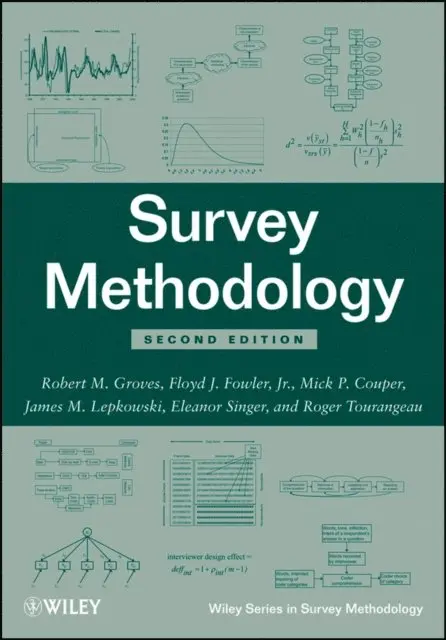
Praise for the First Edition: "The book makes a valuable contribution by synthesizing current research and identifying areas for future investigation for each aspect of the survey process."—Journal of the American Statistical Association"Overall, the high quality of the text material is matched by the quality of writing . . ."—Public Opinion Quarterly". . . it should find an audience everywhere surveys are being conducted."—TechnometricsThis new edition of Survey Methodology continues to provide a state-of-the-science presentation of essential survey methodology topics and techniques. The volume's six world-renowned authors have updated this Second Edition to present newly emerging approaches to survey research and provide more comprehensive coverage of the major considerations in designing and conducting a sample survey.Key topics in survey methodology are clearly explained in the book's chapters, with coverage including sampling frame evaluation, sample design, development of questionnaires, evaluation of questions, alternative modes of data collection, interviewing, nonresponse, post-collection processing of survey data, and practices for maintaining scientific integrity. Acknowledging the growing advances in research and technology, the Second Edition features: Updated explanations of sampling frame issues for mobile telephone and web surveysNew scientific insight on the relationship between nonresponse rates and nonresponse errors Restructured discussion of ethical issues in survey research, emphasizing the growing research results on privacy, informed consent, and confidentiality issues The latest research findings on effective questionnaire development techniques The addition of 50% more exercises at the end of each chapter, illustrating basic principles of survey design An expanded FAQ chapter that addresses the concerns that accompany newly established methods Providing valuable and informative perspectives on the most modern methods in the field, Survey Methodology, Second Edition is an ideal book for survey research courses at the upper-undergraduate and graduate levels. It is also an indispensable reference for practicing survey methodologists and any professional who employs survey research methods.
2 010 kr
Skickas inom 7-10 vardagar
Survey methods research--an interdisciplinary approach. Introducing the theory and tools of cognitive aspects of survey methodology (CASM)--a movement that has greatly contributed to the evolving field of survey methods research--this collection of monographs explores advances in the use of cognitive psychology and other sciences to improve the quality of data collected in surveys. In 22 articles commissioned specifically for this volume, leading survey researchers, social scientists, and statisticians from around the globe evaluate the advantages of interdisciplinary survey techniques, focusing on the many contributions of the CASM movement and drawing on such disciplines as statistics, cognitive psychology, sociology, behavioral sciences, anthropology, linguistics, and computer sciences. The authors explain basic concepts and methodologies and demonstrate the application of cognitive theory to all phases of survey research, including data processing, analysis, presentation, and administration. They provide a critical review of the history and findings of CASM-oriented research and describe useful cognitive models used in survey testing and design. Also, the authors discuss the expanding role of computer technologies and statistical advances in the interdisciplinary aspects of survey methods and draw a roadmap for interdisciplinary survey research into the twenty-first century. Clearly written and supplemented with extensive references and more than 80 figures and charts, Cognition and Survey Research is an indispensable guide for statisticians and professionals who would like to be at the cutting edge of interdisciplinary survey methods research involving the social, cognitive, computer, or statistical sciences.
731 kr
Skickas inom 7-10 vardagar
This valuable book examines the complex psychological processes involved in answering different types of survey questions. Drawing on both classic and modern research from cognitive psychology, social psychology, and survey methodology, the authors examine how survey responses are formulated and they demonstrate how seemingly unimportant features of the survey can affect the answers obtained. The book provides a comprehensive review of the sources of response errors in surveys, and it offers a coherent theory of the relation between the underlying views of the public and the results of public opinion polls. Topics include the comprehension of survey questions, the recall of relevant facts and beliefs, estimation and inferential processes people use to answer survey questions, the sources of the apparent instability of public opinion, the difficulties in getting responses into the required format, and the distortions introduced into surveys by deliberate misreporting.
1 440 kr
Skickas inom 7-10 vardagar
Surveys are used extensively in psychology, sociology and business, as well as many other areas, but they are becoming increasingly difficult to conduct. Some segments of the population are hard to sample, some are hard to find, others are hard to persuade to participate in surveys, and still others are hard to interview. This book offers the first systematic look at the populations and settings that make surveys hard to conduct and at the methods researchers use to meet these challenges. It covers a wide range of populations (immigrants, persons with intellectual difficulties, and political extremists) and settings (war zones, homeless shelters) that offer special problems or present unusual challenges for surveys. The team of international contributors also addresses sampling strategies including methods such as respondent-driven sampling and examines data collection strategies including advertising and other methods for engaging otherwise difficult populations.
667 kr
Skickas inom 7-10 vardagar
Surveys are used extensively in psychology, sociology and business, as well as many other areas, but they are becoming increasingly difficult to conduct. Some segments of the population are hard to sample, some are hard to find, others are hard to persuade to participate in surveys, and still others are hard to interview. This book offers the first systematic look at the populations and settings that make surveys hard to conduct and at the methods researchers use to meet these challenges. It covers a wide range of populations (immigrants, persons with intellectual difficulties, and political extremists) and settings (war zones, homeless shelters) that offer special problems or present unusual challenges for surveys. The team of international contributors also addresses sampling strategies including methods such as respondent-driven sampling and examines data collection strategies including advertising and other methods for engaging otherwise difficult populations.
Del 645 - The ANNALS of the American Academy of Political and Social Science Series
The Nonresponse Challenge to Surveys and Statistics
Häftad, Engelska, 2012
1 265 kr
Skickas inom 3-6 vardagar
Surveys are the principal source of data not only for social science, but for consumer research, political polling, and federal statistics. In response to social and technological trends, rates of survey nonresponse have risen markedly in recent years, prompting observers to worry about the continued validity of surveys as a tool for data gathering. Newspaper stories, magazine articles, radio programs, television broadcasts, and Internet blogs are filled with data derived from surveys of one sort or another. Reputable media outlets generally indicate whether a survey is representative, but much of the data routinely bandied about in the media and on the Internet are not based on representative samples and are of dubious use in making accurate statements about the populations they purport to represent. Surveys are social interactions, and like all interactions between people, they are embedded within social structures and guided by shared cultural understandings. This issue of The ANNALS examines the difficulties with finding willing respondents to these surveys and how the changing structure of society, whether it be the changing family structure, mass immigration, rising inequality, or the rise of technology, has presented new issues to conducting surveys. This volume will be of interest to faculty and students who specialize in sociological movements as well as economic and immigration movements and its effect on surveying.
Del 645 - The ANNALS of the American Academy of Political and Social Science Series
The Nonresponse Challenge to Surveys and Statistics
Inbunden, Engelska, 2012
2 304 kr
Skickas inom 3-6 vardagar
Surveys are the principal source of data not only for social science, but for consumer research, political polling, and federal statistics. In response to social and technological trends, rates of survey nonresponse have risen markedly in recent years, prompting observers to worry about the continued validity of surveys as a tool for data gathering. Newspaper stories, magazine articles, radio programs, television broadcasts, and Internet blogs are filled with data derived from surveys of one sort or another. Reputable media outlets generally indicate whether a survey is representative, but much of the data routinely bandied about in the media and on the Internet are not based on representative samples and are of dubious use in making accurate statements about the populations they purport to represent. Surveys are social interactions, and like all interactions between people, they are embedded within social structures and guided by shared cultural understandings. This issue of The ANNALS examines the difficulties with finding willing respondents to these surveys and how the changing structure of society, whether it be the changing family structure, mass immigration, rising inequality, or the rise of technology, has presented new issues to conducting surveys. This volume will be of interest to faculty and students who specialize in sociological movements as well as economic and immigration movements and its effect on surveying.